

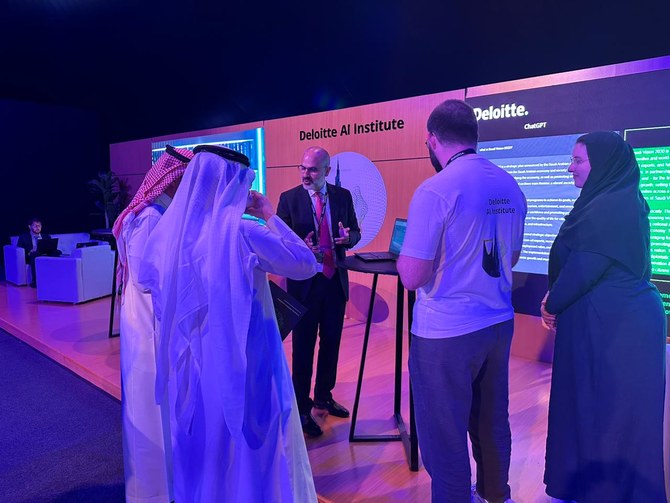

DUBAI: Professional services organization Deloitte launched the Deloitte Middle East AI Institute during the Experience Analytics event held on May 18 at The Arena in Riyadh.
Launched in June 2020, the institute focuses on artificial intelligence research and applied innovation across industries. It currently has operations in the US, UK, Australia, Canada, Germany, and China, with the latest being in Saudi Arabia.
The first-of-its-kind institute in the region was “introduced with the purpose of advancing the agenda of AI for Deloitte internally, as well as for our clients and our communities,” said Yousef Barkawie, AI and data leader, Deloitte Middle East.

Yousef Barkawie, AI and data leader,
Deloitte Middle East
The institute aims to be a “think tank” and a “fountainhead of innovation and advancement of AI” in ways that can “benefit our clients and our societies,” Barkawie told Arab News.
AI is growing exponentially across the world, but its growth in the Middle East region is particularly noteworthy. Earlier this year, Saudi Arabia ranked second globally for societal awareness of AI, according to the 2023 AI Index Report by Stanford University.
The Kingdom has launched several initiatives, including the establishment of the Saudi Arabian Data and Artificial Intelligence Authority and the National Data Management Office (NDMO), to accelerate the implementation of AI in the Kingdom’s various sectors, and announced the investment of billions of dollars into AI projects.
“We decided that it is absolutely imperative for us to think about bringing that kind of talent, capability and entire mindset to our Middle East clients and bring the Deloitte AI Institute right here to our region,” said Barkawie.
“Just like anything, the topic of AI can be highly localized,” he added, explaining that every country has its own unique set of challenges and objectives, which could benefit from the use of AI.
Language, for instance, can be a challenge in the region, as most advancements in AI models have been in English or Latin languages, and the “Arabic language is not getting as much attention as it should on a global scale,” Barkawie said.
Deloitte’s AI and data team is made up of talent with over 15 nationalities, he said, which “brings in a lot of diversity, and localized experience and knowledge.” This diversity is extremely important, he added, because even though Arabic is one language, it has several dialects.
There are also other societal and cultural considerations as well as market maturity because the adoption of AI is dependent on the maturity of industries such as technology, cloud and data practices, said Barkawie.
The NDMO, for example, has a program for all regulated entities in the Kingdom, which is designed to elevate the quality of data through various means such as better governance and policies around privacy and protection of data, he explained.
“Those programs are extremely important but that tells you something: If we have to establish a program to put those controls in place, it means that the quality of data may not be at the desired level,” he said.
The existence of these programs is “excellent news,” but it also means the region is not “entirely there yet,” Barkawie added.
There is much eagerness to adopt AI at scale — both in government and private sector entities in the region — but “we’re not at scale yet compared to other more mature regions where they’ve gone through that cycle of exploration and experimentation with AI,” he said.
Drawing a timeline on the adoption of AI in the region would be difficult, Barkawie said, as some sectors like banking and digital media will grow faster, while other more traditional sectors would take longer.
One report put the Middle East region about four and a half years behind the US and China in AI adoption. However, Barkawie thinks the gap will be closed much faster.
“Don’t underestimate our willingness and eagerness to make a change in the Middle East. We, as a region, are quite adaptable and we pick up very quickly,” he said.
“The conversations I’m having with my clients are strong indications that we are not that far behind, and operationalizing AI is much closer.”
Deloitte’s AI Institute in Riyadh is already working with a number of clients including NEOM and the Ministry of Finance. Although based in Riyadh, it serves as a “connected hub” for the Middle East, said Barkawie, with plans underway to open a second branch in the UAE.
No conversation about AI is complete without discussing its potential dangers — particularly its threat to humans.
Deloitte’s response to this threat is the slogan — one it coined and trademarked — “The Age of With,” which means, Barkawie explained, that “we are more powerful and effective when we combine humans with machines.”
He added: “We are quite serious about our thought leadership in this space that machines are not here to replace humans, but to augment human abilities.”
Having said that, the way humans work will change. For example, Deloitte has developed a generative AI model, which it presented at the Experience Analytics event, that can develop a targeted and coherent presentation complete with text and images within two days.
“So, I worry about my job as a consultant,” Barkawie joked.
On a more serious note, he added, there is no denying that many industries and jobs will be affected.
Earlier this year, ChatGPT passed law exams in four courses at the University of Minnesota and another exam at the University of Pennsylvania’s Wharton School of Business, according to professors at the schools.
Although it did not score very highly, the chatbot did pass the exams, which indicates that “information and knowledge retention is going to change,” said Barkawie.
This, in turn, means that humans are no longer needed to memorize things, but instead understand them better, he added.
“We’re not going to be at risk of losing jobs every day. It’s more about learning newer ways, and the onus is on us, as humans, to focus on value-adding services and capabilities rather than the mundane,” said Barkawie.
Still, some jobs are designed to be mundane and those are perhaps the jobs that will see the biggest learning curve, he added.
“This is where the rescaling and upskilling of resources needs to happen in order to continuously improve and get the most value out of these technologies.”
Generative AI might be able to write this article in a much shorter time, for example, but it will not replace the work that went into it, because ultimately, said Barkawie, “the ability to innovate is not going to come from AI, it will come from humans.”


