

With new trends, inflation, popular money garland businesses barely make cents in southern Pakistan

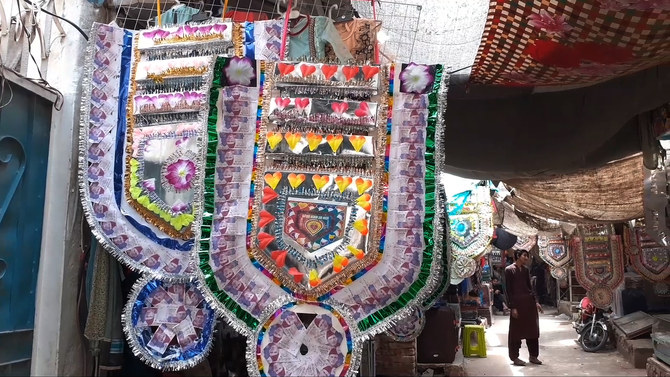
In this photo taken on June 20, 2023, money garlands are seen hanging at a shop in Umerkot, southern Pakistan. (AN Photo)
Short Url
Updated 30 June 2023
Follow

With new trends, inflation, popular money garland businesses barely make cents in southern Pakistan

  • Money garlands commonly gifted on weddings, birthdays, festivals, social and religious occasions
  • Craftsmen say many people nowadays prefer fancier, cheaper flower festoons instead of note garlands 

UMERKOT: Gordhan Das carefully folded 50-rupee banknotes into different shapes and then pasted them onto a large cardboard frame at his shop in the southern Pakistani district of Umerkot.

Das, 50, is one among around 30 shop owners in Umerkot’s famed Shahi Bazar who sell garlands made of real money, commonly gifted on weddings, birthdays, political events and festivals, or offered to honor individuals or deities on social and religious occasions in a district where 50 percent of the population is Hindu.

Not too many years ago, there were over 50 such businesses in the area but today, the money garland industry has been reduced to almost half its size due to record inflation, the availability of cheaper alternatives and new trends and tastes. 

“I am 50 years old and we have been doing this for the past 30 years. This market is more than 100 years old, and this [garlands’] work has been going on for many years,” Das told Arab News at his shop, lamenting the reduction in business.
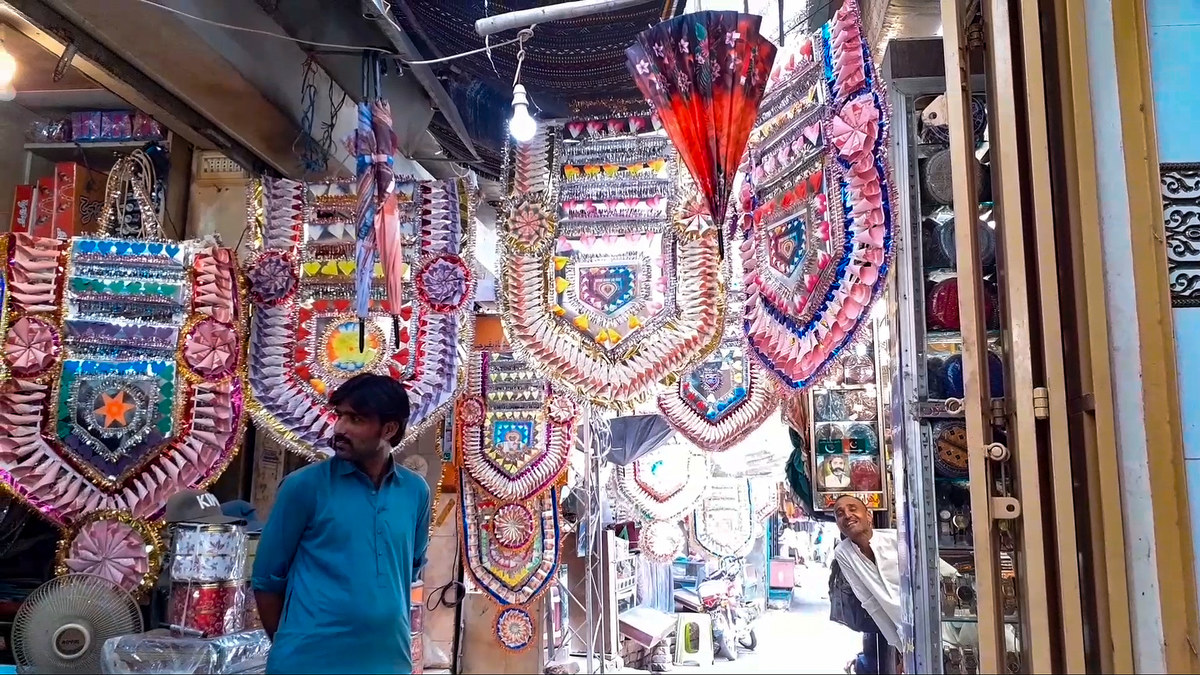


In this photo taken on June 20, 2023, a man gestures outside his money garland shop looking for customers in Umerkot, southern Pakistan. (AN Photo)

“There is inflation so people are not buying money garlands anymore.”

Das explained that a garland made of Rs20 notes could cost up to Rs3,000, while those made of Rs50 notes could go up to Rs5,000 and Rs100 notes to Rs10,000.

“The artificial and flower garlands are cheaply available, from Rs200 to Rs300,” Das said, “So, these garlands of currency notes are sold less now.”

Many brides and grooms, Das said, preferred garlands made of real or artificial flowers, he added.

“Now artificial [flower garlands] are in fashion and it is the age of Facebook, and these flower ones look good in selfies. So that’s why they are selling more,” Das said.

Sunil Kumar, 29, who has run his father’s shop at the Shahi Bazar for the last 10 years, said money garlands were “a little bit heavy and big in size” and thus not preferred by some people, especially in urban areas: 

“But villagers still use these garlands in the same way.”
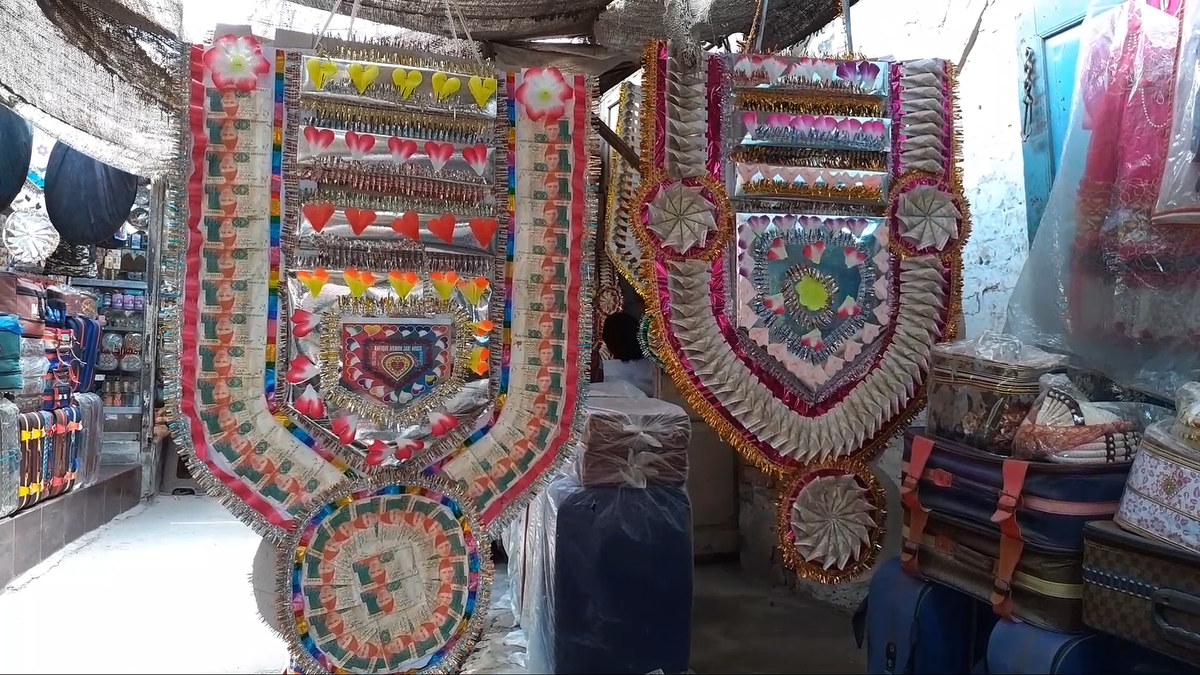


In this photo taken on June 20, 2023, money garlands are seen hanging at a shop in Umerkot, southern Pakistan. (AN Photo)

As money garland shops close down due to lack of demand and less designs are available, many repair and reuse old garlands.

Amin Soomro, 55, said he had received a garland at his son’s wedding and now wanted to get it repaired and gift it to a relative on his wedding.

“These currency note garlands are still used in far-flung areas, but in this modern era, many sensible people have moved away from this tradition, only because it costs more and there is a shortage of currency notes in the market too,” Soomro told Arab News. “The cash is not available.”

“So, right now, used garlands come back to the market and we take them back after getting them repaired … we take care of them because not everyone can afford a new garland because it keeps getting quite expensive.”


Pakistan says Iraq expressed ‘keen interest’ in JF-17 jets at air chiefs meeting

Updated 6 sec ago
Follow

Pakistan says Iraq expressed ‘keen interest’ in JF-17 jets at air chiefs meeting

  • Pakistan’s defense sector has drawn growing interest and investment since a four-day standoff with India in May last year
  • Many countries have since increased defense engagement, while multiple others have proposed learning from Pakistan’s expertise

ISLAMABAD: Pakistan’s military said on Saturday that Iraq had shown “keen interest” in its JF-17 Thunder and Super Mushshak aircraft at a meeting between chiefs of the two air forces.

Pakistan’s Air Chief Marshal Zaheer Ahmed Baber Sidhu called on Lt. Gen. Staff Pilot Mohanad Ghalib Mohammed Radi Al-Asadi, commander of the Iraqi Air Force, during his official visit to Iraq.

The Pakistani air chief was accorded a guard of honor at the Iraqi Air Force headquarters, symbolizing the strong bond of mutual respect, according to the Inter-Services Public Relations (ISPR), the Pakistani military’s media wing.

“Discussions focused on enhancing bilateral military cooperation, with emphasis on joint training, capacity-building and improving operational cooperation,” the ISPR said.

“The Iraqi Air Chief praised PAF’s professionalism and technological advancement, expressed interest in benefiting from PAF’s world-class training and expressed keen interest in JF-17 Thunder fighter jets, Super Mushshak trainer aircraft.”

Pakistan’s defense sector has drawn growing interest and investment, particularly since a four-day India-Pakistan military standoff in May last year. Islamabad claimed victory in the standoff, saying it had shot down six Indian aircraft, including French-made Rafale jets. India acknowledged losses but did not specify a number.

Many countries have since stepped up defense engagement with Pakistan, while delegations from multiple other nations have proposed learning from Pakistan Air Force’s multi-domain air warfare capabilities that successfully demonstrated how advanced Chinese military technology performs against Western hardware.

Pakistan markets the Chinese co-developed JF-17 as a lower-cost multi-role fighter and has positioned itself as a supplier able to offer aircraft, training and maintenance outside Western supply chains.

Islamabad is in the final phases of striking a $1.5-billion deal to supply weapons and jets to Sudan in a major boost for Sudan’s army that has been battling the paramilitary Rapid Support Forces, Reuters reported this week, citing a former top air force official and three sources.

The South Asian country reached a deal worth over $4 billion to sell military equipment to the Libyan National Army, Reuters report last month, citing Pakistani officials. The deal, one of Pakistan’s largest-ever weapons sales, included the sale of 16 JF-17 fighter jets and 12 Super Mushshak trainer aircraft for basic pilot training.