PARIS: France’s highest administrative jurisdiction said Thursday the country’s soccer federation is entitled to ban headscarves in matches.
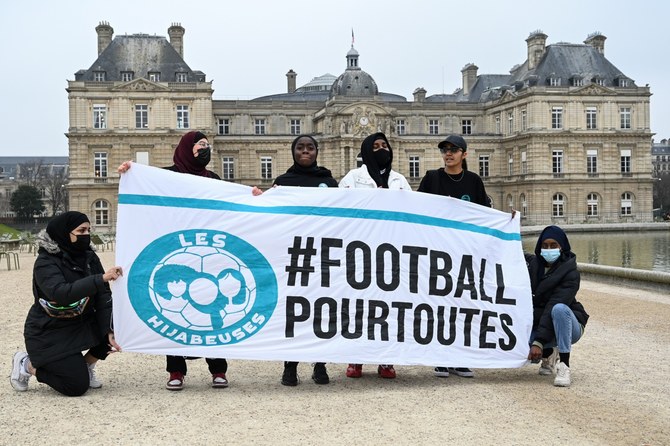
The Council of State issued its ruling after a collective of headscarf-wearing soccer players called “Les Hijabeuses” — the word hijab refers to the headscarf — campaigned against the ban and launched legal action.
The French soccer federation bans players from wearing headscarves in official matches, as well as at competitions it organizes. It’s not in line with the recommendations of soccer governing body FIFA, which authorizes players to compete at international level with headscarves.
The Council of State said sports federations “may impose on their players an obligation to wear neutral clothing during sporting competitions and events, in order to guarantee the smooth running of matches and prevent clashes or confrontation. It considers that the ban imposed by the FFF is appropriate and proportionate.”
The Council of State did not follow its public rapporteur’s recommendations, who earlier this week said Article 1 of the federation’s rules should be annulled. The article prohibits “the wearing of any sign or dress ostensibly manifesting a religious affiliation,” and applies to matches and competitions organized.
It is unclear whether the ban would be implemented for next year’s Paris Olympics.
The rapporteur had argued that religious symbols were already present in soccer, citing the example of players crossing themselves before entering the field.
French Interior Minister Gerard Darmanin told RTL radio earlier this week he was opposed to the wearing of the hijab during sports competitions.
“You don’t wear religious clothes when you play sports,” he said. “When you play soccer, you don’t need to know the religion of the person in front of you.”
Right-wing senators vainly tried last year to introduce an amendment to a law on sports that would have extended the ban on headscarves to all sports competitions, arguing that neutrality was a requirement on the field of play, and that headscarves could put at risk the safety of athletes wearing it when they practice their discipline.
The amendment was rejected in the lower house of the Parliament after a fierce debate.
Lawmakers had previously approved a bill to strengthen oversight of mosques, schools and sports clubs in a bid to safeguard France from radical Islamists and to promote respect for French values — one of President Emmanuel Macron’s landmark projects.
With France bloodied by terror attacks, few disagreed that radicalization was a danger. But critics also saw the law as a political ploy to lure the right wing to Macron’s centrist party ahead of the presidential election that Macron won.


![]()

France’s highest administrative court says the soccer federation can ban headscarves in matches
Short Url
https://arab.news/gswrm
France’s highest administrative court says the soccer federation can ban headscarves in matches
- A group of Muslim women footballers called the "Hijabeuses" launched the action against the French Football Federation (FFF)
- Rules currently ban the headscarves in competition along with "any sign or clothing clearly showing political, philosophical, religious or union affiliation".


Latest updates


© 2026 SAUDI RESEARCH & PUBLISHING COMPANY, All Rights Reserved And subject to Terms of Use Agreement.