

Iraq plants mangrove forest to fight climate disaster

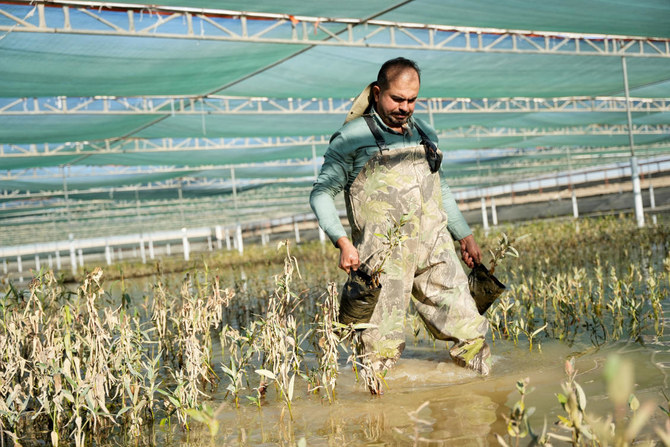
Engineer Ayman Al-Rubaie, 47, carries mangrove tree seedlings in the mangrove tree nursery project, in the branching area of the Shatt Al-Arab River in Basra. (REUTERS)
Short Url
Updated 29 June 2023
Follow

Iraq plants mangrove forest to fight climate disaster

  • Iraqi government bodies and United Nations agency aim to grow up to 4 million mangrove trees in the Khor Al-Zubair mudflats region
  • The scheme was inspired by successful projects to rehabilitate mangrove forests in nearby Kuwait and in the United Arab Emirates at the other end of the Gulf

BASRA: As Aymen Al-Rubaye plants mangrove seedlings in the sprawling tidal flats of southern Iraq, the black smoke rising over the skyline behind him shows the ecological damage that he is toiling to undo.
Rubaye, an agricultural engineer, is working for a project started by Iraqi government bodies and a United Nations agency to grow up to 4 million mangrove trees in the Khor Al-Zubair mudflats region, located near major oil fields.
Ankle-deep mud sucks at his boots as he pats down a seedling and moves on to plant another, part of what he hopes will become a mangrove forest that protects the coast, shelters vulnerable species and battles climate change.


“This plant will save us time and effort in our fight against global warming,” he said, describing the plant’s ability to capture and store carbon dioxide.
Iraq’s carbon emissions have more than doubled over the past decade, according to the World Bank, making it one of the region’s worst polluters when measured against the size of its economy.
The tidal flats south of Basra are a baking landscape of water, salt, mud and hazy sky, riven by channels that Rubaye and his team navigate by boat.
The smoke in the distance is billowing from a petrochemical plant near Zubair oil field, some 20 kilometers (13 miles) away, part of a vast energy sector that provides the bulk of Iraq’s income and is the main industry — and polluter — in the Basra area.


Southern Iraq was once known for rich marshes that were drained decades ago in an environmental catastrophe that wrecked a complex eco-system and pushed many of its inhabitants to ruin.
Planting mangroves on the tidal flats, south of where the marshes once lay, can protect coastal communities from storms and floods and create a new home for threatened species without using any of Iraq’s scarce freshwater for irrigation.
The scheme was inspired by successful projects to rehabilitate mangrove forests in nearby Kuwait and in the United Arab Emirates at the other end of the Gulf.
Mangrove plants “can resist these harsh conditions we are passing through” without needing irrigation water, Rubaye said. Mangroves thrive in the sort of hot, muddy and salty conditions that most other plants find inhospitable.
The new trees come from a nursery where 12,000 seedlings were growing, said Ahmed Albaaj of the UN’s World Food Programme, which worked on the project with Basra’s local government and university, and Iraq’s environment ministry.


High-level Turkish team to visit Damascus on Monday for talks on SDF integration

Updated 5 sec ago
Follow

High-level Turkish team to visit Damascus on Monday for talks on SDF integration

  • The visit by Turkiye’s foreign and defense ministers and its intelligence chief comes amid efforts by Syrian, Kurdish and US officials to show some progress with the deal
ANKARA: A high-level Turkish delegation will visit Damascus on Monday to discuss bilateral ties and the implementation of a deal for integrating the Kurdish-led Syrian Democratic Forces (SDF) into ​Syria’s state apparatus, a Turkish Foreign Ministry source said.
The visit by Turkiye’s foreign and defense ministers and its intelligence chief comes amid efforts by Syrian, Kurdish and US officials to show some progress with the deal. But Ankara accuses the SDF of stalling ahead of a year-end deadline.
Turkiye views the US-backed SDF, which controls swathes ‌of northeastern Syria, as ‌a terrorist organization and has ‌warned of ⁠military ​action ‌if the group does not honor the agreement.
Last week Foreign Minister Hakan Fidan said Ankara hoped to avoid resorting to military action against the SDF but that its patience was running out.
The Foreign Ministry source said Fidan, Defense Minister Yasar Guler and the head of Turkiye’s MIT intelligence agency, Ibrahim Kalin, ⁠would attend the talks in Damascus, a year after the fall of ‌former President Bashar Assad.

TURKEY SAYS ITS ‍NATIONAL SECURITY IS AT ‍STAKE
The source said the integration deal “closely concerned Turkiye’s national ‍security priorities” and the delegation would discuss its implementation. Turkiye has said integration must ensure that the SDF’s chain of command is broken.
Sources have previously told Reuters that Damascus sent a proposal to ​the SDF expressing openness to reorganizing the group’s roughly 50,000 fighters into three main divisions and smaller ⁠brigades as long as it cedes some chains of command and opens its territory to other Syrian army units.
Turkiye sees the SDF as an extension of the outlawed Kurdistan Workers Party (PKK) militant group and says it too must disarm and dissolve itself, in line with a disarmament process now underway between the Turkish state and the PKK.
Ankara has conducted cross-border military operations against the SDF in the past. It accuses the group of wanting to circumvent the integration deal ‌and says this poses a threat to both Turkiye and the unity of Syria.