

‘Godfather of AI’ urges governments to stop machine takeover of society

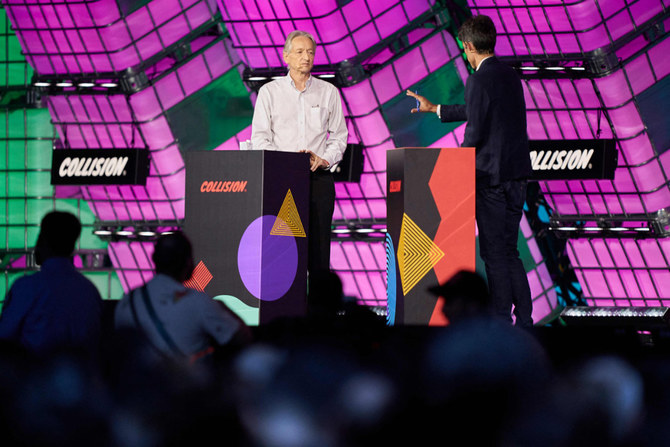
British-Canadian cognitive psychologist and computer scientist Geoffrey Hinton, known as the 'godfather of AI' speaks with technology journalist and CEO of The Atlantic Nick Thompson (R) during the Collision Tech Conference in Toronto, Canada, on June 28, 2023. (AFP)
Short Url
Updated 29 June 2023
Follow

‘Godfather of AI’ urges governments to stop machine takeover of society

TORONTO, Canada: Geoffrey Hinton, one of the so-called godfathers of artificial intelligence, urged governments on Wednesday to step in and make sure that machines do not take control of society.
Hinton made headlines in May when he announced that he quit Google after a decade of work to speak more freely on the dangers of AI, shortly after the release of ChatGPT captured the imagination of the world.
The highly respected AI scientist, who is based at the University of Toronto, was speaking to a packed audience at the Collision tech conference in the Canadian city.
The conference brought together more than 30,000 startup founders, investors and tech workers, most looking to learn how to ride the AI wave and not hear a lesson on its dangers.
“Before AI is smarter than us, I think the people developing it should be encouraged to put a lot of work into understanding how it might try and take control away,” Hinton said.
“Right now there are 99 very smart people trying to make AI better and one very smart person trying to figure out how to stop it taking over and maybe you want to be more balanced,” he said.
Hinton warned that the risks of AI should be taken seriously despite his critics who believe he is overplaying the risks.
“I think it’s important that people understand that this is not science fiction, this is not just fear mongering,” he insisted. “It is a real risk that we must think about, and we need to figure out in advance how to deal with it.”
Hinton also expressed concern that AI would deepen inequality, with the massive productivity gain from its deployment going to the benefit of the rich, and not workers.
“The wealth isn’t going to go to the people doing the work. It is going to go into making the rich richer and not the poorer and that’s very bad for society,” he added.
He also pointed to the danger of fake news created by ChatGPT-style bots and said he hoped that AI-generated content could be marked in a way similar to how central banks watermark cash money.
“It’s very important to try, for example, to mark everything that is fake as fake. Whether we can do that technically, I don’t know,” he said.
The European Union is considering such a technique in its AI Act, a legislation that will set the rules for AI in Europe, which is currently being negotiated by lawmakers.

Hinton’s list of AI dangers contrasted with conference discussions that were less over safety and threats, and more about seizing the opportunity created in the wake of ChatGPT.
Venture Capitalist Sarah Guo said doom and gloom talk of AI as an existential threat was premature and compared it to “talking about overpopulation on Mars,” quoting another AI guru, Andrew Ng.
She also warned against “regulatory capture” that would see government intervention protect the incumbents before it had a chance to benefit sectors such as health, education or science.
Opinions differed on whether the current generative AI giants — mainly Microsoft backed OpenAI and Google — would remain unmatched or whether new actors will expand the field with their own models and innovations.
“In five years, I still imagine that if you want to go and find the best, most accurate, most advanced general model, you’re probably going to still have to go to one of the few companies that have the capital to do it,” said Leigh Marie Braswell of venture capital firm Kleiner Perkins.
Zachary Bratun-Glennon of Gradient Ventures said he foresaw a future where “there are going to be millions of models across a network much like we have a network of websites today.”


A look back at how Arab News marked its 50th anniversary

Updated 31 December 2025
Follow

A look back at how Arab News marked its 50th anniversary

  • In a year crowded with news, the paper still managed to innovate and leverage AI to become available in 50 languages
  • Golden Jubilee Gala, held at the Diplomatic Quarter in Riyadh, now available to watch on YouTube

RIYADH: In 2025, the global news agenda was crowded with headlines concerning wars, elections and rapid technological change.

Inside the newsroom of Arab News, the year carried additional weight: Saudi Arabia’s first English-language daily marked its 50th anniversary.

And with an industry going through turmoil worldwide, the challenge inside the newsroom was how to turn a midlife crisis into a midlife opportunity. 

For the newspaper’s team members, the milestone was less about nostalgia than about ensuring the publication could thrive in a rapidly changing and evolving media landscape.

“We did not want just to celebrate our past,” said Faisal J. Abbas, editor-in-chief of Arab News. “But more importantly, we were constantly thinking of how we can keep Arab News relevant for the next five decades.”

Faisal J. Abbas, editor-in-chief of Arab News. (Supplied)

The solution, he added, came down to two words: “Artificial intelligence.”

For the Arab News newsroom, AI was not a replacement for journalism but as a tool to extend it.

“It was like having three eyes at once: one on the past, one on the present, and one on the future,” said Noor Nugali, the newspaper’s deputy editor-in-chief.

Noor Nugali, deputy editor-in-chief of Arab News. (Supplied)

One of the first initiatives was the 50th anniversary commemorative edition, designed as a compact historical record of the region told through Arab News’ own reporting.

“It was meant to be like a mini history book, telling the history of the region using Arab News’ archive with a story from each year,” said Siraj Wahab, acting executive editor of the newspaper.

The issue, he added, traced events ranging from the outbreak of the Lebanese civil war in 1975 to the swearing-in of Donald Trump, while also paying homage to former editors-in-chief who shaped the newspaper’s direction over five decades.

The anniversary edition, however, was only one part of a broader strategy to signal Arab News’ focus on the future.

To that end, the paper partnered with Google to launch the region’s first AI-produced podcast using NotebookLM, an experimental tool that synthesizes reporting and archival material into audio storytelling.

The project marked a regional first in newsroom-led AI audio production.

The podcast was unveiled during a special 50th anniversary ceremony in mid-November, held on the sidelines of the Arab Media Forum, hosted by the Dubai Future Foundation. The event in the UAE’s commercial hub drew regional media leaders and officials.

Remarks at the event highlighted the project as an example of innovation in legacy media, positioning Arab News as a case study in digital reinvention rather than preservation alone.

“This is a great initiative, and I’m happy that it came from Arab News as a leading media platform, and I hope to see more such initiatives in the Arab world especially,” said Mona Al-Marri, director-general of the Government of Dubai Media Office, on the sidelines of the event.

“AI is the future, and no one should deny this. It will take over so many sectors. We have to be ready for it and be part of it and be ahead of anyone else in this interesting field.”

Behind the scenes, another long-form project was taking shape: a documentary chronicling Arab News’ origins and its transformation into a global, digital-first newsroom.

“While all this was happening, we were also working in-house on a documentary telling the origin story of Arab News and how it transformed under the current editor into a more global, more digital operation,” said Nugali.

The result was “Rewriting Arab News,” a documentary examining the paper’s digital transformation and its navigation of Saudi Arabia’s reforms between 2016 and 2018. The film charted editorial shifts, newsroom restructuring and the challenges of reporting during a period of rapid national change.

The documentary was screened at the Frontline Club in London, the European Union Embassy, Westminster University, and the World Media Congress in Bahrain. It later became available on the streaming platform Shahid and onboard Saudi Arabian Airlines.

The grand slam of the anniversary year was the Golden Jubilee of Arab News gala, held in late September in Riyadh’s Diplomatic Quarter. (AN photo)

It was also nominated for an Association for International Broadcasting award.

In early July, a special screening of the documentary took place at the EU Embassy in Riyadh. During the event, EU Ambassador to Saudi Arabia Christophe Farnaud described the film as an “embodiment” of the “incredible changes” that the Kingdom is undergoing.

“I particularly appreciate … the historical dimension, when (Arab News) was created in 1975 — that was also a project corresponding to the new role of the Kingdom,” Farnaud said. “Now the Kingdom has entered a new phase, a spectacular phase of transformation.”

Part of the documentary is narrated by Prince Turki Al-Faisal, the former Saudi ambassador to the US, who in the film delves into the paper’s origins.

Prince Turki Al-Faisal, the former Saudi ambassador to the US. (AN photo)

The grand slam of the anniversary year was the Golden Jubilee of Arab News gala, held in late September in Riyadh’s Diplomatic Quarter.

Hosted by the Dean of Diplomatic Corps in Saudi Arabia and Ambassador of Djibouti to Riyadh Dya-Eddine Said Bamakhrama, the evening featured a keynote address by Prince Turki, who spoke about Arab News’ founding under his father, the late King Faisal, and its original mission to present the Kingdom to the English-speaking world.

The Dean of Diplomatic Corps in Saudi Arabia and Ambassador of Djibouti to Riyadh Dya-Eddine Said Bamakhrama (far left). (AN photo)

Arab News was established in Jeddah in 1975 by brothers Hisham and Mohammed Ali Hafiz under the slogan to give Arabs a voice in English while documenting the major transformations taking place across the Middle East.

The two founders were honored with a special trophy presented by Prince Turki, Assistant Media Minister Abdullah Maghlouth, Editor-in-Chief Abbas, and family member and renowned columnist Talat Hafiz on behalf of the founders. 

During the gala, Abbas announced Arab News’ most ambitious expansion yet: the launch of the publication in 50 languages, unveiled later at the World Media Congress in Madrid in cooperation with Camb.AI.

The grand slam of the anniversary year was the Golden Jubilee of Arab News gala, held in late September in Riyadh’s Diplomatic Quarter. (AN photo)

The Madrid launch in October underscored Arab News’ aim to reposition itself not simply as a regional paper, but as a global platform for Saudi and Middle Eastern perspectives.

The event was attended by Princess Haifa bint Abdulaziz Al-Mogrin, the Saudi ambassador to Spain; Arab and Spanish diplomats; and senior editors and executives.

As the anniversary year concluded, Arab News released the full video of the Golden Jubilee Gala to the public for the first time, making the event accessible beyond the room in which it was held.

For a newspaper founded in an era of typewriters and wire copy, the message of its 50th year was clear: longevity alone is not enough. Relevance, the newsroom concluded, now depends on how well journalism adapts without losing sight of its past.