

Pakistan issues safety guidelines for rains during Eid after 25 killed earlier this month

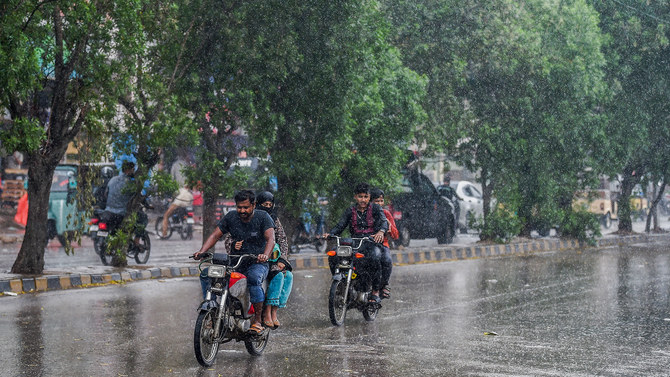
Commuters make their way amid rain showers in Karachi on June 15, 2023. (AFP/File)
Short Url
Updated 28 June 2023
Follow

Pakistan issues safety guidelines for rains during Eid after 25 killed earlier this month

  • Pakistan’s Met Office has forecasted heavy rains in central, upper parts of country during Eid holiday
  • Heavy monsoon rains caused devastating flash floods Pakistan last year, killing at least 1,700 

ISLAMABAD: The provincial disaster management authority in Pakistan’s Khyber Pakhtunkhwa province issued safety guidelines on Wednesday ahead of pre-monsoon rains expected during the Eid holidays, after at least 25 people were killed in rain-related accidents earlier this month.

On June 22, the Pakistan Meteorological Department said heavy showers could lead to urban flooding and landslides in the central and upper parts of the country during Eid Al-Adha, which falls on Thursday in Pakistan.

“In view of the more pre-monsoon rains during the Eid holidays, guidelines have been issued for the concerned institutions and district administration,” a notification from the KP Provincial Disaster Management Authority (PDMA) said on Wednesday.

“To avoid rain-related accidents, people should avoid standing near electric or telephone poles (pylons) during thunderstorms and stay away from seasonal drains (dry streams), bridges, and drainage canals. They should not attempt to cross them during the rain.”

The notification cautioned people to avoid using or crossing roads with high flow of water and advised travelers and tourists planning trips to the country’s north to be mindful of the country’s weather advisory.

“The district administration should share the information of untoward incidents with all concerned institutions in a timely manner, while the civil defense and rescue services (Rescue 1122 and fire brigade) should be on alert,” the notification said, adding that authorities concerned should ensure the availability of emergency response personnel and equipment during the forecast and issue warnings to people living near landslide-prone areas to take extra precautions.

The notification also advised residents and authorities to dispose of the offal of sacrificial animals in properly designated areas so drainage systems would not get blocked. 

Heavy monsoon rains caused devastating flash floods across Pakistan last year, killing at least 1,700 people, displacing millions, and causing damages worth $30 billion, according to government estimates.


UN says 270,000 Afghans have returned from Iran, Pakistan this year

Updated 10 March 2026
Follow

UN says 270,000 Afghans have returned from Iran, Pakistan this year

  • UNHCR says 110,000 Afghans returned from Iran while 160,000 returned from Pakistan since start of 2026
  • Return numbers seem to have risen since Gulf war erupted on Feb. 28, says UNHCR official in Afghanistan

GENEVA: Some 270,000 Afghans have returned to their country from Pakistan and Iran so far this year, the UN said Tuesday, warning that the escalating Middle East war risked pushing the numbers higher.

UNHCR, the United Nations’ refugee agency, said that 110,000 Afghans had returned from Iran and another 160,000 had returned from Pakistan since the start of 2026.

And the numbers seem to have risen since the Middle East erupted on February 28, with the United States and Israel unleashing a barrage of strikes on Iran, and Tehran responding with drone and missile strikes on Israeli and US interests across the region.

Since then, there have been some 1,700 returns from Iran to Afghanistan each day, Arafat Jamal, UNHCR’s representative in Afghanistan, told reporters in Geneva.

Speaking from Islam Qala, on the Afghan-Iranian border, he said the situation there was “deceptively calm.”

“Returns are orderly but freighted with tension and apprehension,” he said, adding that with the hostilities elsewhere escalating, “I do fear there is more to come.”

“We are preparing for massive returns.”

He pointed out that Afghanistan was “facing the ramifications of what is happening with Iran,” while clashes have erupted along the Afghan border with Pakistan.

The new Middle East war, he warned, was “layering itself on top of an existing war on another frontier,” Jamal said.

UNHCR highlighted that the latest crises came after returns to Afghanistan had already been “exceptionally high” in recent years.

More than five million Afghans had returned from neighboring countries in the past two years, including 1.9 million returning from Iran last year alone.

Jamal warned that “many Afghan families are now facing cycles of displacement: first forced to flee Afghanistan, later displaced again inside Iran due to conflict, and now returning once more to Afghanistan.”

“And upon return in Afghanistan, the triply-displaced enter a spiral of precarity and uncertainty.”
Returns from Pakistan had meanwhile stabilized in recent weeks, as the main crossing point at Torkham remained closed due to the tensions there, Jamal said.

But he warned that “movements could increase sharply once the border reopens.”

UNHCR and the UN children’s agency UNICEF said Tuesday they were working to strengthen their capacity to operate at the borders and within Afghanistan.

But “given the scale of returns and the financial constraints facing humanitarian operations, additional support will be needed if arrivals increase,” UNHCR said, without specifying the amount needed.