

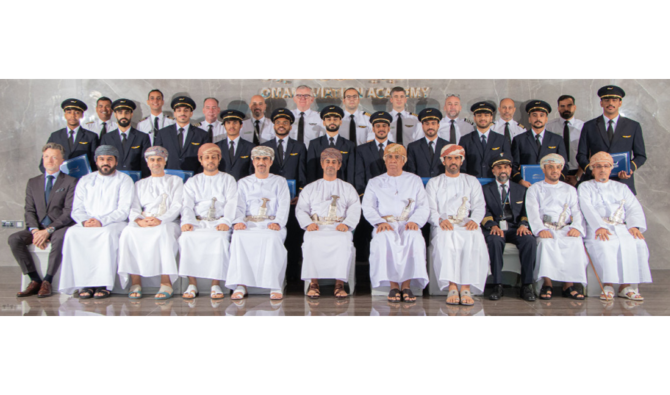
Oman Air marks graduation of 11 Omani cadets as part of training, recruitment drive

Oman Air benefits from highly experienced and qualified Omanis, not just at entry level but throughout the company. (Supplied)
Short Url
Updated 27 June 2023
Follow

Oman Air marks graduation of 11 Omani cadets as part of training, recruitment drive

Oman Air recently celebrated the graduation of its first batch of Omani cadets from the Airline Transport Pilot License program, an initiative it launched in 2018. 

The event was marked with a ceremony held under the auspices of Nayef Al-Abri, president of the Civil Aviation Authority Oman.

The 11 cadets, whose training was held at the Oman Aviation Academy in Sohar in partnership with CAE Oxford, will now join Oman Air as Second Officers. Meanwhile, the remaining batches are still engaged in their training with the next batch anticipated to graduate toward the end of this year.

 Committed to supporting Oman’s socio-economic development and empowering young Omanis, in the last few years Oman Air has ramped up its training and recruitment programs.

In conjunction with several government partnerships and to support its expanding operations, the airline has welcomed more than 260 Omani men and women into the company since 2022.

 “Oman’s aviation sector is fast becoming a value engine of the country’s growth. Oman Air’s strategy reflects national priorities and as such, we continue to develop a sustainable, highly skilled workforce that can support the advancement of the sector, meet the demands of an ever-evolving industry, and fortify our contribution to Oman’s 2040 Vision,” said Captain Moosa Al-Shidhani, senior vice president - flight operations at Oman Air. 

“We are proud to have an exceptional team of world-class pilots and crew that includes many nationalities and are committed to ensuring they have access to a wealth of opportunities for both professional and personal growth. Together, we foster an environment that nurtures their talents and aspirations and supports Oman Air in our relentless pursuit of excellence.”

 Oman Air’s latest training and recruitment initiatives also includes a partnership with The British School of Excellence and Muscat Hospitality Academy for Preparatory Cabin Crew Training for Omani students.

 Last November, the airline also launched “Future Leaders,” an intensive two-year commercial graduate training program that is training 11 Omanis with internationally recognized qualifications and exposing them to all Oman Air’s commercial functions, after which they will be offered roles within the company.

 Most recently, in cooperation with the Ministry of Labour, the airline launched an 18-month on-the-job intensive training program and internship scheme for engineers, with 80 Omanis currently being trained in its engineering department, in addition to 20 graduates that are currently being recruited for its call center.

 As the national carrier, Oman Air benefits from highly experienced and qualified Omanis, not just at entry level but throughout the company.

To date, its overall Omanization rate stands at approximately 75 percent, which is as high as 81 percent pilots, 90 percent  engineers, 100 percent male cabin crew, and 93 percent support functions.


Kuwait Fund for Development: Six decades of humanitarian and developmental impact across globe

Updated 22 January 2026
Follow

Kuwait Fund for Development: Six decades of humanitarian and developmental impact across globe

On Dec. 31, the Kuwait Fund for Development marks the anniversary of its establishment, opening a new chapter of success and ambition as one of the most prominent pioneers of development on both regional and global levels. Founded in 1961, the fund became the first and oldest development institution to operate in Arab countries and other developing nations.

Today, after more than six decades of continuous work, the Kuwait Fund for Development remains steadfast in its mission and has never ceased its efforts to support development causes in developing countries. As it celebrates its 64th anniversary, the fund has drawn a national portrait under the theme “Partners in Development,” reflected through its projects spread across the globe, all of which aim to build brighter and more sustainable future.

An external development arm

The establishment of the Kuwait Fund for Development embodied a wise and visionary decision by the leadership of Kuwait at the time. Kuwait was the only developing country that chose to share the challenges of development with other developing nations, cooperating with them through the provision of concessional loans, grants, financial assistance, and technical support tailored to their development priorities.

Since its inception, the Kuwait Fund for Development has served as Kuwait’s external development arm, sparing no effort in supporting development causes and extending assistance to developing countries worldwide.

Vision and early beginnings

In the early 1960s, the late Amir Sheikh Jaber Al-Ahmad Al-Sabah, then head of the financial department, proposed the idea of establishing a development entity that would serve Kuwait’s foreign policy and assist Arab and other developing countries in achieving development across various sectors. The idea received strong support from the late Amir Sheikh Abdullah Al-Salem Al-Sabah, as it aligned with Kuwait’s vision at the time to build a modern state.

Consequently, an Amiri decree was issued on Dec. 31, 1961, establishing the Kuwait Fund for Development with an initial capital of 50 million Kuwaiti dinars ($162.6 million).

Global reach and development impact

The fund’s activities have extended to all corners of the world, contributing to the financing of projects in 106 countries, including 16 Arab countries, 41 African countries, 19 in East and South Asia and the Pacific, 17 in Central Asia and Europe, and 12 in Latin America and the Caribbean.

This support was delivered through 1,037 concessional loans provided to the governments of these countries, with a total value of approximately 7 billion Kuwaiti dinars. In addition, the fund has provided grants and technical assistance to support a wide range of development services, helping beneficiary countries implement their development programs. A total of 420 grants and technical assistance operations were extended, amounting to approximately 401 million Kuwaiti dinars.

Loan agreements

During the past year, the Kuwait Fund for Development signed several loan agreements supporting development across different regions of the world. Among these were two loan agreements with the government of Bahrain. The first loan, valued at 31.25 million Kuwaiti dinars, contributed to financing the Electricity Transmission Networks Development Project. The second loan, valued at 10 million Kuwaiti dinars, supported the Sheikh Jaber Al-Ahmad Al-Sabah Highway Development Project (Phase II).

On the sidelines of the World Bank Group meetings held in Washington, D.C., the fund has also signed a 4 million Kuwaiti dinar-worth loan agreement with Saint Lucia to help finance the Sir Julian R. Hunte Highway Project, as well as another 4 million Kuwaiti dinar-worth loan agreement with Belize to support the George Price Highway Project.

Supporting and assisting refugees

The Kuwait Fund for Development’s contributions to humanitarian action stand out at both regional and international levels. Since its establishment, the fund has represented a unique model in supporting and assisting refugees in countries affected by disasters, conflicts, and wars, in line with Kuwait’s moderate and balanced policy.

These efforts have helped strengthen Kuwait’s relations with Arab and international partners. The fund has played a significant role in the reconstruction of Lebanon and Iraq following periods of crisis, and its assistance to the Palestinian people has never ceased.

International Participation

Over the past year, the Kuwait Fund for Development recorded notable participations in major international forums. These included taking part in the 2025 annual meetings of the World Bank Group and the International Monetary Fund in Washington, D.C., with a delegation headed by the fund’s Acting Director General Walid Shamlan Al-Bahar. The fund also took part in the Tokyo International Conference on African Development, held in Tokyo, Japan.

Additional international engagements included participation in the Third UN Conference on Landlocked Developing Countries, held in Awaza, Turkmenistan, and the Fourth International Conference on Financing for Development, organized by the UN in Seville, Spain.