

Pakistani president signs into law bill limiting disqualification of lawmakers to 5 years

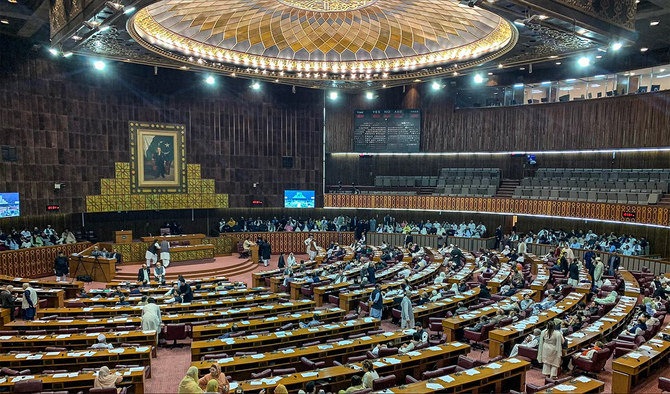
This undated file photo shows a general view of a parliament session at the National Assembly of Pakistan in Islamabad. (Photo courtesy: social media)
Short Url
Updated 26 June 2023
Follow

Pakistani president signs into law bill limiting disqualification of lawmakers to 5 years

  • Law could potentially pave the way for former PM Nawaz Sharif to return to electoral politics
  • Sharif, convicted in corruption case in 2018, lives in self-imposed exile in London since 2019

ISLAMABAD: The Pakistani president on Monday signed into law a bill that limits the disqualification of lawmakers to a period of up to five years, a move that could potentially pave the way for former Prime Minister Nawaz Sharif to return to electoral politics.

Sharif, who has served as Pakistan’s prime minister thrice, was disqualified from office on July 28, 2017, by Pakistan's apex court in a case instigated by the “Panama Papers” leaks that disclosed expensive and undeclared property owned by the Sharif family in London.

Following the verdict, the court also barred Sharif from holding office for life. Sharif and his Pakistan Muslim League-Nawaz (PML-N) party rejected the verdict, saying the corruption cases against him were "politically motivated."

The National Assembly had a day earlier passed the Election Act Law, limiting the disqualification of a parliamentarian to a maximum of five years. The bill, having already been passed by the Senate, needed to be approved by the president to become law.

Under the new law, disqualification of a person "to be elected, chosen or to remain as a member of the Parliament or provincial assembly under paragraph (f) of clause (1) of Article 62 of the Constitution shall be for a period not exceeding five years from the declaration of the court of law in that regard and such declaration shall be subject to the due process of law."

The development comes as PML-N leaders have said Sharif would return to Pakistan to lead the party before general elections in October. The party has lost a string of by-elections over the past year to former prime minister Imran Khan's Pakistan Tehreek-e-Insaf party.

After the Supreme Court disqualified Sharif from office in 2017, he was convicted in 2018 on corruption charges and sentenced to seven years in jail. In 2019, however, a Pakistani court granted medical bail to the former prime minister and he left for treatment in London in November that year and has since lived there in self-imposed exile.


Former spy chief Faiz Hameed appeals conviction by Pakistan military court

Updated 11 sec ago
Follow

Former spy chief Faiz Hameed appeals conviction by Pakistan military court

  • The ex-ISI chief was sentenced to 14 years in prison over engagement in political activities, misuse of authority
  • His conviction is highly unusual in a country where the military has ruled for almost half of its 78-year history

ISLAMABAD: Pakistan’s former intelligence chief Lt. Gen. (retired) Faiz Hameed has appealed his sentencing to 14 years in prison by a Pakistani military court, Hameed’s lawyer said on Sunday. 

Hameed was arrested in Aug. 2024 amid accusations he was involved in land grabbing and coercive seizures of property belonging to the owner of the Top City housing development near Islamabad. At the time, the military said multiple violations of the Pakistan Army Act after his retirement had also been established, prompting court martial proceedings.

On Dec. 11, Pakistan’s military announced that Hameed was found guilty of engaging in political activities, violating the Official Secrets Act and misusing authority and government resources as the chief of the Inter-Services Intelligence (ISI) agency.

“We have filed an appeal against the sentence handed down to Lt. Gen. Faiz Hameed by the military courts. The appeal was submitted to the Registrar Court of Appeals, AG Branch, Chief of Army Staff,” Hameed’s counsel Mian Ali Ashfaq told Arab News, without providing further details.

Hameed served as the ISI director-general from 2019 to 2021. His conviction is highly unusual in a country where the military has ruled for almost half of its history and continues to exert significant influence during civilian rule.

The Inter-Services Public Relations (ISPR), the military’s media wing, had said that Hameed was tried on four charges relating to political interference, breaches of the Official Secrets Act, misuse of authority and causing “wrongful loss to persons.”

“After lengthy and laborious legal proceedings, accused has been found guilty on all charges and sentenced to 14 years rigorous imprisonment by the Court which has been promulgated on 11 December 2025,” the ISPR said on Dec. 11.

Hameed was widely seen as close to Imran Khan when he was the prime minister and after his removal in a no-trust vote in 2022.

The military had previously accused Hameed of helping engineer political unrest during violent clashes on May 9, 2023, when Khan supporters rioted nationwide after his brief arrest on graft charges. Protesters were accused of torching government and military buildings “at the behest of and in collusion with vested political interests.” Khan, jailed since August 2023 on charges he says are politically motivated, denies ordering the attacks.

In its Dec. 11 statement, the military said the trial against Hameed complied with all legal requirements, adding that the former spy chief was given full rights, including the ability to choose his defense team, and retained the right to appeal “at the relevant forum.”

The ISPR also said his alleged role in “fomenting vested political agitation and instability in cahoots with political elements” was being handled separately, leading to speculation about more inquiries and legal cases.

Hameed, who retired in Dec. 2022, has long been a polarizing figure. The ruling Pakistan Muslim League-Nawaz (PML-N) also accuses him of helping engineer the 2017 removal of former premier Nawaz Sharif through court cases. Hameed denied the allegations.

“This is a landmark decision and I think the rule of law and accountability mechanism has been strengthened,” Information Minister Attaullah Tarar, who belongs to the PMLN-N, had told a Pakistani broadcaster after the announcement of the verdict against Hameed.