

Medical charity records hundreds of measles cases in Houthi-controlled Hajjah

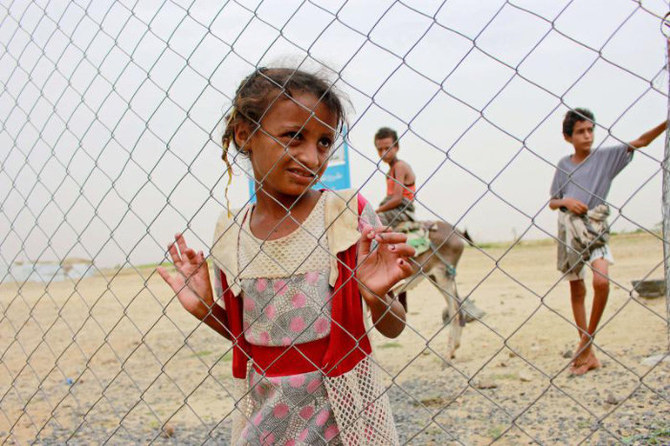
A Yemeni girl looks through the fence of a closed clinic at a camp for internally displaced people in Hajjah province, Yemen. (Reuters)
Short Url
Updated 24 June 2023
Follow

Medical charity records hundreds of measles cases in Houthi-controlled Hajjah

  • Concern grows over patients’ limited access to healthcare in northern Yemen province

AL-MUKALLA: The international medical charity Medecins Sans Frontieres said that its medical teams in Yemen’s northern Hajjah province have recorded hundreds of measles cases, many critical, as the Iran-backed Houthis oppose the distribution of vaccines.

Between February and May this year, the Abs Hospital in Hajjah treated 341 measles patients, including 22 critical cases, while the other MSF-operated Al-Mahabisha Hospital in the same province admitted an increasing number of children with the illness, the organization said on Twitter.

“We’re concerned about the increase in measles cases reported among children from areas surrounding Abs, including from more isolated areas where patients have limited access to healthcare, including vaccination services that could contribute to preventing the spread of measles,” Dr. Bakeel Ghushaim, MSF deputy medical coordinator, said.

The UN Office for the Coordination of Humanitarian Affairs said in April that a measles outbreak in Yemen had killed 77 Yemenis and that 10,000 cases of measles had been detected in Houthi-controlled northern Yemeni provinces since the beginning of the year.

In 2022, the same UN body recorded 22,000 measles cases, including 161 fatalities, as well as an increase in diphtheria and whooping cough cases.

Yemeni health officials and international aid organizations attributed the epidemic of measles in northern provinces, primarily Hajjah, to anti-vaccine campaigns by the Houthis.

During the past three years, Houthi media and officials have adopted a narrative that demonizes vaccines, describing them as a weapon used by the US to kill Yemenis and urging Yemeni parents to refrain from vaccinating their children.

Even Houthi officials claimed that children who did not receive vaccinations were healthier than those who did.

Meanwhile, Yemeni Landmine Record, a group that chronicles land mine casualties in Yemen, said on Friday that Houthi-planted mines have killed or injured 12 Yemeni civilians in multiple Yemeni regions since the beginning of this month.

Six civilians, including three children and a woman, were killed and six others, including two children, were injured in land mine blasts in Hodeidah, Taiz, Saada, Jouf and Al-Bayda.

Even as fighting has decreased significantly since early last year as a result of the UN-brokered agreement, land mines planted by the Houthis have continued to kill and maim dozens of Yemeni civilians, primarily in the western province of Hodeidah, where the militia planted thousands of land mines to obstruct Yemeni government forces.

Masam, a Saudi-funded demining program, has defused more than 400,000 land mines and unexploded ordnance in Yemen since mid-2018, enabling hundreds of Yemenis to return to their homes, workplaces and schools.


Children dying from cold as storm batters Gaza, killing 13

Updated 4 sec ago
Follow

Children dying from cold as storm batters Gaza, killing 13

  • Three children die from exposure as winter rains flood displacement camps
  • Wet weather causes war-damaged buildings and walls to collapse, killing 10
GAZA CITY: Gaza’s civil defense agency on Friday said at least 13 people had died in the last 24 hours, including three children who died from exposure to the cold, as a winter storm batters the territory.
Heavy rain from Storm Byron has flooded tents and temporary shelters across the Gaza Strip since late Wednesday, compounding the suffering of the territory’s residents, nearly all of whom were displaced during more than two years of war.
Gaza’s civil defense agency, which operates as a rescue force under Hamas authority, told AFP three children had died from exposure to the cold — two in Gaza City and one in Khan Yunis in the south.
Al-Shifa Hospital in Gaza City confirmed the deaths of Hadeel Al-Masri, aged nine, and Taim Al-Khawaja, who it said was just several months old.
Nasser Hospital in Khan Yunis on Thursday said eight-month-old Rahaf Abu Jazar had died in the nearby tented encampment of Al-Mawasi due to the cold.
With most of Gaza’s buildings destroyed or damaged, thousands of tents and homemade shelters now line areas cleared of rubble.
Civil defense spokesman Mahmud Bassal said six people died when a house collapsed in the Bir Al-Naja area of the northern Gaza Strip.
Four others died when walls collapsed in multiple separate incidents, he said.
In a statement, the civil defense said its teams had responded to calls from “13 houses that collapsed due to heavy rains and strong winds, mostly in Gaza City and the north.”

No dry clothes

Under gloomy skies in Nuseirat in the central Gaza Strip, Palestinians used bowls, buckets and hoes to try and remove the water that had pooled around their tents made of plastic sheeting.
Young children, some barefoot and others wearing open sandals, trudged and hopped through ponds of muddy water as the rain continued to fall.
“The mattress has been soaked since this morning, and the children slept in wet bedding last night,” Umm Muhammad Joudah told AFP.
“We don’t have any dry clothes to change into.”
Saif Ayman, a 17-year-old who was on crutches due to a leg injury, said his tent had also been submerged.
“In this tent we have no blankets. There are six of us sleeping on one mattress, and we cover ourselves with our clothes,” he said.
The Hamas-run interior and national security ministry gave a preliminary toll of 14 dead due to the effects of the winter rains since Wednesday.
A ceasefire between Israel and militant group Hamas that took effect in October has partially eased restrictions on goods and aid entering into the Gaza Strip.
But supplies have entered in insufficient quantities, according to the United Nations, and the humanitarian needs are still immense.
The UN’s World Health Organization warned on Friday that thousands of families were “sheltering in low-lying or debris-filled coastal areas with no drainage or protective barriers.”
“Winter conditions, combined with poor water and sanitation, are expected to drive a surge in acute respiratory infections,” it added.