

Conservative MP Gove faces backlash from his own party over bill banning boycotts of Israeli goods

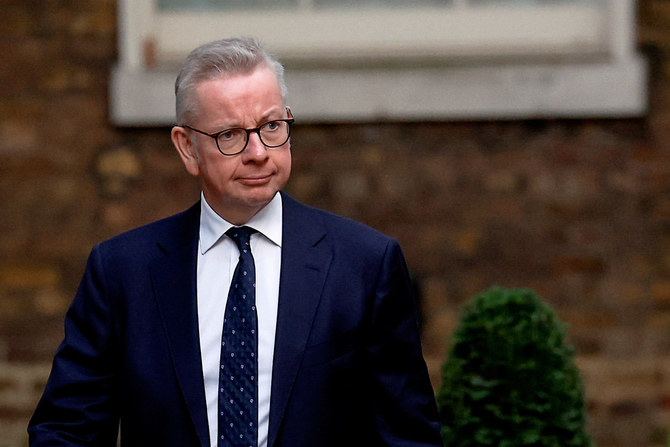
Conservative politicians in the UK have voiced concerns over MP Michael Gove’s (pictured) bill designed to stop public bodies from boycotting Israeli goods and services. (Reuters/File Photo)
Short Url
Updated 24 June 2023
Follow

Conservative MP Gove faces backlash from his own party over bill banning boycotts of Israeli goods

  • The Economic Activity of Public Bodies Bill aimed at stopping local councils from supporting the BDS movement

LONDON: Conservative politicians in the UK have voiced concerns over MP Michael Gove’s bill designed to stop public bodies from boycotting Israeli goods and services.

The Economic Activity of Public Bodies Bill, which is set for a second reading in the British Parliament in the coming weeks, is aimed at stopping local councils from supporting the Boycott, Divestment and Sanctions movement, which opposes Israel’s occupation of Palestinian territories.

A group of Tory lawmakers have told the Levelling Up, Housing and Communities secretary they have reservations about the proposed law, The Guardian reported on Saturday.

Opposition-led councils in the English cities of Leicester and Lancaster, both of which have Labour as the largest party, have approved the imposition of boycotts on Israeli goods by organizations.

“These (BDS) campaigns not only undermine the UK’s foreign policy but lead to appalling antisemitic rhetoric and abuse. My message to these organizations is to get on with your job and focus on delivering for the public,” Gove said.

However, those within his own party have said they take issue with the singling out of Israel and how the bill may stop public bodies from targeting goods and firms from other countries such as China, the report added.

“I support the principle that taxpayers’ money should not be politicized and should not be used to undermine the government’s foreign policy,” Alicia Kearns, Conservative party chair of the foreign affairs select committee, told the newspaper.

“My concern is we should not specifically name Israel on the face of the bill. We should not do country-specific legislation as it undermines our foreign policy. I also worry whether this will undermine community cohesion,” she added.

Several civil society groups in the UK have also called on the British government to drop the bill, including the International Center of Justice for Palestinians and Amnesty International, who slammed the proposed law as “outrageous.”

A spokesperson for the government said public bodies should not be pursuing their own foreign policy agenda, adding that the bill would ensure the UK spoke “with one voice internationally” and that the “taxpayer only has to pay for foreign policy once.”


Japan restarts world’s biggest nuclear plant

Updated 12 sec ago
Follow

Japan restarts world’s biggest nuclear plant

  • Japan wants to revive atomic energy to reduce its reliance on fossil fuels

KARIWA: The world’s biggest nuclear power plant was restarted Wednesday for the first time since the 2011 Fukushima disaster, its Japanese operator said, despite persistent safety concerns among residents.

The plant was “started at 19:02” (1002 GMT), Tokyo Electric Power Company spokesman Tatsuya Matoba said of the Kashiwazaki-Kariwa plant in Niigata prefecture.

The regional governor approved the resumption last month, although public opinion remains sharply divided.

On Tuesday, a few dozen protesters — mostly elderly — braved freezing temperatures to demonstrate in the snow near the plant’s entrance, whose buildings line the Sea of Japan coast.

“It’s Tokyo’s electricity that is produced in Kashiwazaki, so why should the people here be put at risk? That makes no sense,” Yumiko Abe, a 73-year-old resident, told AFP.

Around 60 percent of residents oppose the restart, while 37 percent support it, according to a survey conducted in September.

TEPCO said Wednesday it would “proceed with careful verification of each plant facility’s integrity” and address any issues appropriately and transparently.

Kashiwazaki-Kariwa is the world’s biggest nuclear power plant by potential capacity, although just one reactor of seven was restarted.

The facility was taken offline when Japan pulled the plug on nuclear power after a colossal earthquake and tsunami sent three reactors at the Fukushima atomic plant into meltdown in 2011.

However, resource-poor Japan now wants to revive atomic energy to reduce its reliance on fossil fuels, achieve carbon neutrality by 2050 and meet growing energy needs from artificial intelligence.

Prime Minister Sanae Takaichi has voiced support for the energy source.

Fourteen reactors, mostly in western and southern Japan, have resumed operation since the post-Fukushima shutdown under strict safety rules, with 13 running as of mid-January. The vast Kashiwazaki-Kariwa complex has been fitted with a 15-meter-high (50-foot) tsunami wall, elevated emergency power systems and other safety upgrades.

However, residents raised concerns about the risk of a serious accident, citing frequent cover-up scandals, minor accidents and evacuation plans they say are inadequate.