

102 suspects in army's custody over violent riots in Pakistan after ex-PM Khan arrest in May — official

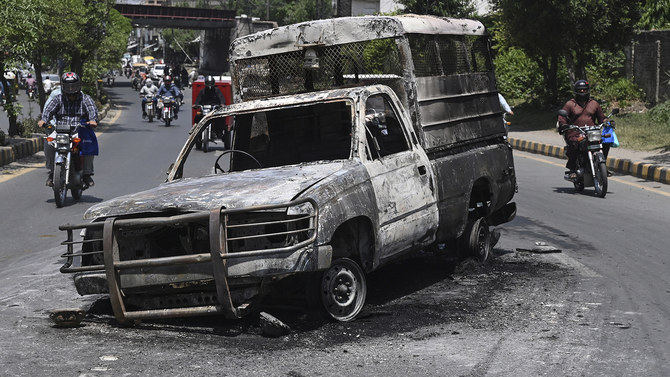
Commuters ride past a burnt vehicle set on fire during a protest by supporters of former Pakistan's Prime Minister Imran Khan over the arrest of their leader, in Lahore on May 11, 2023. (AFP/File)
Short Url
Updated 23 June 2023
Follow

102 suspects in army's custody over violent riots in Pakistan after ex-PM Khan arrest in May — official

  • Supreme Court is currently hearing petitions filed against the trial of civilians in military courts
  • Attorney General Mansoor Usman Awan says 'no journalists or lawyers are in the army’s custody'

ISLAMABAD: Mansoor Usman Awan, the attorney general for Pakistan (AGP), on Friday informed the Supreme Court that the army had 102 people in its custody who had been involved in violence that broke out in the South Asian country after former prime minister Imran Khan's arrest on May 9, Pakistani media reported. 

Pakistan’s government and army have said they will try in military courts suspects accused of attacking army installations in countrywide protests in the wake of Khan's arrest. Military courts operate under a separate system from the civilian legal system. Trials are closed to outsiders, and no media is allowed. Rights groups have criticized the secretive nature of the process. 

Four petitions have been filed against the use of military courts to try civilians by, namely, former Chief Justice Jawwad S. Khawaja, prominent lawyer and politician Aitzaz Ahsan, Pakistan Institute of Labour Education and Research Chief Executive Karamat Ali, and former PM Khan. 

A seven-member bench, led by Chief Justice of Pakistan (CJP) Umar Ata Bandial, on Friday resumed hearing pleas challenging the trials of civilians in military courts, Pakistan's Dawn newspaper reported. 

"The AGP took the rostrum at the tail-end of today’s hearing, telling the seven-member bench that 102 people were in the army’s custody, adding that none of these were women or minors," the report read. 

“No journalists or lawyers are in the army’s custody.” 

AGP Awan said the authorities had doubts about one of the suspects in custody being below 18 years of age. “His tests are being conducted. If he is less than 18 years of age he will be released,” he said. 

A day earlier, the chief justice had ignored a request to issue an interim order to stop the trials of civilians in the military courts, saying it was not possible without hearing AGP Awan first. 

While issuing notice to the respondents, the court had asked the AGP to furnish the total number of detained suspects in civil and military custody on account of offences allegedly committed by them on May 9. 

A bruising year-long standoff between Khan, arguably Pakistan’s most popular leader, and the army came to a head when military buildings and property were ransacked last month, allegedly by Khan supporters, following his arrest in a graft case. Khan was later released on bail but hundreds of his followers were arrested in the aftermath and the military said it would punish all those who had damaged military properties or instigated people to do so. 

Many of the top members of Khan’s party have since jumped ship and the government of PM Shehbaz Sharif has threatened to ban Khan's Pakistan Tehreek-e-Insaf party.  

Meanwhile, authorities have begun the process of trying dozens of people, including members of Khan’s party, suspected of involvement in the protests in military courts, usually reserved for service members or those categorized as enemies of the state. Khan says the purpose of military courts, in this case, is to put him in prison and dismantle his party. 

Pakistan’s Army Act of 1952 established military courts primarily to try members of the military or enemies of the state. Civilians can only be tried there under a federal government order. 

Civilians accused of offenses such as waging war against the armed forces or law enforcement agencies, attacking military installations, or inciting mutiny, can be tried at military courts. 


Pakistan accepts Trump’s invitation to join ‘Board of Peace’ for lasting peace in Gaza

Updated 7 sec ago
Follow

Pakistan accepts Trump’s invitation to join ‘Board of Peace’ for lasting peace in Gaza

  • Pakistan’s foreign office hopes board’s efforts lead to permanent ceasefire in Gaza, independent Palestinian state
  • UAE, Egypt, Israel, Bahrain and others have also accepted Trump’s invitation to join body that aims to resolve conflicts

ISLAMABAD: Pakistan’s foreign office announced on Wednesday that Islamabad has accepted US President Donald Trump’s invitation to join his Board of Peace (BoP), hoping it would lead to the implementation of a permanent ceasefire in Gaza and the establishment of a Palestinian state. 

The White House last week announced the names of some members of the BoP, a global body that aims to restore peace in areas affected by conflict including Gaza, where a fragile ceasefire has been in place since October 2025. Chaired by Trump, the board would include US Secretary of State Marco Rubio, Trump’s special envoy Steve Witkoff, former British prime minister Tony Blair and Trump’s son-in-law, Jared Kushner. 

Pakistan joins the UAE, Egypt, Bahrain, Albania, Armenia, Azerbaijan, Belarus, Hungary, Kazakhstan, Morocco and Vietnam in joining the BoP. Israel announced on Wednesday its Prime Minister Benjamin Netanyahu will also be a member of the board.

“In response to the invitation extended to Prime Minister Muhammad Shehbaz Sharif by the President of the United States, H.E. Donald J. Trump, Pakistan would like to announce its decision to join the Board of Peace (BoP) as part of its ongoing efforts to support the implementation of the Gaza Peace Plan under the framework of the United Nations Security Council Resolution 2803,” the Pakistani foreign office said in a statement. 

The foreign office said Pakistan hoped concrete steps will be taken toward the implementation of a permanent ceasefire, further scaling up of humanitarian aid for the Palestinians as well as reconstruction of Gaza with the creation of the board.

The statement said Islamabad also hopes these efforts will lead to the realization of the right to self-determination of Palestinians through a “credible, time-bound political process, consistent with international legitimacy and relevant UN resolutions, resulting in the establishment of an independent, sovereign, and contiguous State of Palestine, based on the pre-1967 borders with Al-Quds Al-Sharif as its capital.”

“Pakistan looks forward to continue playing a constructive role as part of the Board of Peace for the achievement of these goals as well as to end the suffering of our Palestinian brothers and sisters,” the statement concluded. 

Pakistan has consistently supported the demand for Palestinian statehood under UN resolutions and has publicly criticized Israeli military operations in Gaza, while also opposing broader regional escalations, including attacks on Iran.

According to the BoP’s charter seen by international wire agency AFP, the board is “an international organization that seeks to promote stability, restore dependable and lawful governance, and secure enduring peace in areas affected or threatened by conflict.”

As chairman of the BoP, Trump has the power to pick members of an executive board to be “leaders of global stature” to “serve two-year terms, subject to removal by the chairman,” the board’s charter as seen by AFP reads.