

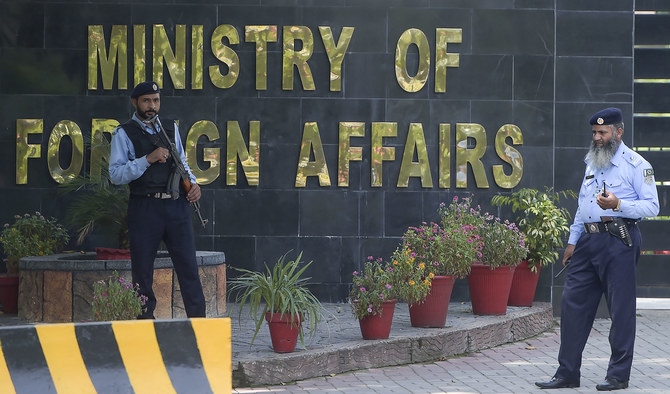

ISLAMABAD: Pakistan on Friday emphasized that world powers should avoid turning the fight against "terrorism" into a controversial issue or using it for geopolitical objectives, hours after the United States and India jointly asked Islamabad to act against militancy.
The White House, following a meeting between US President Joe Biden and Indian Prime Minister Narendra Modi, on Friday issued a joint statement that urged Pakistan to take immediate action to prevent its territory from being used as a base for militant attacks in other countries.
The statement came at a time when Pakistan's relations with the US experience a low due to mistrust between the two countries in connection with Islamabad allegedly not supporting Washington's decades-long military campaign in Afghanistan the way the US wanted it to. The bilateral ties appeared to take another downturn after former Pakistan premier Imran Khan accused Washington of siding with his opponents to oust him from power.
The joint statement drew criticism from Pakistani officials who said that eliminating militancy from the world required "collective efforts," reminding Washington of Pakistan's sacrifices in its “War on Terror” in Afghanistan.
“The international community should take this menace seriously,” Pakistan’s Foreign Minister Bilawal Bhutto-Zardari said while speaking on the floor of Pakistan's parliament.
"It is only through collective efforts the scourge can be eliminated from the face of the earth."
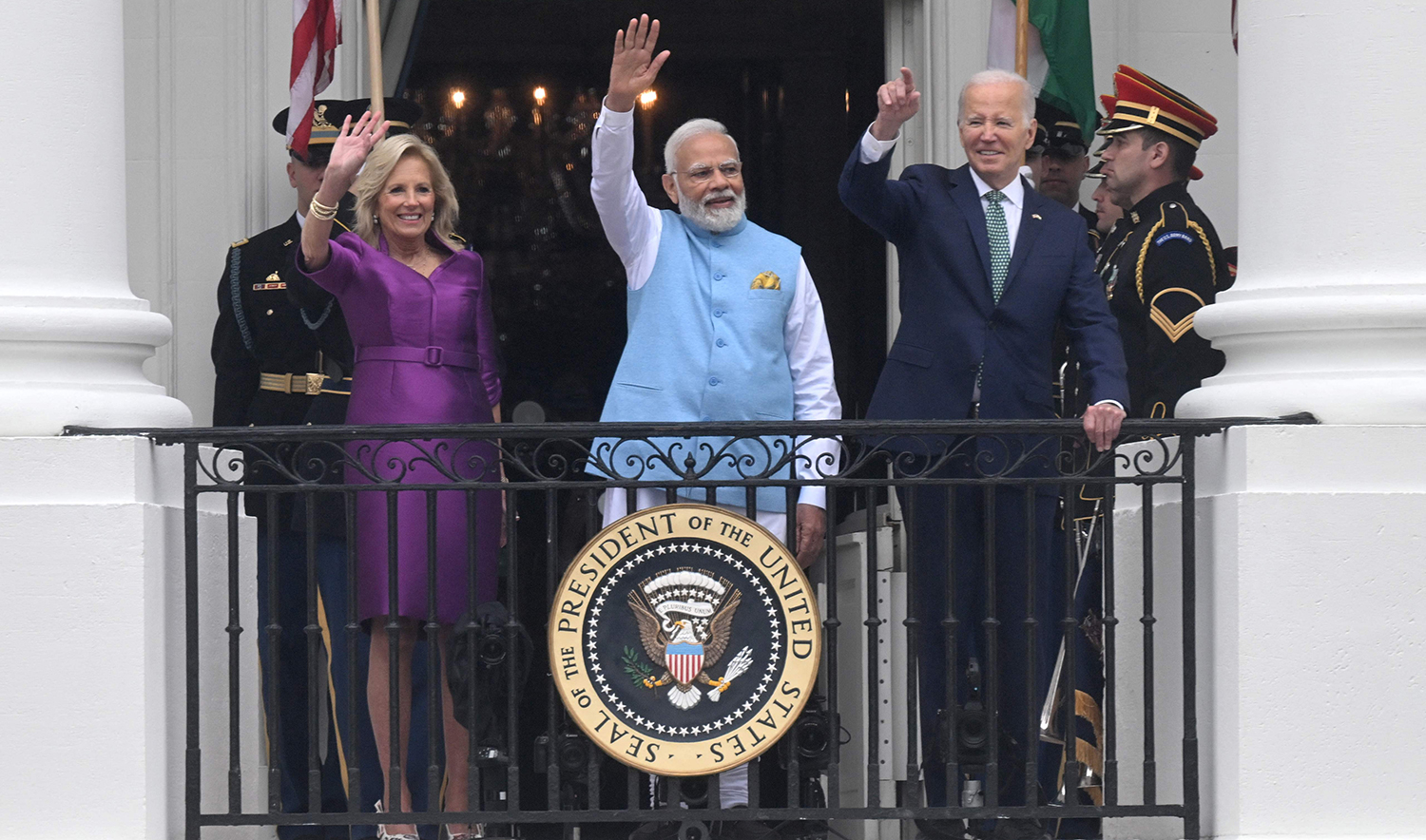
US First Lady Jill Biden, left, India's Prime Minister Narendra Modi, center, and President Joe Biden wave from the Truman Balcony during a welcoming ceremony for Modi at the White House in Washington, DC, on June 22, 2023. (AFP)
Biden and Modi on Friday called for “concerted action” against UN-listed militant groups including Al-Qaeda, Daesh, Lashkar e-Tayyiba (LeT), Jaish-e-Mohammad (JeM), and Hizb-ul-Mujhahideen.
India accuses Pakistan of arming militants and destabilizing the country. The issues of cross-border militancy and of the disputed Himalayan Kashmir region have always sparked conflict between the two nuclear-armed South Asian countries. Islamabad denies Indian allegations and accuses New Delhi of sponsoring state-sponsored militancy in Pakistan.
Taking exception to the US-India statement, Defence Minister Khawaja Asif said Pakistan had been paying a heavy price for aligning itself with the US in the two Afghan wars.
“Terrorism entered Pakistan as a consequence of its alliance with the United States in the war on terrorism, but regretfully its sacrifices are not recognized,” Asif said.
He criticized the Indian prime minister and accused him of "overseeing" the killings of thousands of Muslims and the rape of Muslim women in the 2002 riots in Gujarat when Modi was its chief minister.
“In response to these atrocities, the US imposed a ban on issuing a visa to Narendra Modi at the time,” Asif recalled, saying that minorities, especially Muslims, in India were still being targeted under Modi's leadership.
Pakistan’s foreign office also issued an official response to the joint statement, terming it “unwarranted, one-sided, and misleading.”
“We consider the Pakistan-specific reference in the ‘Joint Statement from the United States and India’, issued on 22 June 2023, as unwarranted, one-sided, and misleading,” Foreign Office spokesperson Mumtaz Zahra Baloch said.
“The reference is contrary to diplomatic norms and has political overtones. We are surprised that it has been added despite Pakistan’s close counterterrorism cooperation with the US."
She added that Pakistan’s international partners should take a holistic and objective view of the issues of peace and security in South Asia and “refrain from endorsing one-sided positions.”
Former Pakistani diplomats and foreign affairs experts also said the joint statement violated the "norms of bilateralism" and warned that the remarks would further affect the already strained Pakistan-US relations.
“The negative references to Pakistan in the US-India joint statement are a violation of the norms of bilateralism which require that third country is not commented upon,” Aizaz Ahmed Chaudhary, a former diplomat who also served as Pakistan's ambassador to the US, told Arab News.
“The US, which is a friendly country, should not have agreed to include such anti-Pakistan language in the joint statement.”
Chaudhry said Pakistan had worked hard to defeat terrorism and achieved results.
In fact, he added, India "indulged in cross-border terrorism" by sending in spies like Kulbhushan Jadhav, an Indian navy officer who was working with the Indian spy agency, RAW, when Pakistani agencies arrested him in Balochistan in 2016.
Maleeha Lodhi, another former diplomat, said the growing ties between the US and India were their sovereign right, but their defense cooperation had implications for Pakistan's security.
“This is because that aggravates the strategic imbalance in the region to Pakistan's detriment,” she told Arab News. “The fact that the Biden administration overlooked Modi's grim human rights record, including in Indian-occupied Kashmir, lays bare the double standards practiced by Washington on this issue.”
Lodhi believes that Modi's visit and the growing strategic ties between the US and India were principally about containing China.
Dr. Salma Malik, a Pakistani foreign affairs expert, said the joint statement would dampen Pakistan’s efforts to have good relations with the US.
“This statement definitely will have an adverse impact on Pakistan-US relations and hurt Pakistani efforts to take forward the relations onto a positive trajectory,” she told Arab News.
Malik, however, said this was a "consistent policy" of the Biden administration as he had given such statements in the past as well, which impacted the relationship negatively. The joint statement also showed the influence of the pro-India lobby in the US, she believed.
“The US is trying to woo and appease India as much as possible to implement its future strategic plans to counter China and to have India as a proxy in the region,” she added.
Najam Rafiq, another expert on foreign policies and relations, said Pakistan-US relations had been witnessing a downward trend for a long time and Washington had already shown its preference for India.
“It has done strategic partnership with India, and it not only sees India as the most prominent power in South Asia but also as [member of] a major alliance, called Quad, in the larger Asia Pacific region,” Rafiq told Arab News.
“The US has been telling Pakistan for a long time to at least put a hold on China-Pakistan Economic Corridor, but Pakistan has refused to do so, and we saw its impact in terms of the IMF program to Pakistan as the 9th review which has been stalled completely,” he added.


