

Pakistan’s top court asks for record of all civilians arrested after May 9 riots

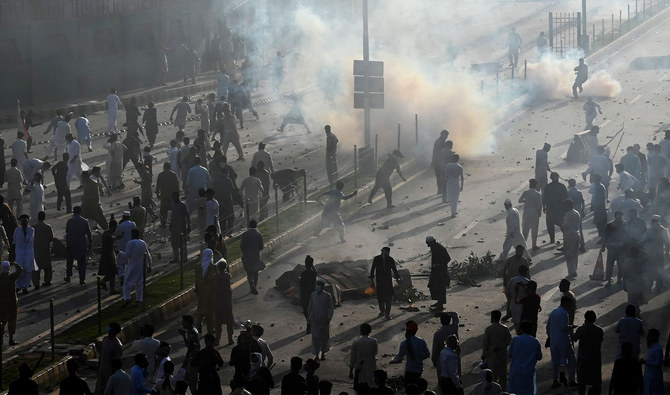
Pakistan Tehreek-e-Insaf (PTI) party supporters of former Pakistan's Prime Minister Imran gather amid teargas fired by police during a protest against the arrest of their leader, in Peshawar, Pakistan, on May 9, 2023. (AFP/File)
Short Url
Updated 22 June 2023
Follow

Pakistan’s top court asks for record of all civilians arrested after May 9 riots

  • Supreme Court hears petitions filed against the use of military courts to try civilians
  • Civilians accused of waging war against armed forces can be tried at military courts

ISLAMABAD: A seven-member bench of the Supreme Court, headed by Chief Justice Umar Ata Bandial on Thursday sought details of all individuals, including women and juveniles, arrested after violent riots broke out in many parts of the country on May 9, local media reported. 

Pakistan’s government and army have said they will try in military courts suspects accused of attacking army installations in countrywide protests in the wake of former Prime Minister Imran Khan's arrest last month.

Military courts operate under a separate system from the civilian legal system. Trials are closed to outsiders, and no media is allowed. Rights groups have criticized the secretive nature of the process.

Four petitions have been filed against the use of military courts to try civilians by, namely, former Chief Justice Jawwad S. Khawaja, prominent lawyer and politician Aitzaz Ahsan, Pakistan Institute of Labour Education and Research Chief Executive Karamat Ali, and former PM Khan.

"We want details as to how many individuals, including women and juveniles, are detained by civilians and military authorities", The Express Tribune quoted Chief Justice Bandial as saying while he resumed hearing of the petitions. 

The chief justice, according to the report, noted that several objections had been raised regarding military courts holding trials of civilians, “which include no public hearing, no representation of counsel, no concept of independence of the judiciary, and lack of a location for court premises.”

The hearing was adjourned till Friday.

Speaking to the media following after the hearing, Latif Khosa, petitioner Ahsan's lawyer, confirmed during the hearing that the chief justice asked the attorney general of Pakistan to provide a list of all the people who are currently in jail on charges related to the May 9 violence. The chief justice also wanted to know how many of them had been transferred to military courts. 

“We have argued that there is no legal justification for hearing civilian cases in military courts. This practice creates a parallel judicial system and goes against basic human rights,” Khosa said.

Khosa said that initially, a nine-member bench was formed to hear the petitions. However, two judges, including Justice Qazi Faez Isa, recused themselves from hearing the petitions. 

He added that nevertheless, the petitioners were satisfied with Thursday’s proceedings as the chief justice raised “valid points regarding the structure of military courts and the representation of accused individuals by lawyers.”

A bruising year-long standoff between Khan, arguably Pakistan’s most popular leader, and the army came to a head when military buildings and property were ransacked last month, allegedly by Khan supporters, following his arrest in a graft case. Khan was later released on bail but hundreds of his followers were arrested in the aftermath and the military said it would punish all those who had damaged military properties or instigated people to do so.

Many of the top members of Khan’s party have since jumped ship and the government of Prime Minister Shehbaz Sharif has threatened to ban his Pakistan Tehreek-e-Insaf party.

Meanwhile, authorities have begun the process of trying dozens of people, including members of Khan’s party, suspected of involvement in the protests in military courts, usually reserved for service members or those categorized as enemies of the state. Khan says the purpose of military courts, in this case, is to put him in prison and dismantle his party.

Pakistan’s Army Act of 1952 established military courts primarily to try members of the military or enemies of the state. Civilians can only be tried there under a federal government order.

Civilians accused of offenses such as waging war against the armed forces or law enforcement agencies, attacking military installations, or inciting mutiny, can be tried at military courts.


Imran Khan’s party seeks ‘confidence-building measures’ after government’s talks offer

Updated 03 January 2026
Follow

Imran Khan’s party seeks ‘confidence-building measures’ after government’s talks offer

  • PTI says access to jailed founding leader essential for talks to be considered credible
  • Government says it’s ready for dialogue but nothing will happen until Khan favors the idea

ISLAMABAD: Pakistan’s jailed former prime minister Imran Khan’s party said on Saturday it would only consider the government’s offer for talks credible if it is accompanied by “concrete confidence-building measures,” such as unhindered access to its founding leader in a high-security prison in Rawalpindi.

Last month, Prime Minister Shehbaz Sharif said the government was fully prepared to hold a dialogue with Khan’s Pakistan Tehreek-e-Insaf (PTI) party to address political polarization that has deepened since the downfall of the PTI administration in a parliamentary no-confidence vote in 2022.

PTI has frequently complained about a state crackdown against its top leadership, including Khan and his wife, who are serving prison sentences in multiple cases ranging from corruption charges to inciting violence against state institutions and attacks on government properties.

Sharif’s offer for talks came amid media reports that PTI wanted a dialogue with the government, though he noted that negotiations would not be allowed to proceed on the basis of “blackmailing” or unlawful demands and would only cater to legitimate issues.

“Announcements of talks, without concrete confidence-building measures, cannot be treated as credible progress,” Azhar Leghari, PTI’s central deputy information secretary, told Arab News.

He recalled that Khan had authorized Mahmood Khan Achakzai and Allama Raja Nasir Abbas to carry forward with the dialogue process, adding that talks “require trust, and trust cannot be built at the cost of constitutional rights or democratic legitimacy.”

“For dialogue to be meaningful, it is essential that these authorized representatives are allowed regular and unhindered access to Imran Khan so that any engagement accurately reflects his views and PTI’s collective position,” he added.

Khan’s family, party and legal team have complained in the past they are stopped by the authorities from meeting the ex-PM in prison. Last month, they also raised concerns about his health, prompting the officials to allow one of his sisters to meet him, who said he was fine.

Shortly thereafter, a scathing message was posted on his social media account, criticizing the army chief. Khan’s post elicited a bitter response from the government and the military amid accusations of inciting people against state institutions.

Leghari’s comments came only a day after Rana Sanaullah, adviser to Prime Minister Sharif on political affairs, said PTI’s “second- or third-tier leadership” wanted dialogue, but nothing was going to happen until Khan favored these negotiations.

He also maintained that while the government was ready for talks, “uncertainty and delays from PTI are preventing progress.”

Meanwhile, a newly formed National Dialogue Committee of former PTI leaders told Arab News it had organized a session on Wednesday, January 7, in the federal capital that will bring together all major political parties, journalists, lawyers and representatives of civil society.

“Our goal is to bring political leaders together so that, while discussing their own issues, they can collectively seek solutions to the nation’s challenges,” Mahmood Baqi Moulvi, a Pakistani politician and member of the committee, said.

“The initiative also builds on previous efforts, including a letter to the prime minister requesting confidence-building measures to enable talks with PTI,” he added.

The National Dialogue Committee had urged the government in the letter to grant parole to jailed party figures in Lahore, including former foreign minister Shah Mahmood Qureshi and Dr. Yasmin Rashid, describing the move as vital for building trust ahead of negotiations.

It had also maintained such a step “would not only create an extremely positive, conducive, and trust-filled environment for the negotiations but would also lay a strong foundation for restoring mutual confidence among all stakeholders.”

While the government has also offered dialogue in the past, PTI leaders have conditioned participation on substantive measures, including what they describe as an end to politically motivated prosecutions and arrests, restoration of fundamental rights, respect for judicial independence and a credible roadmap toward free and fair elections.

“Reconciliation is possible, but it must be based on correcting injustices rather than managing optics,” Leghari said. “A genuine reset requires restoring respect for the Constitution, ending political victimization and allowing democratic processes to function without interference.”

Rana Sanaullah and Deputy Law Minister Barrister Aqeel Malik did not respond to requests for comment.