

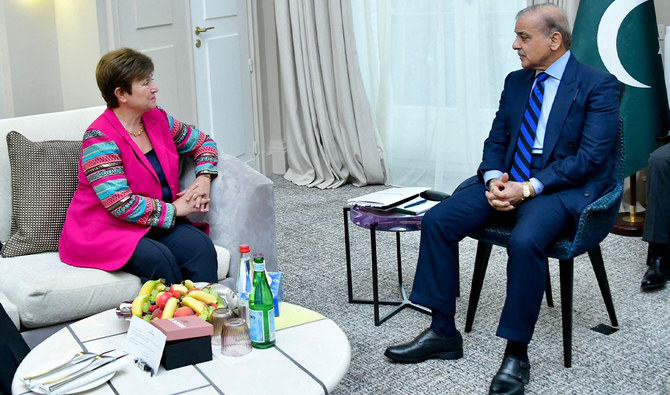

ISLAMABAD: Pakistani Prime Minister Shehbaz Sharif held a meeting with the managing director of the International Monetary Fund (IMF), Kristalina Georgieva, in Paris on Thursday and expressed hope funds allocated under the lender’s Extended Fund Facility (EFF) would be released “as soon as possible.”
Cash-strapped Pakistan’s staff-level agreement with the IMF to release $1.1 billion out of a $6.5 billion package has been delayed since November, with more than 100 days gone since the last IMF mission came to Pakistan, the longest such delay since at least 2008. The program expires at the end of June, while the release of pending bailout funds under the 9th IMF review is crucial for Pakistan to resolve an acute balance of payments crisis. Reserves at the country’s central bank can just cover a month’s worth of imports.
To keep the economy afloat, Pakistan has doubled down on its efforts to secure external financing from “friendly countries.” Last week, the country’s central bank announced it had received $1 billion from China, while it is also waiting to receive loans worth $2 billion and $1 billion from Saudi Arabia and the UAE, respectively.
Pakistan has also been pushing the US to influence the IMF to approve the bailout package.
“Prime Minister outlined the steps taken by the Government for economic growth and stability,” a statement from Sharif’s office said.
“He underscored that all prior actions for 9th Review under the Extended Fund Facility had been completed and the Government of Pakistan was fully committed to fulfilling its obligations as agreed with the IMF.”
“The PM expressed the hope that the funds allocated under the IMF’s Extended Fund Facility (EFF) would be released as soon as possible,” the statement added. “This would help strengthen Pakistan’s ongoing efforts toward economic stabilization, and bring relief to its people.”
Last week, Pakistani Finance Minister Ishaq Dar blamed “geopolitics” for repeated delays in the resumption of the IMF’s program after the lender criticized Islamabad for failing to broaden the tax net in the new budget.
“Pakistan is a sovereign country and cannot accept everything from the IMF,” he was quoted as saying.
Pakistan had to complete a series of prior actions demanded by the IMF, which included reversing subsidies, a hike in energy and fuel prices, jacking up its key policy rate, a market-based exchange rate, arranging for external financing and raising over 170 billion rupees ($613 million) in new taxation.
The fiscal adjustments have already fueled Pakistan’s highest ever inflation.


