Pakistan finance minister blames ‘geopolitics’ for delay in IMF bailout

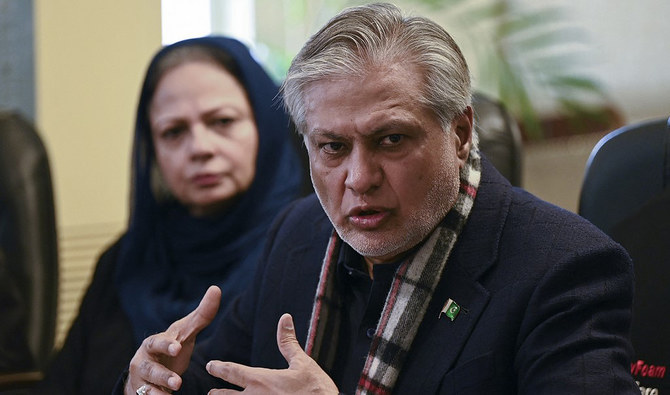
Pakistan’s Finance Minister Ishaq Dar (R) speaks during a press conference in Islamabad on February 10, 2023. (AFP/File)
Short Url
Updated 16 June 2023
Follow

Pakistan finance minister blames ‘geopolitics’ for delay in IMF bailout

  • The program has been stalled since November last year despite several rounds of talks between the two sides
  • Finance Minister Ishaq Dar assures Senate committee the country would not default on its external payments

ISLAMABAD: Pakistan's Finance Minister Ishaq Dar on Thursday blamed "geopolitics" for repeated delays in the resumption of Pakistan's $6.5 billion International Monetary Fund (IMF) program, local media reported, hours after the lender criticized Islamabad for failing to broaden tax net in the new budget.

The IMF and the Pakistani authorities have been negotiating with each other since last November to complete the ninth review of the loan program. However, they have not managed to make headway in ensuring the revival of the facility which is set to expire at the end of June.

Last week, Dar presented the budget for the next fiscal year with an outlay of Rs14.46 trillion ($50.4 billion), with the government targeting a 6.5 percent fiscal deficit and allocating around 50 percent of the amount to make interest payments.

Addressing the Senate standing committee on finance, Dar responded to the IMF country representative's criticism of the country’s new federal budget, saying Pakistan was a "sovereign" country and could not accept everything demanded by the IMF, Pakistan's Geo News channel reported.

“Pakistan is a sovereign country and cannot accept everything from the IMF,” he was quoted as saying. “Foreign hostile elements want Pakistan to turn into another Sri Lanka and then the IMF negotiate with Islamabad.” 

The finance minister assured the committee that the government knew how much tax it needed to collect and form where the revenue could be generated. 

About Pakistan’s external payments, he assured the country will not defer any foreign payments, according to the report.

“Pakistan does not need to go to Paris Club to reschedule loans,” he said. "We will manage external payments of Pakistan."

Pakistan has for months been facing an acute balance of payment crisis, with its forex reserves barely enough to cover a month's imports, inflation skyrocketing and local currency depreciating fast.

The South Asian country still has to draw around $2.5 billion from the IMF, though it remains uncertain due to inconclusive negotiations and the content of the latest budget.


Pakistan forms committee to negotiate financial advisory services for Islamabad airport privatization

Updated 18 February 2026
Follow

Pakistan forms committee to negotiate financial advisory services for Islamabad airport privatization

  • Committee to engage Asian Development Bank to negotiate terms of financial advisory services agreement, says privatization ministry
  • Inaugurated in 2018, Islamabad airport has faced criticism over construction delays, poor facilities and operational inefficiencies

ISLAMABAD: Pakistan’s Privatization Ministry announced on Wednesday that it has formed a committee to engage the Asian Development Bank (ADB) to negotiate a potential financial advisory services agreement for the privatization of Islamabad International Airport.

The Islamabad International Airport, inaugurated in 2018 at a cost of over $1 billion, has faced criticism over construction delays, poor facilities, and operational inefficiencies.

The Negotiation Committee formed by the Privatization Commission will engage with the ADB to negotiate the terms of a potential Financial Advisory Services Agreement (FASA) for the airport’s privatization, the ministry said. 

“The Negotiation Committee has been mandated to undertake negotiations and submit its recommendations to the Board for consideration and approval, in line with the applicable regulatory framework,” the Privatization Ministry said in a statement. 

The ministry said Islamabad airport operations will be outsourced under a concession model through an open and competitive process to enhance its operational efficiency and improve service delivery standards. 

Pakistan has recently sought to privatize or outsource management of several state-run enterprises under conditions agreed with the International Monetary Fund (IMF) as part of a $7 billion bailout approved in September last year.

Islamabad hopes outsourcing airport operations will bring operational expertise, enhance passenger experience and restore confidence in the aviation sector.

In December 2025, Pakistan’s government successfully privatized its national flag carrier Pakistan International Airlines (PIA), selling 75 percent of its stakes to a consortium led by the Arif Habib Group. 

The group secured a 75 percent stake in the PIA for Rs135 billion ($482 million) after several rounds of bidding, valuing the airline at Rs180 billion ($643 million).

Pakistan’s Finance Minister Muhammad Aurangzeb said this week the government has handed over 26 state-owned enterprises to the Privatization Commission.