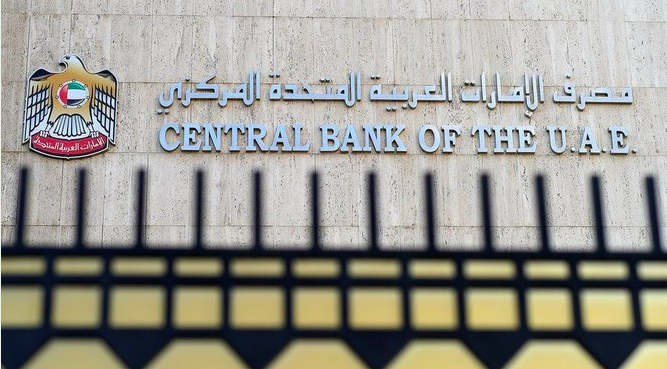
UAE In-Focus — Central Bank of the UAE records surge in foreign assets in April, surpassing $156.2bn 

The Central Bank of the UAE expects the country’s GDP to grow by 3.3 percent in 2023 (File/Getty)
Short Url
Updated 26 September 2024
Follow

UAE In-Focus — Central Bank of the UAE records surge in foreign assets in April, surpassing $156.2bn 

RIYADH: Foreign assets of the Central Bank of the UAE surpassed 574 billion dirhams ($156.2 billion) in April 2023 for the first time in its history, according to data released by the institution on Tuesday. 

The CBUAE’s foreign assets increased 27 percent to 574.18 billion dirhams in April, compared to 452.18 billion dirhams in the same month last year. 

It also recorded a monthly increase of 6.85 percent against the 537.39 billion dirhams achieved in March. 

According to the CBUAE, current account balances and deposits with banks abroad reached 366.5 billion dirhams in April, a monthly increase of 7.8 percent.

These current account balances and deposits were up 19 percent compared to 264.1 billion dirhams in April 2022. 

Furthermore, the CBUAE’s balance sheet grew by 6.3 percent on a monthly basis to reach 631.63 billion dirhams at the end of April 2023, marking the largest level ever.

The CBUAE said its balance sheet also increased year on year by 24 percent against 509.81 billion dirhams at the end of April 2022. 

Reflecting the strong fundamentals in the country, the bank expected the real gross domestic product of the UAE to expand by 4.3 percent in 2024, with the non-oil sector growing by 4.6 percent and the oil sector by about 3.5 percent. 

The CBUAE also said that the country’s economy continued to grow at a robust pace during the first quarter of this year, supported by the strong performance of the non-oil sector. 

It expects the UAE’s GDP to grow by 3.3 percent in 2023. 

Abu Dhabi’s TAQA plans to acquire water company for $463m   

Abu Dhabi National Energy Co., also known as TAQA, announced its plans to buy Sustainable Water Solutions Holding Co. for 1.7 billion dirhams on Wednesday.   

SWS Holding, a newly established company announced in May, took ownership of Abu Dhabi Sustainable Water Solutions Co., the entity behind wastewater collection, treatment and reuse in the emirate.   

TAQA said in a bourse filing that the transaction would generate significant synergies, creating value for its shareholders.   

ADSWS has a network of sewer pipelines extending to over 12,000 km and has a sewage treatment capacity of approximately 1.3 million cubic meters per day through its 37 treatment plants. 

In addition, it holds a 60 percent stake in two companies that own four plants in the emirate. 

CYVN Holdings to invest $740m in China’s Nio 

CYVN Holdings, a firm backed by the Abu Dhabi government, will invest about $738.5 million in Nio, the Chinese electric vehicle maker said on Tuesday. 

Nio and peers Xpeng and Li Auto are competing to grab a larger EV share in the world’s largest automotive market dominated by fellow Chinese firm BYD.  

Under the deal, Nio will issue about 85 million new Class A shares priced at $8.72 each to CYVN Holdings.   

The news sent Nio’s US-listed shares down about 1 percent to $9.30.   

CYVN has also entered into a deal with an affiliate of Tencent Holdings, under which it will pick up some shares of Nio.   

Upon closing both deals, CYVN will own a 7 percent stake in Nio, the EV maker said, adding that the holding will entitle the investment firm to nominate one director to Nio’s board.   

Nio said it would pursue global business opportunities jointly with CYVN following the closing of the investment deal. 

(With input from Reuters) 


‘The future is renewables,’ Indian energy minister tells World Economic Forum

Updated 22 January 2026
Follow

‘The future is renewables,’ Indian energy minister tells World Economic Forum

  • ‘In India, I can very confidently say, affordability (of renewables) is better than fossil fuel energy,’ says Pralhad Venkatesh Joshi during panel discussion
  • Renewables are an increasingly important part of the energy mix and the technology is evolving rapidly, another expert says at session titled ‘Unstoppable March of Renewables?’

BEIRUT: “The future is renewables,” India’s minister of new and renewable energy told the World Economic Forum in Davos on Wednesday.
“In India, I can very confidently say, affordability (of renewables) is better than fossil fuel energy,” Pralhad Venkatesh Joshi said during a panel discussion titled “Unstoppable March of Renewables?”
The cost of solar power has has fallen steeply in recent years compared with fossil fuels, Joshi said, adding: “The unstoppable march of renewables is perfectly right, and the future is renewables.”
Indian authorities have launched a major initiative to install rooftop solar panels on 10 million homes, he said. As a result, people are not only saving money on their electricity bills, “they are also selling (electricity) and earning money.”
He said that this represents a “success story” in India in terms of affordability and “that is what we planned.”
He acknowledged that more work needs to be done to improve reliability and consistency of supplies, and plans were being made to address this, including improved storage.
The other panelists in the discussion, which was moderated by Godfrey Mutizwa, the chief editor of CNBC Africa, included Marco Arcelli, CEO of ACWA Power; Catherine MacGregor, CEO of electricity company ENGIE Group; and Pan Jian, co-chair of lithium-ion battery manufacturer Contemporary Amperex Technology.
Asked by the moderator whether she believes “renewables are unstoppable,” MacGregor said: “Yes. I think some of the numbers that we are now facing are just proof points in terms of their magnitude.
“In 2024, I think it was 600 gigawatts that were installed across the globe … in Europe, close to 50 percent of the energy was produced from renewables in 2024. That has tripled since 2004.”
Renewables are an increasingly important and prominent part of the energy mix, she added, and the technology is evolving rapidly.
“It’s not small projects; it’s the magnitude of projects that strikes me the most, the scale-up that we are able to deliver,” MacGregor said.
“We are just starting construction in the UAE, for example. In terms of solar size it’s 1.5 gigawatts, just pure solar technology. So when I see in the Middle East a round-the-clock project with just solar and battery, it’s coming within reach.
“The technology advance, the cost, the competitiveness, the size, the R&D, the technology behind it and the pace is very impressive, which makes me, indeed, really say (renewables) is real. It plays a key role in, obviously, the energy demand that we see growing in most of the countries.
“You know, we talk a lot about energy transition, but for a lot of regions now it is more about energy additions. And renewables are indeed the fastest to come to market, and also in terms of scale are really impressive.”
Mutizwa asked Pan: “Are we there yet, in terms of beginning to declare mission accomplished? Are renewables here to stay?”
“I think we are on the road but (its is) very promising,” Pan replied. There is “great potential for future growth,” he added, and “the technology is ready, despite the fact that there are still a lot of challenges to overcome … it is all engineering questions. And from our perspective, we have been putting in a lot of resources and we are confident all these engineering challenges will be tackled along the way.”
Responding to the same question, Arcelli said: “Yes, I think we are beyond there on power, but on other sectors we are way behind … I would argue today that the technology you install by default is renewables.
“Is it a universal truth nowadays that renewables are the cheapest?” asked Mutizwa.
“It’s the cheapest everywhere,” Arcelli said.