

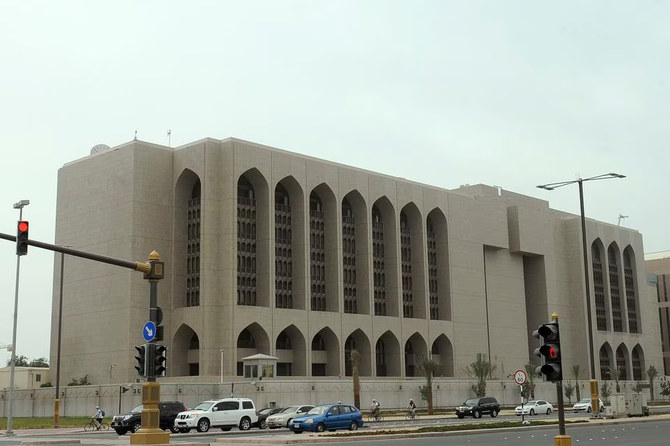
UAE In-Focus — Islamic banks’ assets rise to $177bn in Q1

According to the Central Bank of the UAE, there was increase in Islamic banks’ credit to 400.2 billion dirhams at the end of March 2023, an annual growth of 2.51 percent compared to nearly 390.4 billion dirhams in the year-ago period. (Reuters)
Short Url
Updated 21 June 2023
Follow

UAE In-Focus — Islamic banks’ assets rise to $177bn in Q1

RIYADH: Gross assets of Islamic banks operating in the UAE grew 7.31 percent to 650 billion dirhams ($177 billion) by the end of the first quarter of 2023 compared to 605.7 billion dirhams in the same period last year, according to the latest figures of the apex bank.

The Central Bank of the UAE’s data also reflected an increase in Islamic banks’ credit to 400.2 billion dirhams at the end of March 2023, an annual growth of 2.51 percent compared to nearly 390.4 billion dirhams in the year-ago period.

The banks registered a 0.91 percent month-over-month rise in credit from 396.6 billion dirhams in February.  

The Islamic banks’ deposits increased to 453.4 billion dirhams in March 2023, a year-over-year increase of 6.2 percent, from nearly 427 billion dirhams in March 2022.  

Meanwhile, the total assets of UAE-based conventional banks reached 3.11 trillion dirhams, up 14.1 percent from 2.73 trillion dirhams in March 2022. 

These banks account for 82.7 percent of the total assets of the UAE’s banking sector by the end of March 2023, or 3.76 trillion dirhams, while Islamic lenders held the remaining 17.3 percent.  

DIFC’s AI and Web3.0 campus to attract 500 startups  

In a bid to attract more than 500 startups by 2028, the Dubai International Financial Centre will build a campus to harness artificial intelligence and Web 3.0 technologies. 

Dubai AI & Web 3.0 Campus will be the largest cluster of AI and tech companies in the Middle East and North Africa region.  

According to DIFC Gov. Essa Kazim, the new initiative will attract $300 million in collective funds, more than 500 global AI and Web 3.0 startups, and create over 3,000 jobs by 2028.  

The dedicated campus spanning over 100,000 sq. feet will be set up in the DIFC premises for entrepreneurs, disruptors and engineers with a deep passion for emerging technologies.  

Arif Amiri, CEO of DIFC Authority, said: “Dubai AI & Web 3.0 Campus will act as a catalyst for growth by attracting global innovators, startups, venture capitalists, and industry leaders as we establish MENA’s largest ecosystem for the AI and Web 3.0 sectors.”  

flydubai network to fly 4.5m passengers this summer  

Preparing for another record-breaking summer, flydubai expects over 4.5 million passengers to travel across its network between June 1 and Sept. 30, 2023.  

Ghaith Al-Ghaith, CEO of flydubai, said: “More than 4.5 million passengers are expected to travel across the flydubai network over the next few months, which reflects the increasing demand for travel, passengers’ confidence in our services and the attractiveness of Dubai’s offering as well as our growing network.”  

Hamad Obaidalla, chief commercial officer at flydubai, added: “flydubai’s seasonal summer routes, alongside its growing network, will enable more people to travel whether for a holiday, business or visiting friends and family. We have added 33 percent more capacity across our markets and look forward to welcoming passengers on board for the Eid holiday and busy summer period.”  

The carrier, which allows passengers to travel to 117 destinations across 52 countries, will start operating to nine summer destinations from June 21.


First EU–Saudi roundtable on critical raw materials reflects shared policy commitment

Updated 16 January 2026
Follow

First EU–Saudi roundtable on critical raw materials reflects shared policy commitment

RIYADH: The EU–Saudi Arabia Business and Investment Dialogue on Advancing Critical Raw Materials Value Chains, held in Riyadh as part of the Future Minerals Forum, brought together senior policymakers, industry leaders, and investors to advance strategic cooperation across critical raw materials value chains.

Organized under a Team Europe approach by the EU–GCC Cooperation on Green Transition Project, in coordination with the EU Delegation to Saudi Arabia, the European Chamber of Commerce in the Kingdom and in close cooperation with FMF, the dialogue provided a high-level platform to explore European actions under the EU Critical Raw Materials Act and ResourceEU alongside the Kingdom’s aspirations for minerals, industrial, and investment priorities.

This is in line with Saudi Vision 2030 and broader regional ambitions across the GCC, MENA, and Africa.

ResourceEU is the EU’s new strategic action plan, launched in late 2025, to secure a reliable supply of critical raw materials like lithium, rare earths, and cobalt, reducing dependency on single suppliers, such as China, by boosting domestic extraction, processing, recycling, stockpiling, and strategic partnerships with resource-rich nations.

The first ever EU–Saudi roundtable on critical raw materials was opened by the bloc’s Ambassador to the Kingdom, Christophe Farnaud, together with Saudi Deputy Minister for Mining Development Turki Al-Babtain, turning policy alignment into concrete cooperation.

Farnaud underlined the central role of international cooperation in the implementation of the EU’s critical raw materials policy framework.

“As the European Union advances the implementation of its Critical Raw Materials policy, international cooperation is indispensable to building secure, diversified, and sustainable value chains. Saudi Arabia is a key partner in this effort. This dialogue reflects our shared commitment to translate policy alignment into concrete business and investment cooperation that supports the green and digital transitions,” said the ambassador.

Discussions focused on strengthening resilient, diversified, and responsible CRM supply chains that are essential to the green and digital transitions.

Participants explored concrete opportunities for EU–Saudi cooperation across the full value chain, including exploration, mining, and processing and refining, as well as recycling, downstream manufacturing, and the mobilization of private investment and sustainable finance, underpinned by high environmental, social, and governance standards.

From the Saudi side, the dialogue was framed as a key contribution to the Kingdom’s industrial transformation and long-term economic diversification agenda under Vision 2030, with a strong focus on responsible resource development and global market integration.

“Developing globally competitive mineral hubs and sustainable value chains is a central pillar of Saudi Vision 2030 and the Kingdom’s industrial transformation. Our engagement with the European Union through this dialogue to strengthen upstream and downstream integration, attract high-quality investment, and advance responsible mining and processing. Enhanced cooperation with the EU, capitalizing on the demand dynamics of the EU Critical Raw Materials Act, will be key to delivering long-term value for both sides,” said Al-Babtain.

Valere Moutarlier, deputy director-general for European industry decarbonization, and directorate-general for the internal market, industry, entrepreneurship and SMEs at European Commission, said the EU Critical Raw Materials Act and ResourceEU provided a clear framework to strengthen Europe’s resilience while deepening its cooperation with international partners.

“Cooperation with Saudi Arabia is essential to advancing secure, sustainable, and diversified critical raw materials value chains. Dialogues such as this play a key role in translating policy ambitions into concrete industrial and investment cooperation,” she added.