New ‘investment facilitation’ council gives Pakistan army formal seat at economic table

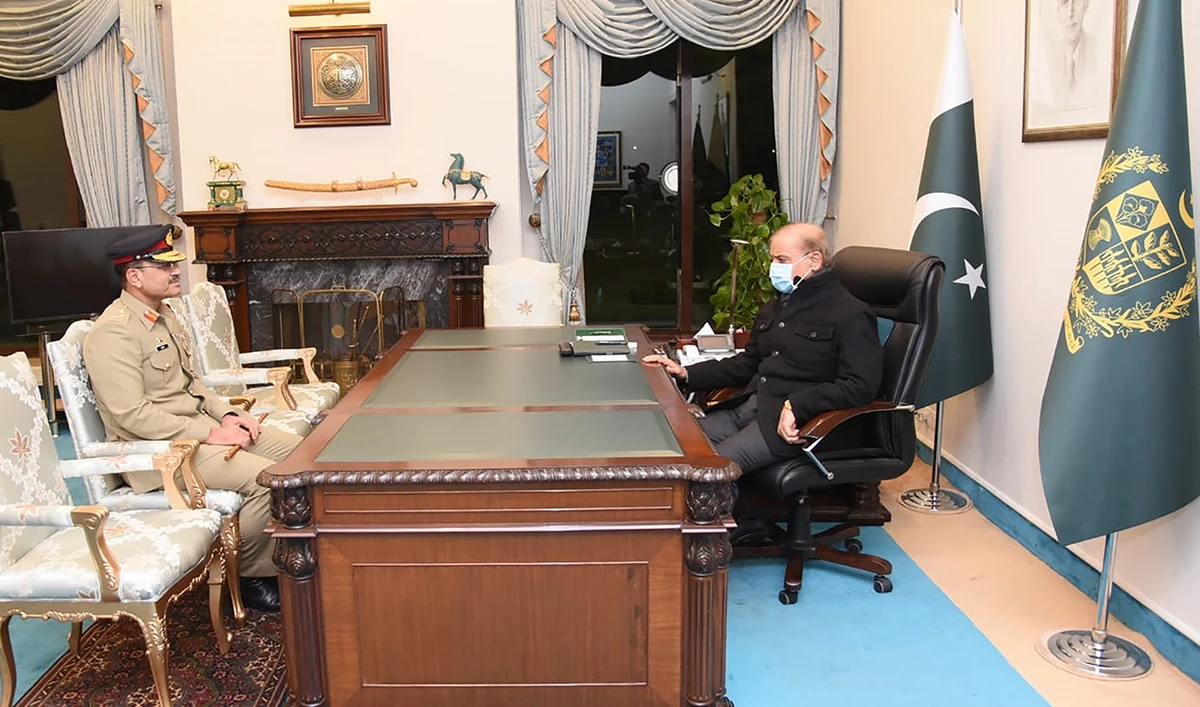
This handout picture taken and released by Pakistan Prime Minister's Office on November 24, 2022, shows Pakistan's Prime Minister Shehbaz Sharif (R) meets with Pakistan's army Chief General Syed Asim Munir (L) at the Prime Minister House in Islamabad. (AFP/File)
Short Url
Updated 21 June 2023
Follow

New ‘investment facilitation’ council gives Pakistan army formal seat at economic table

  • Army will be national coordinator for both apex and executive committees of Special Investment Facilitation Council
  • Army chief will be member of apex committee, army official will be director general of implementation committee 

ISLAMABAD: Pakistan has set up a Special Investment Facilitation Council (SIFC) — of which the army chief will be a member and the military will play a key role — to attract foreign investment, with Prime Minister Shehbaz Sharif saying on Wednesday the body reflected a “unified approach” to steer the country out of economic crisis.

The South Asian country faces its worst economic crisis to date, with months of delay in securing funding from the International Monetary Fund (IMF). Pakistan, which is also in political turmoil, has been caught up for months in an acute balance of payments crisis, with its central bank’s foreign exchange reserves dipping to as low as to cover hardly a month of controlled imports. Inflation is at an all-time high.

“Employing a whole-of-the-the-government approach, the coalition government has decided to set up a Special Investment Facilitation Council (SIFC) with a mandate to frame economic policies that ensure policy predictability, continuity & effective implementation to revive the economy,” Sharif said on Twitter.

The military will have a significant role in the new body, with the army chief being a member of its apex committee and the army itself serving as the national coordinator for both the apex and executive committees. An army official will also be the director general of the body’s implementation committee.

A notification dated June 17 from the Prime Minister’s Office said SIFC was being set up after a meeting on June 2 to discuss attracting investments in energy, IT, minerals, defense and agriculture from GCC countries.

“Attracting investment from friendly countries remains one of the key goals of the SIFC. The immediate task is to increase FDI to $5 billion,” Sharif said, adding that “collective wisdom” was needed to tackle economic challenges.

At a meeting at the Prime Minister’s Office on SIFC on Tuesday, Army Chief Asim Munir “assured Pakistan Army’s all out support to complement Government’s efforts for Economic Revival Plan, considered fundamental to socio-economic prosperity of Pakistanis and reclaiming Pakistan’s rightful stature among the comity of nations.”

The establishment of the SIFC and the inclusion of the military in ley roles is a throwback to June 2019 when then Prime Minister Imran Khan set up a high-powered National Development Council (NDC) of which then powerful army chief, General Qamar Javed Bajwa, was a member. It was the first time the army had been given a formal seat at the economic table.


Pakistan PM invites UAE investment across tech and resource sectors at National Day event

Updated 08 December 2025
Follow

Pakistan PM invites UAE investment across tech and resource sectors at National Day event

  • Shehbaz Sharif says the UAE remains a key economic partner and continues to lend ‘critical support’ to Pakistan
  • UAE envoy says both nations have potential for cooperation in renewable energy, AI and economic diversification

ISLAMABAD: Pakistan is ready to welcome investment from the United Arab Emirates across emerging technologies and resource sectors, Prime Minister Shehbaz Sharif said on Monday, as both countries marked the 54th National Day of the Gulf country in Islamabad.

Speaking at the ceremony attended by senior ministers, diplomats and business leaders, Sharif said the UAE remained a key economic partner for Pakistan and continued to lend “critical support” to the country’s stabilizing economy.

“Pakistan takes great pride in its strategic partnership with the UAE, which continues to deepen across every domain of life,” he said. “With Pakistan’s economy stabilizing, we stand ready to welcome Emirati investment in renewable energy, AI, fintech, agriculture and minerals.”

Sharif praised the UAE’s leadership and recalled his earliest memories of the Gulf nation as “a land that believed in possibilities long before they became realities,” saying the country’s progress under President Sheikh Mohamed bin Zayed Al Nahyan commanded “profound admiration.”

UAE Ambassador Salem Al Bawab Al Zaabi said the Emirates was committed to strengthening ties with Pakistan in areas including the economy, energy and artificial intelligence.

He said the two countries shared a “deep-rooted friendship built on mutual respect, shared values and a common vision for regional peace and development.”

“We see tremendous potential for collaboration in renewable energy, artificial intelligence, sustainability and economic diversification,” the ambassador said, adding that the UAE aimed to broaden the scope of its economic relations with Pakistan.

The UAE hosts around 1.8 million Pakistani expatriates, one of the country’s largest overseas communities, who Sharif said contributed “tirelessly” to the Gulf state’s development.

Sharif and Deputy Prime Minister Ishaq Dar also joined the UAE ambassador in a cake-cutting ceremony to mark the occasion.