

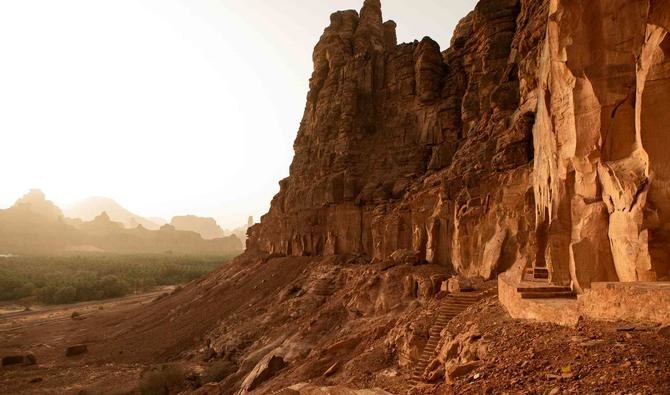

PARIS: If there is an exemplary model of cooperation between two countries, it is the Franco-Saudi cooperation for the development and enhancement of the archaeological site of AlUla in northeastern Saudi Arabia.
Born out of a bilateral agreement signed in April 2018 at the Élysée Palace, the project is led by the Royal Commission for AlUla (RCU) and the French Agency for the Development of AlUla (AFALULA), united with the goal of promoting Saudi culture and history.
The French agency and the royal commission have been working hand in hand to make this site a model of economic and tourist development.
Often described as an open-air museum, with an area equal to that of Belgium, AlUla is on its way to becoming a renowned destination appreciated by tourists from around the world.
Even before the scheduled completion of the development works in 2035, AlUla is already attracting a large number of visitors, eager to explore breathtaking landscapes and unparalleled richness.
The archaeological discoveries provide no respite for the 120 archaeologists and experts actively engaged in missions deployed in AlUla and Khaybar, which constitute the largest archaeological hub in the Arabian Peninsula, as stated by Ingrid Périssé, Director of Archaeology and Research, interviewed by Arab News en franҫais.
It is a true "heritage gem," she asserts, that experts from around the world are busy studying.
The year 2022 was marked by numerous archaeological discoveries, including walls found in the old town of AlUla dating back at least to the 15th century. "Extraordinary discoveries have also been made in Dadan, including a new colossal statue that was stabilized by French restorers and then transported from the site to the AlUla museum. Additionally, the discovery of a small funerary sanctuary with its offerings, statuettes, and libation tables in situ, which will be exhibited in the next stage of the traveling exhibition 'Wonders of Arabia' created at the IMA in 2019. We are currently working with the royal commission on the next stage, which will be Beijing at the end of this year."
In 2022, and specifically last September, as highlighted by Ingrid Périssé, another colossal statue from the sanctuary of Dadan joined the exhibition halls of the Louvre Museum as part of a renewable five-year loan.
"It is the first time that Saudi Arabia has loaned an artwork to a third country, and it is a major work," according to the archaeologist, who believes that this sandstone statue "puts AlUla and Saudi Arabia back on the map of great civilizations exhibited in the world's largest museum."
For 2023, she declares, "we have the first research projects reaching completion, but some of them are extended in agreement with the Royal Commission because the results they have yielded are truly extraordinary and open up new perspectives."
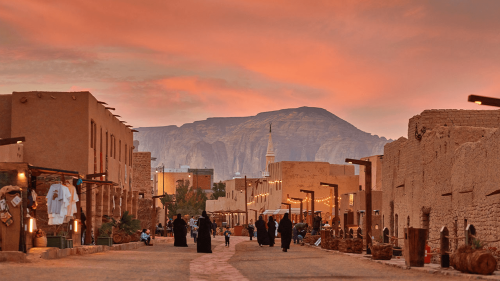
The old town as it is today. (Photo AFALULA/RCU)
AlUla, already a confirmed tourist destination
Among them is the prospecting mission of the AlUla oasis, which has allowed for the redrawing of the map of this palm grove throughout the ages and constitutes the world's first exploration of this kind.
"We are developing new research projects with the Royal Commission, particularly on Khaybar during the Islamic era, as well as the prehistory of the entire AlUla region, and Hégra, which will open a new chapter in its exploration."
"All the researchers involved understand the privilege of being part of such a project supported by the authorities of both countries," enthusiastically confides Ingrid Périssé, adding that "AlUla is already at this stage a confirmed tourist destination, where visitors come with the desire to learn about Dadanite society and who the Nabateans were."
For Mathias Curnier, Chief of Staff of Gérard Mestrallet, Executive Chairman of the French agency and Director of Communication, "AlUla has always been the flagship project within the framework of Crown Prince Mohammed bin Salman's Vision 2030, concerning the country's tourist and cultural attractiveness."
According to him, this is due to the archaeological richness of AlUla and the wealth of its history, which highlights the incredible pre-Islamic history of Arabia.
Mathias Curnier asserts that we must "applaud the speed with which this territory has gained recognition in the Middle East and around the world," indicating that the ambition "by 2030/2035 is to reach around two million tourists with a strong focus on sustainable development."
250 contracts for a total amount of 1.6 billion euros.
That's why it will remain a "niche" tourism, but intentionally so, because AlUla is first and foremost "an immense archaeological and historical site that needs to be preserved, and this factor is taken into account in the entire urban planning and architectural strategy implemented by the Royal Commission."
This choice is actually an imperative "to ensure that this gem remains intact," supports Mathias Curnier.
The population of AlUla is currently around fifty thousand inhabitants, but this number is expected to triple to reach one hundred and fifty thousand inhabitants by 2030 due to development.

The colossal statue of Dadan in the spring of 2022. (Photo AFALULA/RCU)
The valley attracts new residents, but the most important aspect, according to Mathias Curnier, is "the settlement of the people of AlUla, who no longer feel the need to settle in other regions of the country and thus actively contribute to the development of the territory."
Regarding the economic aspect, he emphasizes that "our cooperation with the Royal Commission also aims to attract French expertise in all fields," including architecture, museums, botany, hospitality, horse industry, infrastructure, and smart cities.
There are currently numerous sectors involved, says Mathias Curnier: "AFALULA has finalized the signing of two hundred and fifty contracts, totaling 1.6 billion euros," which is quite remarkable.
"Just ten days ago, the Royal Commission signed a contract with Bouygues Construction for the construction of the iconic hotel designed by architect Jean Nouvel in the Shaaran Reserve, a fully troglodyte hotel, as well as a convention center."
According to him, for all the French companies involved, AlUla is "a launch pad since the success they achieve on-site becomes a reference throughout the kingdom and the region."
He expresses confidence "1000%" that the valorization missions in all fields will be completed by the scheduled date in 2035, and this is "mainly due to the incredible structuring of the Vision 2030, which permeates the entire Kingdom."
As for the Saudi part, AlUla will host two million tourists per year by 2035, create over 38 thousand jobs, and contribute 120 billion Saudi riyals to the kingdom's GDP.


