‘Heads will roll’: Pakistani PM orders high-level inquiry into Greek boat tragedy

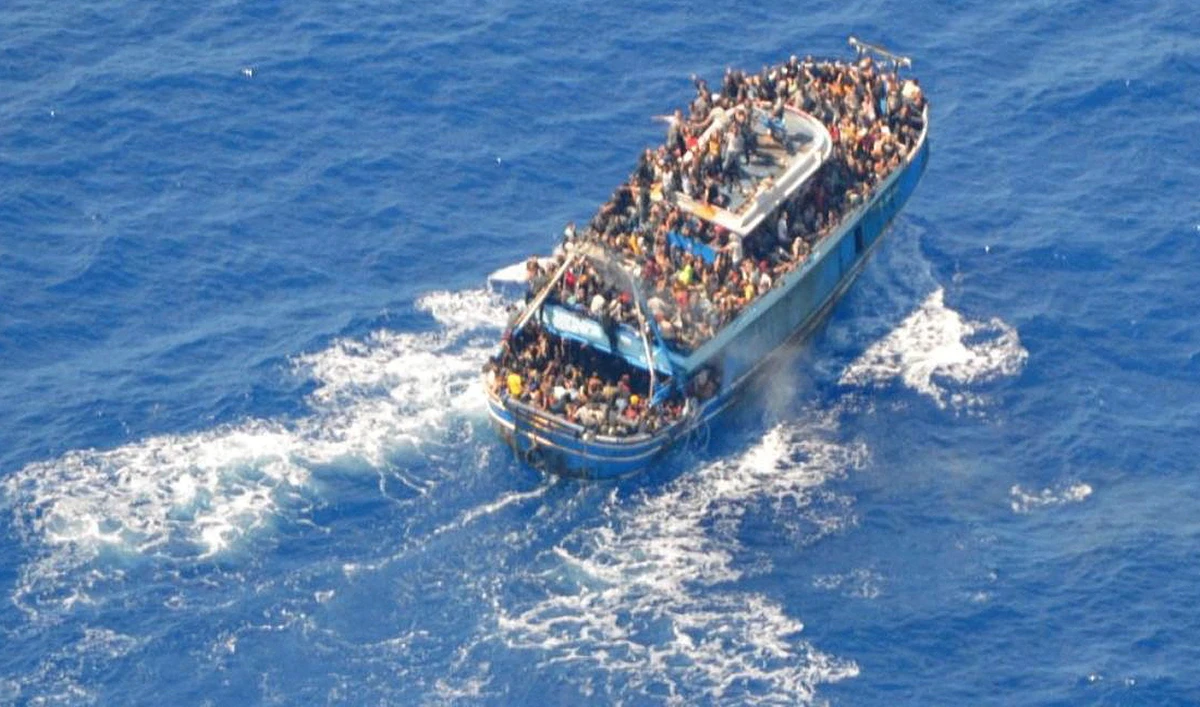
A undated handout photo provided by the Hellenic Coast Guard shows migrants onboard a boat during a rescue operation, before their boat capsized on the open sea, off Greece, June 14, 2023. (Photo courtesy: Hellenic Coast Guard via REUTERS)
Short Url
Updated 18 June 2023
Follow

‘Heads will roll’: Pakistani PM orders high-level inquiry into Greek boat tragedy

  • Local, international media reports say hundreds of Pakistanis may have died in Wednesday’s shipwreck off a coast in Greece
  • PM says officials found to be negligent would face action, orders foreign office to collect information on missing persons

ISLAMABAD: Prime Minister Shehbaz Sharif on Sunday announced a “high-level inquiry” into a tragic shipwreck off the coast of Greece last week in which several Pakistanis— and other migrants— are feared to be dead, promising that responsibility would be fixed and “heads will roll.”

Pakistani officials have said multiple raids have been conducted and 10 alleged human smugglers have been arrested following Wednesday’s devastating shipwreck that took place in Greece’s Peloponnese peninsula. As per Greek authorities, 400-750 migrants were on board the ship. Nearly 80 people were found dead while 104 have been rescued so far.

Each year, thousands of Pakistanis reportedly attempt to flee economic hardships in the South Asian country and illegally enter Europe via migrant boats. Sharif has called for all those involved in the incident to be “severely punished.”

“In order to ascertain facts in the wake of the tragic incident of the capsizing of the boat in the Mediterranean Sea off the coast of Greece, I have ordered a high-level inquiry,” Sharif wrote on Twitter.

The Pakistani premier said he has directed the foreign office to undertake “immediate coordination at all levels” to collect information about the missing persons. Sharif said those found negligent toward their duty would face action.

“Responsibility will be fixed after the inquiry and heads will roll,” Sharif wrote.

Earlier, a statement from the Prime Minister’s Office (PMO) announced Pakistan would observe a “Day of Mourning” on Monday during which the national flag would fly at half-mast, in solidarity with Pakistanis who drowned in the shipwreck.

The PMO also said Sharif had formed a four-member inquiry committee to probe the incident and provide recommendations to ensure similar incidents do not happen in the future.

Reeling from macroeconomic crises due to political turmoil and poor management of the country’s resources over the years, tens of thousands of Pakistanis are forced to leave the country — legally and illegally.

Young men, primarily from eastern Punjab and northwestern Khyber Pakhtunkhwa province, often use a route through Iran, Libya, Turkiye, and Greece to unlawfully enter Europe.

World Bank approves $400 million to expand water, sanitation services in Pakistan’s Punjab

Updated 12 December 2025
Follow

World Bank approves $400 million to expand water, sanitation services in Pakistan’s Punjab

  • Project aims to improve access for 4.5 million people and curb waterborne diseases
  • Program to prioritize women’s participation and climate-resilient urban infrastructure

ISLAMABAD: The World Bank this week approved $400 million for a new project to expand access to safe water, sanitation and hygiene services for around 4.5 million people in Pakistan’s most populous Punjab province, aiming to curb waterborne diseases and reduce long-term public health costs.

The project, known as the Punjab Inclusive Cities Program (PICP), is the second phase of the World Bank-supported Pakistan Urban Water, Sanitation and Hygiene Services Multiphase Programmatic Approach. It will focus on rehabilitating water supply networks, sewerage systems and wastewater treatment plants, while expanding stormwater drainage infrastructure across 16 secondary cities in Punjab.

Punjab faces persistent challenges in providing safe drinking water and adequate sanitation, with many urban households relying on contaminated sources. Weak infrastructure and limited hygiene services contribute to high rates of waterborne diseases such as diarrhea, typhoid and hepatitis, which disproportionately affect children and low-income communities.

“Reducing child stunting is essential for Pakistan’s future. Through the Punjab Inclusive Cities Program, we are investing in safe water, sanitation, and hygiene services to break the cycle of malnutrition and disease that holds back so many children from reaching their full potential,” the World Bank quoted its Country Director for Pakistan, Bolormaa Amgaabazar, as saying in a statement.

“In collaboration with the Punjab Government, the program represents a significant step forward in improving urban infrastructure and strengthening local institutions, thereby laying the foundation for healthier communities and a more prosperous Pakistan.”

Child stunting, a form of chronic malnutrition that leaves children too short for their age, is often linked to repeated infections, poor sanitation and unsafe drinking water, and remains a major public health concern in Pakistan.

Beyond water and sanitation, the project will also support solid waste management systems to improve sanitary waste disposal, extending services to an additional two million people in Punjab’s urban areas. The program will strengthen the capacity of local governments, including efforts to improve revenue generation and long-term service sustainability.

“The program complements infrastructure investments with capacity building and revenue generation, helping to ensure that service delivery is well sustained,” the statement quoted Amena Raja, Senior Urban Specialist at the World Bank, as saying.

“It will also help Punjab’s cities better withstand floods and droughts, ensuring urban development is both environmentally responsible and resilient to climate change.”

The program includes a gender-focused component, prioritizing the hiring of women in decision-making roles, establishing gender-compliant service desks and supporting skills development. It also aims to mobilize private capital to support water and sanitation services in Punjab’s secondary cities.

Pakistan has been a member of the World Bank since 1950 and has received more than $48 billion in assistance since. The Bank’s current portfolio in the country comprises 54 projects with total commitments of $15.7 billion, while its private-sector arm, the International Finance Corporation, has invested about $13 billion since 1956.

Earlier this year, Pakistan and the World Bank signed a first-of-its-kind agreement for a plan to focus $20 billion in lending to the cash-strapped nation over the coming decade on development issues like the impact of climate change as well as boosting private-sector growth.