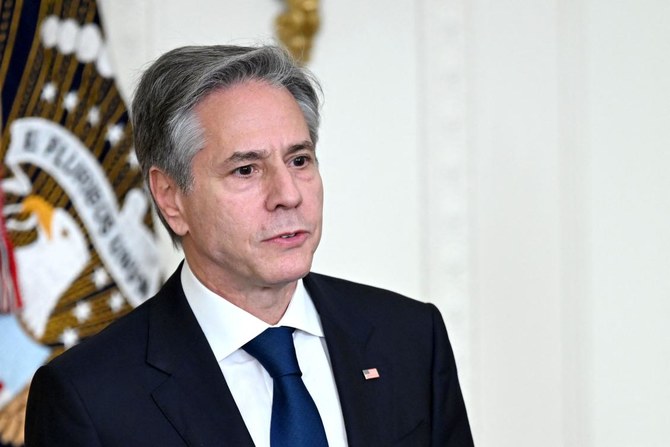
BEIJING: US Secretary of State Antony Blinken has embarked on a high-stakes diplomatic trip to China to try to cool down escalating tensions between the two powers that have set many around the world on edge.
Blinken will be the highest-level American official to visit China since President Joe Biden took office, and the first secretary of state to make the trip in five years.
Yet prospects for any significant breakthrough on the most vexing issues facing the planet’s two largest economies are slim, as already ties have grown increasingly fraught in recent years. Animosity and recriminations have steadily escalated over a series of disagreements that have implications for global security and stability.
Blinken arrives in Beijing on Sunday for two days of talks. He expects to meet with Qin on Sunday, Wang, and possibly Chinese President Xi Jinping on Monday, according to US officials.
Biden and Chinese President Xi Jinping agreed to Blinken’s trip early at a meeting last year in Bali. It came within a day of happening in February but was delayed by the diplomatic and political tumult brought on by the discovery of what the US says was a Chinese spy balloon flying across the United States that was shot down.
The list of disagreements and potential conflict points is long: ranging from trade with Taiwan, human rights conditions in China to Hong Kong, as well as the Chinese military assertiveness in the South China Sea to Russia’s war in Ukraine.
US officials said before Blinken’s departure from Washington on Friday that he would raise each of them, though neither side has shown any inclination to back down on their positions.
Shortly before leaving, Blinken emphasized the importance of the US and China establishing and maintaining better lines of communication. The US wants to make sure “that the competition we have with China doesn’t veer into conflict” due to avoidable misunderstandings, he told reporters.
Biden and Xi had made commitments to improve communications “precisely so that we can make sure we are communicating as clearly as possible to avoid possible misunderstandings and miscommunications,” Blinken said Friday.
Xi offered a hint of a possible willingness to reduce tensions, saying Friday that the United States and China can cooperate to “benefit our two countries” in a meeting with Microsoft Corp. co-founder Bill Gates.
“I believe that the foundation of Sino-US relations lies in the people,” Xi said to Gates. “Under the current world situation, we can carry out various activities that benefit our two countries, the people of our countries, and the entire human race.”
Since the cancelation of Blinken’s trip in February, there have been some high-level engagements. CIA chief William Burns traveled to China in May, while China’s commerce minister traveled to the US And Biden’s national security adviser Jake Sullivan met with China’s top diplomat Wang Yi in Vienna in May.
But those have been punctuated by bursts of angry rhetoric from both sides over the Taiwan Strait, their broader intentions in the Indo-Pacific, China’s refusal to condemn Russia for its war against Ukraine, and US allegations from Washington that Beijing is attempting to boost its worldwide surveillance capabilities, including in Cuba.
And, earlier this month, China’s defense minister rebuffed a request from US Defense Secretary Lloyd Austin for a meeting on the sidelines of a security symposium in Singapore, a sign of continuing discontent.
Austin said Friday he was confident that he and his Chinese counterpart would meet “at some point in time, but we’re not there yet.”
Underscoring the situation, China rejected a report by a US security firm, that blamed Chinese-linked hackers for attacks on hundreds of public agencies, schools and other targets around the world, as “far-fetched and unprofessional”
A Chinese foreign ministry spokesperson repeated accusations that Washington carries out hacking attacks and complained the cybersecurity industry rarely reports on them.
That followed a similar retort earlier in the week when China said Foreign Minister Qin Gang had in a phone call with Blinken urged the United States to respect “China’s core concerns” such as the issue of Taiwan’s self-rule, and “stop interfering in China’s internal affairs, and stop harming China’s sovereignty, security and development interests in the name of competition.”
Meanwhile, the national security advisers of the United States, Japan and the Philippines held their first joint talks Friday and agreed to strengthen their defense cooperation, in part to counter China’s growing influence and ambitions.
This coincides with the Biden administration inking an agreement with Australia and Britain to provide the first with nuclear-powered submarines, with China moving rapidly to expand its diplomatic presence, especially in the Indian Ocean and the Pacific Island nations, where it has opened or has plans to open at least five new embassies over the next year.
The agreement is part of an 18-month-old nuclear partnership given the acronym AUKUS — for Australia, the United Kingdom and the United States.
Speaking before Blinken’s departure, two US officials downplayed hopes for major progress and stressed that the trip was intended to restore a sense of calm and normalcy to high-level contacts.
“We’re coming to Beijing with a realistic, confident approach and a sincere desire to manage our competition in the most responsible way possible,” said Daniel Kritenbrink, the top US diplomat for East Asia and the Pacific.
Kurt Campbell, the top Asia expert at the National Security Council, said “intense competition requires intense diplomacy if we’re going to manage tensions. That is the only way to clear up misperceptions, to signal, to communicate, and to work together where and when our interests align.”


![]()

Blinken set for high-stakes China visit with tensions rising and breakthrough prospects low
Short Url
https://arab.news/nc4s7
Blinken set for high-stakes China visit with tensions rising and breakthrough prospects low
- Animosity and recriminations have steadily escalated over a series of disagreements that have implications for global security and stability
- Blinken arrives in Beijing on Sunday, expects to meet with Qin on Sunday, Wang, and possibly Chinese President Xi Jinping on Monday


Latest updates


© 2026 SAUDI RESEARCH & PUBLISHING COMPANY, All Rights Reserved And subject to Terms of Use Agreement.