

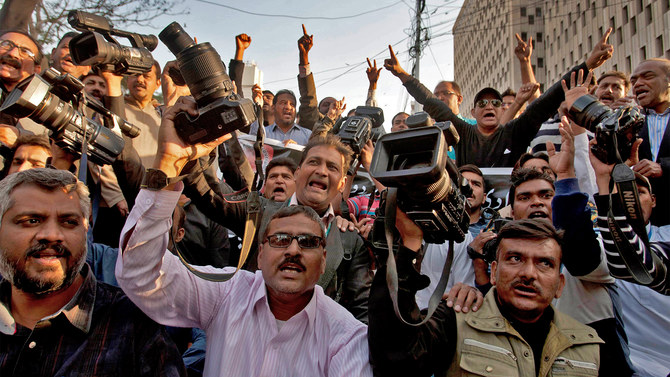

ISLAMABAD: An international rights organization has said it is “extremely concerned” about a crackdown on voices critical of the Pakistani state and military while urging the relevant authorities not to use legal provisions enacted to deal with militants and other anti-state elements to quell dissenting voices.
The statement by Amnesty International in the United Kingdom was issued after the Pakistani authorities booked two journalists on charges of sedition and terrorism for their alleged involvement in the violent protests that erupted in different parts of the country following the arrest of ex-PM Imran Khan on May 9.
Khan’s supporters vandalized state-owned buildings, torched military installations, and burned the house of a top army general in Lahore to demand the release of their leader. While Khan was released on bail shortly after detention, Prime Minister Shehbaz Sharif vowed strict legal action against the perpetrators of violence and the military announced that those involved in attacks on its properties would be tried under the Pakistan Army Act.
The government said last month it had arrested more than 5,000 arsonists as well as their abettors, including Khan’s top aides, in connection to the May 9 mayhem, adding that 33 individuals would be tried in a military court.
“Amnesty International is extremely concerned with the crackdown on voices critical of the state and military,” the body said in a Twitter post on Thursday.
“At least seven journalists and commentators have been charged with offenses against the state and anti-terror laws in the past four days. The use of these laws to silence commentators and journalists is a violation of the right to freedom of expression.”
The organization cited media reports and said that prominent journalists and pro-PTI social media commentators, including Shaheen Sehbai, Wajahat Saeed Khan, Syed Haider Raza Mehdi, Sabir Shakir, Moeed Pirzada and Adil Raja had been charged with offenses against the state and anti-terror laws.
“The Anti-Terrorism Act has been criticized for the sweeping powers given to the police and armed forces, to abuse human rights with impunity, and removes safeguards against arbitrary arrest, detention, and ill-treatment,” it said.
“Pakistani authorities must end the use of offenses against the state and anti-terror laws to silence critics,” it added. “In the event there is sufficient evidence of wrongdoing, suspects should be charged under ordinary criminal laws, with an internationally recognizable offense not weaponized to restrict the freedom of expression, and produced before a civilian court.”
International rights advocacy groups Human Rights Watch (HRW), global media watchdog Reporters Without Borders (RSF), and the US government have also urged Pakistan to end the crackdown and “respect democratic principles” in dealing with dissenting voices.
“We continue, as we have in the past, to urge Pakistani authorities to respect democratic principles and the rule of law for all people as enshrined in the country’s constitution,” US State Department Spokesperson Mathew Miller told reporters in Washington on Tuesday.



