

Pakistan, Oman navies discuss maritime security, ink agreement to share shipping data

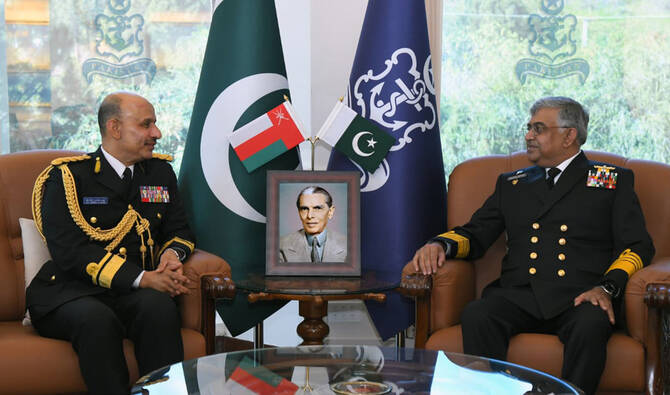
Pakistan Naval Chief Admiral Naveed Ashraf (right) in conversation with Oman Royal Navy Commander Rear Admiral Saif Bin Nasser Bin Mohsin Al Rahbi at Naval Headquarters in Islamabad on December 24, 2025. (DG PR Pakistan Navy)
Short Url
Updated 24 December 2025
Follow

Pakistan, Oman navies discuss maritime security, ink agreement to share shipping data

  • Visiting Oman royal navy commander calls on Pakistan Naval Chief Admiral Naveed Ashraf in Islamabad
  • White shipping agreement refers to exchange of prior information on movement of commercial ships

ISLAMABAD: The naval commanders of Pakistan and Oman discussed regional maritime security on Wednesday and signed an agreement to share shipping information with each other, the Pakistan Navy said in a statement.

The press release followed a meeting between Pakistan Naval Chief Admiral Naveed Ashraf and the visiting Oman Royal Navy Commander Rear Admiral Saif Bin Nasser Bin Mohsin Al Rahbi at Naval Headquarters in Islamabad.

Both navies maintain close professional relations, reflected in expert-level staff talks, joint training, bilateral exercises, and participation in multilateral exercises between the Pakistan Navy and the Royal Navy of Oman.

“During the meeting, matters of mutual interest, regional maritime security and bilateral naval cooperation were discussed,” the Pakistan Navy said.

The MoU was signed by both sides at a ceremony at the Naval Headquarters, the navy’s media wing confirmed. 

“The MoU is aimed at establishing of guidelines and procedures for information sharing in order to enhance mutual awareness of white shipping,” the Pakistan Navy said in a statement. 

White shipping agreement refers to the exchange of prior information on the movement and identity of commercial non-military merchant vessels.

Information regarding the identity of vessels helps countries tackle potential threats from sea routes. This particularly helps in the development of a proper regional maritime domain awareness

The statement said Al Rahbi lauded Pakistan Navy’s professionalism and acknowledged its ongoing contributions to maritime security and regional stability.

Pakistan and Oman share geographical proximity and common maritime boundaries. Bilateral relations between the two brotherly countries span a wide range of areas, including economic cooperation, people-to-people contacts and strong defense ties.

In December, a Royal Navy flotilla from Oman visited Karachi to take part in the annual bilateral Thamar Al Tayyib (TAT) 2025 exercise. 

Pakistan Navy and the Royal Navy of Oman have been conducting the TAT series of exercises regularly since 1980.


Opposition protests over Imran Khan’s eye treatment as government offers specialist care

Updated 5 sec ago
Follow

Opposition protests over Imran Khan’s eye treatment as government offers specialist care

  • Opposition alliance says protest in front of parliament to continue until Khan is admitted to Shifa Hospital
  • Government says the ex-premier’s medical report will be compiled again amid judicial oversight of the case

ISLAMABAD: Pakistan’s opposition alliance staged a sit-in outside Parliament House on Friday demanding that jailed former prime minister Imran Khan be shifted to a private hospital for treatment of his worsening eye condition, as the government promised the best possible treatment and said the case was under judicial oversight.

Police locked the gates of parliament and cordoned off surrounding roads, preventing protesters from gathering in front of the building, witnesses and opposition leaders said. Security was also tightened around Khyber Pakhtunkhwa (KP) House, where officials and lawmakers from Khyber Pakhtunkhwa were stopped from approaching parliament.

The province is governed by Khan’s Pakistan Tehreek-e-Insaf (PTI) party which is in the opposition at the center.

“We have staged a sit-in for the earliest medical check-up of Imran Khan, which would take just ten minutes,” Mehmood Khan Achakzai, Leader of the Opposition in the National Assembly and head of the opposition Tehreek-e-Tahafuz-e-Ayeen-e-Pakistan alliance, told reporters at Parliament House.

“If it is conducted, we will end our protest,” he added.

In a post on X, the alliance said its leadership would continue the sit-in “until Imran Khan is admitted to Al-Shifa Hospital.”

A group of protesters, led by Khyber Pakhtunkhwa Chief Minister Sohail Afridi, also camped outside the KP House in the federal capital after an initial scuffle with police.

During the clash KP government spokesperson Shafi Jan was arrested but later released as more protesters gathered outside the facility.

Jan warned that if PTI activists were prevented from joining the main protest, they “will give a call for a countrywide strike.”

“We want to proceed toward Parliament to join the protest,” he added. “We want the Supreme Court’s verdict to be implemented that Imran Khan be shifted to Shifa Hospital, treated there and then brought back.”

The protest follows a rare prison visit earlier this month by Barrister Salman Safdar, appointed as amicus curiae by the Supreme Court to assess Khan’s health and living conditions at Rawalpindi’s Adiala jail. Safdar submitted a detailed report that was made public on Thursday.

The report said that in view of the seriousness of Khan’s ocular condition, “it is imperative that the seriousness of the condition be independently ascertained without delay.”

Safdar also recommended that the court consider involving Khan’s personal physicians or other specialists of his choice, warning that “any further delay poses a serious risk to the Petitioner’s well-being.”

According to a Feb. 6 medical report from the Pakistan Institute of Medical Sciences (PIMS) cited in Safdar’s filing, Khan was diagnosed with “right central retinal vein occlusion” after reporting reduced vision in his right eye. He underwent an intravitreal injection at PIMS and was discharged with follow-up advice.

In his interaction with Safdar, Khan said he had suffered “rapid and substantial loss of vision over the preceding three months” and claimed his complaints had not been addressed promptly in custody. He further said he had been left with “only 15 percent vision in his right eye.”

Safdar’s report noted that the 73-year-old former premier appeared “visibly perturbed and deeply distressed” over the loss of vision, though it also recorded that he expressed satisfaction with his safety, basic amenities and food provisions in prison.

Responding to the controversy, Parliamentary Affairs Minister Tariq Fazal Chaudhry rejected PTI’s claims that Khan had been suffering from an eye issue since October last year.

Speaking to reporters in Islamabad, he said Khan was visited by his sister on Dec. 2 but she did not mention the medical issue.

“Medical report will be compiled again, the chief justice of the Supreme Court is himself monitoring this case,” he said. “Wherever it will be requested, Imran Khan’s eye will be examined at.”

Chaudhry vowed there would be no negligence.

Information Minister Attaullah Tarar earlier rejected claims of mistreatment, saying the “narrative being propagated to international media” by Khan’s family had “fallen flat on its face,” and that prison records showed he enjoyed facilities “more than any other prisoner.”

Khan has been in custody since August 2023 in connection with multiple cases that he and his party describe as politically motivated. The government denies the allegation.

Concerns over his health resurfaced after authorities confirmed he had briefly been taken from prison to a hospital in Islamabad for an eye procedure. While the government said his condition was stable, Khan’s family and PTI leaders alleged they were not informed in advance and that he was being denied timely and independent medical access.