

UAE, Kazakhstan sign deal to boost trade ties 

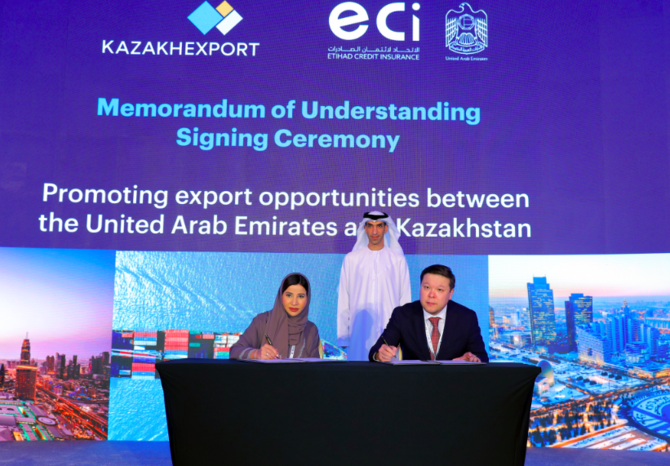
The MoU was signed by ECI CEO Raja Al-Mazrouei and KazakhExport chairman Aslan Kaligazin at the 13th annual Aman Union General Meeting in Dubai (WAM)
Short Url
Updated 14 June 2023
Follow

UAE, Kazakhstan sign deal to boost trade ties 

RIYADH: Exporters from the UAE and Kazakhstan will have better access to Shariah-compliant insurance and trade credit after both countries signed an agreement to protect companies from potential commercial risks in international dealings.

The UAE export credit company Etihad Credit Insurance signed a memorandum of understanding with Kazakhstan’s export insurance firm KazakhExport to enhance trade and support sustainable economic growth between the two countries.

Under the terms of the agreement, both parties will organize workshops aimed at educating small and medium-sized enterprises on the gains of using trade protection solutions to mitigate the risks of nonpayment resulting from several commercial and geopolitical factors.

The MoU falls in line with the “We the UAE 2031” vision which aims to further strengthen bilateral economic relations between both countries, according to a statement.

The two sides are also expected to form a task force to explore more opportunities for cooperation, with a special focus on seven strategic areas including insurance, trade promotion, programs for supporting SMEs, among others.

The MoU was signed by ECI CEO Raja Al-Mazrouei and KazakhExport chairman Aslan Kaligazin at the 13th annual Aman Union General Meeting in Dubai.

“By entering into this agreement with KazakhExport, we are strengthening our dedication to enhancing the global competitiveness of businesses within the UAE and Kazakhstan,” Al-Mazrouei said,

“This vital partnership directly aligns with ECI’s mission to boost non-oil exports, simultaneously extending comprehensive protection to SMEs, thereby enriching the UAE’s economic diversification,” the CEO added.

He went on to say that as ECI amplifies the global footprint of SMEs, it also seeks to bolster the UAE’s economic aspirations.

“Ultimately, this agreement not only fortifies our commitment to enhancing economic and trade relationships with Kazakhstan but also paves the way for sustainable economic growth, reflecting our mutual objectives,” Al-Mazrouei said.

The agreement bolsters the UAE’s constant efforts to position itself as a global hub for trade and finance as well as to elevate its role as an attractive market for global firms.

In January, UAE-based port developer and regulator AD Ports Group also signed deals with Kazakhstan’s national oil company and government to develop shipping fleets and facilities on the Caspian and Black Seas to aid growing exports.


Growing pressure on Arab banks amid complex cross-border contracts, legal risks 

Updated 7 sec ago
Follow

Growing pressure on Arab banks amid complex cross-border contracts, legal risks 

DAMMAM: Arab banks — numbering around 520 this year — are facing mounting challenges, led by the growing complexity of cross-border banking contracts and rising legal risks tied to modern financial products, Wissam Fattouh, secretary-general of the Union of Arab Banks, told Al-Eqtisadiah. 

Fattouh said addressing these challenges, driven by global economic and financial shifts, requires Arab banks — whose combined assets exceed $5.5 trillion — to strengthen risk management, continue structural reforms, and expand cooperation with foreign banks and financial institutions in line with the nature of global financial markets. 

He noted that the “Certified International Arbitrator” credential offered by the UAB to Arab banks is one of the professional tools supporting governance in banking transactions and providing effective, specialized alternatives to traditional litigation, particularly in cross-border disputes. 

Growing complexity of financial products and services 

Fattouh said the certification represents a specialized professional program aimed at preparing qualified banking and legal professionals to handle international commercial and banking disputes, particularly those linked to the financial sector, as financial products and services become more complex, regulations tighten, and global compliance requirements increase. 

In November, the UAB told Al-Eqtisadiah that the assets of 11 Saudi banks included among the 100 largest Arab banks last year, accounted for 24 percent of the total, reaching $1.1 trillion out of $4.5 trillion. 

The top 10 Arab banks were led by Qatar National Bank, followed by First Abu Dhabi Bank, Saudi National Bank, Emirates NBD, Al-Rajhi Bank, Abu Dhabi Commercial Bank, National Bank of Egypt, National Bank of Kuwait, Riyad Bank, and Kuwait Finance House. 

Fattouh said Arab banks have demonstrated a clear ability in recent years to withstand global economic shocks, supported by solid capitalization and liquidity levels, as well as a relative improvement in asset quality, strengthening the sector compared with several other emerging markets. 

Betting on continued development of regulatory frameworks 

Fattouh expects the Arab banking sector to continue playing a pivotal role in financing productive sectors, supporting small and medium-sized enterprises, and contributing to funding the transition toward a green economy, as well as advancing digital transformation across Arab economies. 

He stressed that this role depends on the continued development of regulatory frameworks and stronger risk management, particularly amid rising cyber risks, compliance challenges, and global market volatility. 

He added that digitalization has become essential for improving operational efficiency, noting that the UAB will focus in 2026 on enhancing dialogue between Arab banks and regulators, supporting the development of banking and financial policies, and contributing to regional financial stability. 

He further said that the Union also plans to organize specialized training programs in risk management, compliance, digitalization, and finance.