

IMF, World Bank are key counterweights to China: Yellen 

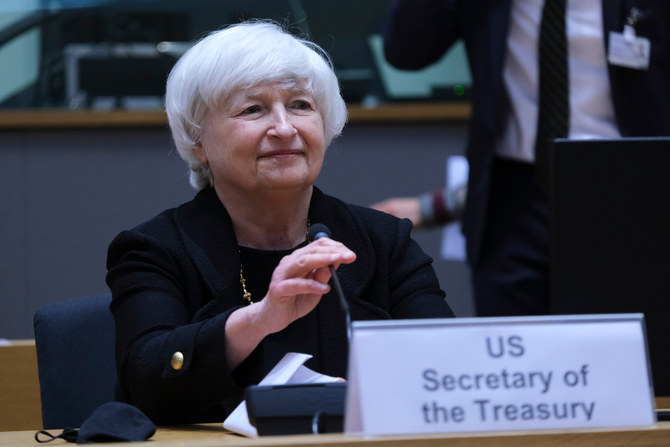
US Treasury Secretary Janet Yellen. (Shutterstock)
Short Url
Updated 14 June 2023
Follow

IMF, World Bank are key counterweights to China: Yellen 

WASHINGTON: US Treasury Secretary Janet Yellen said Tuesday that international financial institutions like the International Monetary Fund and World Bank “reflect American values” and serve as key counterweights to “unsustainable lending from others like China.” 

Speaking before the House Financial Services Committee, she sought congressional support for the US to lend more money to such organizations, going towards helping developing countries. 

“Our leadership at these institutions is one of the core ways of engaging with emerging markets and developing countries,” Yellen told lawmakers. 

Assistance from international financial institutions comes “with strong requirements for governance, accountability, and debt sustainability,” she said. 

“It serves as an important counterweight to non-transparent, unsustainable lending from others like China,” she added. 

Yellen’s comments come at a time of heightened tensions between the world’s two biggest economies, and both are also jostling for influence in the developing world. 

For now, Yellen said US authorities sought permission to continue participating in the IMF’s “New Arrangements to Borrow,” a backstop to the fund’s resources, and also seeks permission to lend up to $21 billion to two IMF funds. 

Yellen also said she did not think China should qualify for the World Bank’s loans, and that Washington would not vote in favor of the bank lending to China. 

Asked about Yellen’s comments that international financial institutions reflect American values, a Chinese foreign ministry spokesman said: “The IMF is not the IMF of the United States, nor is the World Bank for that matter.” 

US authorities have also worked to convince other countries to cease such funding. 

On security issues, Yellen said: “We are looking at potential restrictions on outbound investment, that could pertain to private equity firms that invest in Chinese firms with connections to their military.”  

“We are worried about potential national security risks,” she said. 

But she stressed it is not in America’s interest to stifle the Chinese people’s economic progress.  

“I think we gain in trying to gain from trade and investment that is as open as possible, and it would be disastrous for us to attempt to decouple from China. De-risk, yes. Decouple? Absolutely not,” she said. 


Education spending surges 251% as students return from autumn break: SAMA

Updated 12 December 2025
Follow

Education spending surges 251% as students return from autumn break: SAMA

RIYADH: Education spending in Saudi Arabia surged 251.3 percent in the week ending Dec. 6, reflecting the sharp uptick in purchases as students returned from the autumn break.

According to the latest data from the Saudi Central Bank, expenditure in the sector reached SR218.73 million ($58.2 million), with the number of transactions increasing by 61 percent to 233,000.

Despite this surge, overall point-of-sale spending fell 4.3 percent to SR14.45 billion, while the number of transactions dipped 1.7 percent to 236.18 million week on week.

The week saw mixed changes between the sectors. Spending on freight transport, postal and courier services saw the second-biggest uptick at 33.3 percent to SR60.93 million, followed by medical services, which saw an 8.1 percent increase to SR505.35 million.

Expenditure on apparel and clothing saw a decrease of 16.3 percent, followed by a 2 percent reduction in spending on telecommunication.

Jewelry outlays witnessed an 8.1 percent decline to reach SR325.90 million. Data revealed decreases across many other sectors, led by hotels, which saw the largest dip at 24.5 percent to reach SR335.98 million. 

Spending on car rentals in the Kingdom fell by 12.6 percent, while airlines saw a 3.7 percent increase to SR46.28 million.

Expenditure on food and beverages saw a 1.7 percent increase to SR2.35 billion, claiming the largest share of the POS. Restaurants and cafes retained the second position despite a 12.6 percent dip to SR1.66 billion.

Saudi Arabia’s key urban centers mirrored the national decline. Riyadh, which accounted for the largest share of total POS spending, saw a 3.9 percent dip to SR4.89 billion, down from SR5.08 billion the previous week.

The number of transactions in the capital settled at 74.16 million, down 1.4 percent week on week.

In Jeddah, transaction values decreased by 5.9 percent to SR1.91 billion, while Dammam reported a 0.8 percent surge to SR713.71 million.

POS data, tracked weekly by SAMA, provides an indicator of consumer spending trends and the ongoing growth of digital payments in Saudi Arabia. 

The data also highlights the expanding reach of POS infrastructure, extending beyond major retail hubs to smaller cities and service sectors, supporting broader digital inclusion initiatives. 

The growth of digital payment technologies aligns with the Kingdom’s Vision 2030 objectives, promoting electronic transactions and contributing to the nation’s broader digital economy.