Netherlands, Canada take Syria to World Court over torture claims

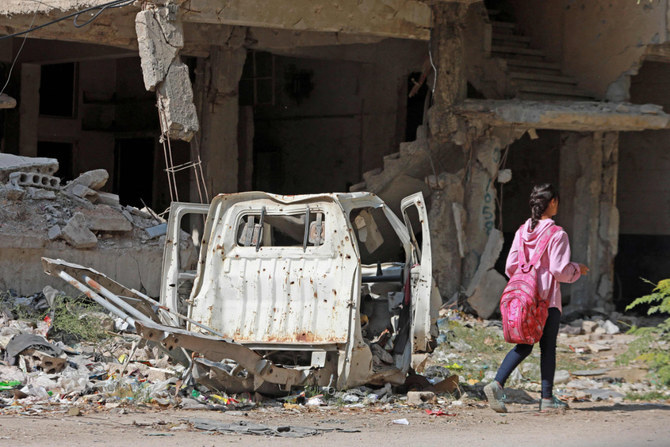
A young girl walks past a damaged vehicle and destroyed building in the southern suburbs of Damascus on Nov. 2, 2022. (AFP/File)
Short Url
Updated 12 June 2023
Follow

Netherlands, Canada take Syria to World Court over torture claims

  • Canada and the Netherlands claim that “Syria has committed countless violations of International law, beginning at least in 2011“
  • They are seeking to hold the government of President Bashar Assad accountable for gross human rights violations and torture under the UN Convention against Torture

AMSTERDAM: The Netherlands and Canada are taking Syria to the World Court over torture claims, the International Court of Justice (ICJ) said on Monday.
In their application, Canada and the Netherlands claim that “Syria has committed countless violations of International law, beginning at least in 2011,” and asked for emergency measures to be taken to protect those at risk of being tortured, the ICJ, also known as the World Court, said in a statement.
They are seeking to hold the government of President Bashar Assad accountable for gross human rights violations and torture under the UN Convention against Torture, which Damascus ratified in 2004.
“It is the Dutch government’s position that there is ample evidence demonstrating that Syria has committed serious human rights violations against Syrian citizens on a grand scale,” the Dutch Foreign Ministry said in a statement.
In their application, Canada and the Netherlands have asked the court to issue emergency orders for Syria to cease all acts of torture and cruel treatment and to end arbitrary detentions, among other things. Usually, the World Court will order emergency hearings to mull such requests within days of receiving a claim.
If it finds it has jurisdiction, the ICJ would be the first international court to be able to make a legal finding on the alleged state use of torture in Syria.
Canada and the Netherlands decided to act in 2020 after Russia blocked multiple efforts in the United Nations Security Council to refer a case on human rights violations in Syria to the International Criminal Court, which prosecutes individuals for war crimes and is also based in The Hague.
So far, there has been one conviction for the use of torture by a former Syrian state official in a landmark trial in Germany in January last year. The German case was filed under the country’s universal jurisdiction laws, allowing its courts to prosecute crimes against humanity committed anywhere.
Cases before the ICJ usually take years to reach a final verdict, but emergency orders can be issued within weeks.
Syria’s 12-year civil has killed hundreds of thousands of people, displaced millions and drawn in regional and world powers. The devastation of the conflict has been compounded by the large-scale destruction caused by earthquakes that hit northwestern Syria in February.


Ceasefire with Kurdish-led force extended for another 15 days, Syrian army says

Updated 25 January 2026
Follow

Ceasefire with Kurdish-led force extended for another 15 days, Syrian army says

  • The defense ministry said the extension was in support of an operation by US forces to transfer accused Daesh militants to Iraq
  • The Kurdish-led Syrian Democratic Forces confirmed the ceasefire extension

RAQQA, Syria: Hours after the expiration of a four-day truce between the Syrian government and Kurdish-led fighters Saturday, Syria’s defense ministry announced the ceasefire had been extended by another 15 days.
The defense ministry said in a statement that the extension was in support of an operation by US forces to transfer accused Daesh militants who had been held in prisons in northeastern Syria to detention centers in Iraq.
The Kurdish-led Syrian Democratic Forces confirmed the ceasefire extension.
“Our forces affirm their commitment to the agreement and their dedication to respecting it, which contributes to de-escalation, the protection of civilians, and the creation of the necessary conditions for stability,” the group said in a statement.
Over the past three weeks, there have been intense clashes between government forces and the SDF, in which the SDF lost large parts of the area they once controlled.
Earlier in the day, the Kurdish-led force called on the international community to prevent any escalation.
The end of the truce came as government forces have been sending reinforcements to Syria’s northeast.
Syria’s interim government signed an agreement last March with the SDF for it to hand over territory and to eventually merge its fighters with government forces. In early January, a new round of talks failed to make progress over the merger, leading to renewed fighting between the two sides.
A new version of the accord was signed last weekend, and a four-day ceasefire was declared Tuesday. Part of the new deal is that SDF members will have to merge into the army and police forces as individuals.
The SDF said in a statement Saturday that military buildups and logistical movements by government forces have been observed, “clearly indicating an intent to escalate and push the region toward a new confrontation.” The SDF said it will continue to abide by the truce.
On Saturday, state TV said authorities on Saturday released 126 boys under the age of 18 who were held at the Al-Aqtan prison near the northern city of Raqqa that was taken by government forces Friday. The teenagers were taken to the city of Raqqa where they were handed over to their families, the TV station said.
The prison is also home to some of the 9,000 members of the Daesh group who are held in northeastern Syria. Most of them remain held in jails run by the SDF. Government forces have so far taken control of two prisons while the rest are still run by the SDF.
Earlier this week, the US military said that some 7,000 Daesh detainees will be transferred to detention centers in neighboring Iraq.
On Wednesday, the US military said that 150 prisoners have been taken to Iraq.