

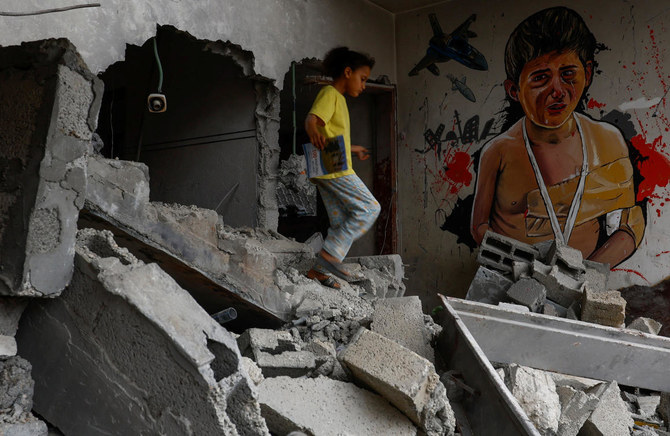
Gaza graffiti artists bedeck houses destroyed by Israel in war

1 / 3
Palestinian girl walks past a graffiti drawn by Palestinian artists on a house destroyed by Israel in Deir Al-Balah in the central Gaza Strip. (Reuters)
2 / 3
Palestinian girl sits on the remains of a destroyed house, next to a graffiti of a missile drawn by Hussein Abu Sadeq, on houses destroyed by Israel in recent Israeli-Gaza fighting. (Reuters)
3 / 3
Palestinian children walk near a graffiti, as artists draw graffiti on houses destroyed by Israel in recent Israeli-Gaza fighting, in Deir Al-Balah, central Gaza Strip. (Reuters)
Short Url
Updated 12 June 2023
Follow

Gaza graffiti artists bedeck houses destroyed by Israel in war

  • Parts of exploded Israeli missiles were placed on tables for display.

GAZA: Graffiti artists in Gaza have painted murals on the remains of houses destroyed in an Israeli missile strike during cross-border fighting in May.
On one wall the artists depicted a woman holding her son. On another a boy is painted with tears in his eyes. A third shows a girl, seen through a mirror, combing her hair.


A painting drawn by artists is seen at a house destroyed by Israel, in recent Israeli-Gaza fighting in central Gaza Strip. (Reuters)


Piles of rubble still encircle the houses in the town of Deir Al-Balah. Parts of exploded Israeli missiles were placed on tables for display.
“Out of suffering, pain, and siege, we derive hope, art, and victory,” said artist Hussein Abu Sadeq. “We drew on the rubble so we can get the message through using a brush and color.”
Gaza, home to 2.3 million people and ruled by the Islamist group Hamas, is blockaded by Israel and Egypt.
In May, Israel launched a campaign against commanders of the Islamic Jihad militant group who it said had planned attacks in Israel. In response, the Iranian-backed group fired more than 1,000 rockets, sending Israelis fleeing into bomb shelters.
Israel killed six senior Islamic Jihad commanders and said it destroyed a number of military installations. Fifteen Palestinian civilians, including women and children, were also killed, according to Palestinian health officials.
In Israel, two people — an Israeli woman and a Palestinian laborer — were killed by Palestinian rocket fire in Israel.
“We collected those remains (of missiles) after the bombardment,” said Mohammad Thuraya, an organizer of an exhibition of the art work on Sunday. “One missile destroyed a neighborhood and destroyed the lives of ten families who used to live here.”


First responders enter devastated Aleppo neighborhood after days of deadly fighting

Updated 10 sec ago
Follow

First responders enter devastated Aleppo neighborhood after days of deadly fighting

  • The US-backed SDF, which have played a key role in combating the Daesh group in large swaths of eastern Syria, are the largest force yet to be absorbed into Syria’s national army

ALEPPO, Syria: First responders on Sunday entered a contested neighborhood in Syria’ s northern city of Aleppo after days of deadly clashes between government forces and Kurdish-led forces. Syrian state media said the military was deployed in large numbers.
The clashes broke out Tuesday in the predominantly Kurdish neighborhoods of Sheikh Maqsoud, Achrafieh and Bani Zaid after the government and the Syrian Democratic Forces, the main Kurdish-led force in the country, failed to make progress on how to merge the SDF into the national army. Security forces captured Achrafieh and Bani Zaid.
The fighting between the two sides was the most intense since the fall of then-President Bashar Assad to insurgents in December 2024. At least 23 people were killed in five days of clashes and more than 140,000 were displaced amid shelling and drone strikes.
The US-backed SDF, which have played a key role in combating the Daesh group in large swaths of eastern Syria, are the largest force yet to be absorbed into Syria’s national army. Some of the factions that make up the army, however, were previously Turkish-backed insurgent groups that have a long history of clashing with Kurdish forces.
The Kurdish fighters have now evacuated from the Sheikh Maqsoud neighborhood to northeastern Syria, which is under the control of the SDF. However, they said in a statement they will continue to fight now that the wounded and civilians have been evacuated, in what they called a “partial ceasefire.”
The neighborhood appeared calm Sunday. The United Nations said it was trying to dispatch more convoys to the neighborhoods with food, fuel, blankets and other urgent supplies.
Government security forces brought journalists to tour the devastated area, showing them the damaged Khalid Al-Fajer Hospital and a military position belonging to the SDF’s security forces that government forces had targeted.
The SDF statement accused the government of targeting the hospital “dozens of times” before patients were evacuated. Damascus accused the Kurdish-led group of using the hospital and other civilian facilities as military positions.
On one street, Syrian Red Crescent first responders spoke to a resident surrounded by charred cars and badly damaged residential buildings.
Some residents told The Associated Press that SDF forces did not allow their cars through checkpoints to leave.
“We lived a night of horror. I still cannot believe that I am right here standing on my own two feet,” said Ahmad Shaikho. “So far the situation has been calm. There hasn’t been any gunfire.”
Syrian Civil Defense first responders have been disarming improvised mines that they say were left by the Kurdish forces as booby traps.
Residents who fled are not being allowed back into the neighborhood until all the mines are cleared. Some were reminded of the displacement during Syria’s long civil war.
“I want to go back to my home, I beg you,” said Hoda Alnasiri.