

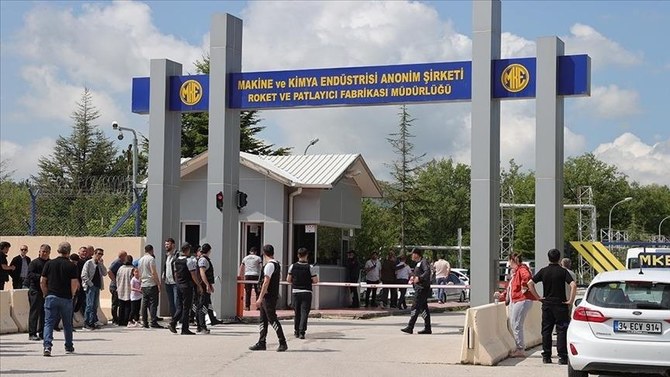
Turkiye investigates fatal explosion at munitions factory which killed 5

1 / 2
Several ambulances and fire trucks were dispatched to area. (Aytuğ Can Sencar/Anadolu Agency)
2 / 2
Several ambulances and fire trucks were dispatched to area. (Aytuğ Can Sencar/Anadolu Agency)
Short Url
Updated 10 June 2023
Follow

Turkiye investigates fatal explosion at munitions factory which killed 5

  • Investigation launched into cause of explosion

ANKARA: Five people were killed in an explosion at a military factory in Ankara’s Elmadag district early on Saturday. 

The bodies of the victims have been recovered and judicial and administrative investigations into the cause of the explosion are underway. Vasip Sahin, the governor of Ankara province, said initial investigations suggest the blast was caused by a chemical reaction. 

According to the Turkish Ministry of Defense, the explosion occurred in the manufacturing unit of the Machinery and Chemical Industry Corporation (MKE), a subsidiary of the ministry. 

Fatal accidents have previously occurred at the factory, which produces rockets and explosives for the defense and interior ministries.

In 2018, Health and Safety Labor Watch (ISIG), a civil watchdog, issued a report about workplace fatalities at the factory after an explosion on May 24 that year left one worker dead and six others injured. The official investigation blamed the explosion on a technical fault, ruling out sabotage. ISIG criticized the factory for not having sufficient workplace security measures in place. 

On May 20, 2013, an explosion at the factory left two workers dead. 

Petrol-Is, Turkiye’s petroleum, chemical and rubber workers union, has long demanded improved working conditions at the same factory. Workers staged a three-day strike in November 2012 to draw the government’s attention to the situation.

In July 2013, Petrol-Is claimed there were serious issues with the factory, that its technological infrastructure had not been modernized, and that more explosions could occur. Work at the factory was temporarily halted at that time so improvements could be made. 


Iraq majority bloc backs Nouri al-Maliki as next PM: statement

Updated 8 sec ago
Follow

Iraq majority bloc backs Nouri al-Maliki as next PM: statement

  • The Coordination Framework said that it “decided, by majority vote, to nominate” Al-Maliki for the position
  • The statement spoke of Al-Maliki’s “political and administrative experience and his record in running the state“

BAGHDAD: Iraq’s main Shiite alliance, which holds a parliamentary majority, endorsed on Saturday former prime minister and powerbroker Nouri Al-Maliki as the country’s next premier.
The Coordination Framework, an alliance of Shiite factions with varying links to Iran, said in a statement that it “decided, by majority vote, to nominate” Al-Maliki for the position “as the candidate of the largest parliamentary bloc.”
The statement spoke of Al-Maliki’s “political and administrative experience and his record in running the state.”
A shrewd politician, Al-Maliki, 75, has long been a central figure in Iraq’s politics and its only two-term prime minister (2006-2014) since the US invasion of 2003, which ended decades of rule by the autocratic Sunni president Saddam Hussein.
Since the invasion and by convention in Iraq, a Shiite Muslim holds the powerful post of prime minister, a Sunni is parliament speaker, and the largely ceremonial presidency goes to a Kurd. After Iraq’s November general election, the Coordination Framework, which includes Al-Maliki, formed the majority bloc.
Soon after, it held heated talks to choose the next prime minister, along with other discussions with Sunni and Kurdish parties regarding other posts.
Iraq’s parliament chose a speaker last month and should convene next to elect a new president, who will then appoint a prime minister to replace the incumbent Mohammed Shia Al-Sudani.
Al-Maliki, leader of the State of Law Coalition, remains influential in Iraqi politics despite his controversial past, including widespread accusations of corruption, stoking sectarian tensions, and failing to stop the Daesh group.