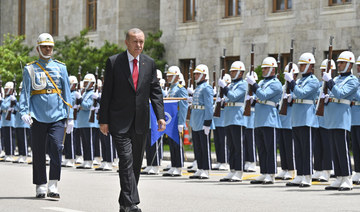

ANKARA: As part of recently re-elected Turkish President Recep Tayyip Erdogan’s attempts to overhaul his economic team, the country’s central bank will be governed by a female executive for the first time.
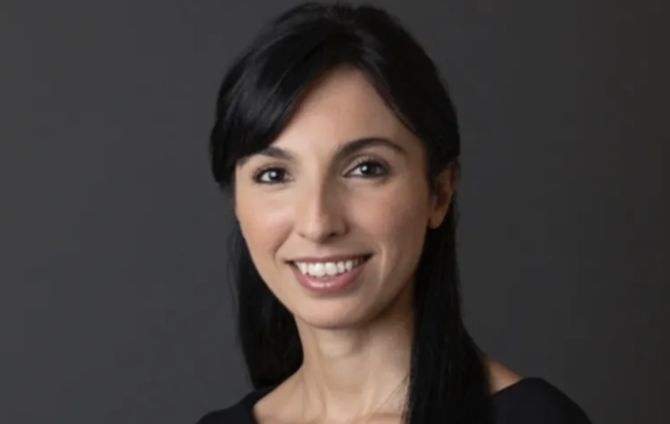
US-based Hafize Gaye Erkan, 41, is Turkiye’s fifth central bank chief in four years, replacing Sahap Kavcioglu, who followed a policy of slashing interest rates despite rising inflation of around 40 percent. Kavcioglu has now been appointed head of the Banking Regulatory and Supervision Agency (BDDK).
Erdogan has always been opposed to interest rate hikes and has focused on economic growth, investment and exports.
Erkan was the first woman under the age of 40 to hold the title of president or CEO at one of America’s 100 largest banks. She has a doctorate in financial engineering from Princeton, and previously worked as First Republic’s co-chief executive officer. She abruptly resigned from that position in December 2021 before the bank was sold. She also worked at Goldman Sachs for almost a decade as a managing director, and was a director at Marsh McLennan. Last year, she was appointed CEO of the real estate finance and investment firm Greystone, a post she resigned in December.
Following her new appointment, there are now 23 female central bank governors around the world.
On Monday, Erkan reportedly met Turkiye’s newly appointed Treasury and Finance Minister, Mehmet Simsek, a former Merrill Lynch economist, in Ankara to discuss her new role.
Simsek told media on Wednesday that Turkiye would now return to economic “rationality” with a “credible program” to address the cost-of-living crisis. However, he also warned there would be “no shortcuts or quick fixes” and asked the public to be patient.
Brad W. Setser, senior fellow at the Washington-based Council on Foreign Relations, recently calculated that, apart from Turkey’s swap and deposit deals with foreign countries including Saudi Arabia, the central bank has only $30 billion in actual foreign reserves.
Economists believe that Erkan’s appointment may indicate that Turkiye will now follow orthodox economic policies, including interest rate hikes.
The new governor’s policy preferences are unclear, however, as she has previously worked only in the private sector. It also remains to be seen how much independence she will be granted, especially with local elections approaching. In March 2021, former central bank governor Naci Agbal was fired after just five months in the job after he decided to raise interest rates.
Erik Meyersson, chief emerging markets strategist at the European financial services group SEB, said the appointment of Erkan “provides valuable synergies” to Simsek’s attempts to shift policy.
“But, at the same time, the experience of Agbal — and the manner in which his efforts to push policy in a similar direction ended prematurely — does hang like a shadow over the current initiative,” he told Arab News. “The continued presence of Kavcioglu — a figurehead of the devastating policy mistakes of recent years — as head of the BDDK does not provide similar synergies and instead could be a sign of a limited commitment on behalf of Erdogan to the new policy direction.”
The retention of Kavcioglu, he added, “risks becoming an unwanted deadweight to what could otherwise have signaled fresh and significant policy momentum.”
According to Meyersson, one interpretation is that the old economic model that caused so much damage is “more dormant than dead” and is a reminder that “arbitrary rule implies arbitrary and often sudden changes.”
Meyersson believes that markets will likely look to test the extent of the new mandate from the presidential palace, and said that front-loaded rate hikes would be a good start.
“The gap between the policy rate and current inflation is minus 30 percent, and given the low credibility ascribed to the central bank, the real policy rate should increase toward positive territory soon. But that amount of policy tightening is unlikely to have been approved by President Erdogan, setting up Turkish financial markets for further volatility during the year,” he said.
The central bank’s monetary policy committee will have its first meeting under the new governor on June 22, and an increase in interest rates is expected.
Ehsan Khoman, head of emerging markets, ESG and commodities research at MUFG Bank in Dubai, said Erkan’s appointment, coupled with Simsek’s pledges to restore credibility, was a clear signal of a return toward rules-based monetary policymaking to re-anchor inflation expectations.
“Our base case is for a supersized rates hike from 8.5 percent to 20 percent on 22 June — with a likely pre-meeting statement to prepare markets for the start of the hiking cycle — to reach levels that imply positive real rates by year-end,” he told Arab News.
Critically, given Turkey’s past experience with relatively short-lived U-turns in policy regarding interest rates, Khoman said that (gaining) credibility will require patience, though these latest market-friendly appointments should rule out risks related to reliance on less-orthodox measures, including stricter regulations on foreign exchange transactions, to sustain acutely negative real rates.
Wolfango Piccoli, co-president of London-based Teneo Intelligence, thinks that “an outright and fast pivot toward a conventional policy set, especially in terms of monetary policy, remains unlikely.”
He told Arab News: “Erkan’s appointment seems designed to regain credibility in the eyes of foreign investors. But how she will adapt to Ankara’s working culture, where obedience matters, remains to be seen. Also, Erkan has no formal monetary policy experience.
“The appointments are important, but the next crucial step should be the decisions,” he continued.
He also noted that a shift towards orthodox economic policy requires the support of the banking regulator, which is now headed by a loyalist, suggesting a likely return to previous economic policies.
“Turkey’s domestic banks — private and state-owned — are under close political scrutiny and command,” he said.