

Pakistan’s finance minister criticizes IMF’s treatment of his country, calls it ‘totally unfair’

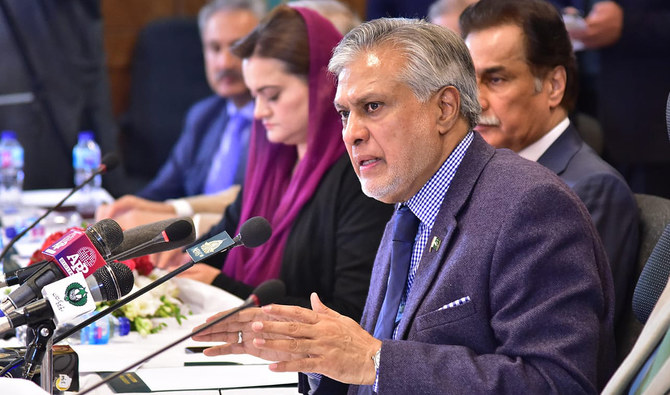
Pakistan finance minister Ishaq Dar gestures during a press briefing in Islamabad on January 4, 2023. (Photo courtesy: @FinMinistryPak/Twitter)
Short Url
Updated 09 June 2023
Follow

Pakistan’s finance minister criticizes IMF’s treatment of his country, calls it ‘totally unfair’

  • Ishaq Dar mentions geopolitics, asks global institutions like the IMF ‘not to corner Pakistan’
  • Finance minister says IMF was one of the main contributors to Pakistan’s economic turmoil

ISLAMABAD: Pakistan’s finance minister Ishaq Dar on Friday said the International Monetary Fund’s decision to delay the bailout program for the country was “totally unfair,” adding the global lender had also contributed to the economic turmoil in his country.

Dar presented the federal budget for the next fiscal year earlier in the day with a total outlay of Rs14.46 trillion ($50.4 billion). Prior to that, the government was holding negotiations with the IMF to unlock a stalled loan program which it desperately needed to shore up foreign currency reserves.

As the finance minister unveiled the country’s fiscal plan, analysts widely said the government’s tax collection targets were “unrealistic” while expressing fear that the international lending agency would not accept the budget.

Speaking to a local news channel, however, Dar said the IMF had no reason to object to the new budget since the numbers presented on Friday were “better than what the government had sent it during this week.” He added the “undue delay” by the IMF in signing the staff-level agreement with Pakistan had pushed the country toward economic turmoil.

“The IMF is one of the main contributors to the economic turmoil in Pakistan along with political instability,” he told Geo News. “This is geopolitics. I can’t say much on camera, but the ninth review [of the $6.5 billion loan program] should have been completed by February. Its delay was totally unfair treatment toward Pakistan.”

The minister maintained global institutions like the IMF should “not corner Pakistan.”

Asked if the lender was not releasing the funds due to trust issues it had developed with the country, he said that he blamed the policies of the previous, Imran Khan-led, government for sabotaging the deal with the IMF.

“The trust eroded because of the previous government’s antics,” he continued. “The previous regime made a sovereign commitment in 2019-20, but it failed to implement it. Whatever little [decisions] they implemented were also reversed. That’s what led the IMF to deal with us in this way.”

Prime Minister Shehbaz Sharif said earlier today Pakistan had not only accepted all conditions laid forth by the global lender but also implemented the prior actions that it required from the country.

“Still, the staff-level agreement has not been signed,” he said in a speech made before the cabinet ahead of the budget announcement. “Now, the matter will go to the IMF board for review.”

“We must hope that, as we have fulfilled all the conditions, the IMF ninth review will be completed this month after seeking approval from the lender’s board.”

Sharif added he had recently spoken to the managing director of the international lending agency over the phone and had asked her for “verbal” assurances related to the release of the next tranche.

“I suggested to her that if she provided me with a verbal commitment [regarding the signing of the agreement], we would take a few more steps the lender had asked for. Once we received the verbal commitment from her, we took those steps too, so now, no other [requirements] are left that could turn out to be an impediment in signing this deal.”


Pakistan, China to sign multiple MoUs at major agriculture investment conference today

Updated 18 January 2026
Follow

Pakistan, China to sign multiple MoUs at major agriculture investment conference today

  • Hundreds of Chinese and Pakistani firms to attend Islamabad event
  • Conference seen as part of expanding CPEC ties into agriculture, trade

KARACHI: Islamabad and Beijing are set to sign multiple memorandums of understanding (MoUs) to boost agricultural investment and cooperation at a major conference taking place in the capital today, Monday, with hundreds of Chinese and Pakistani companies expected to participate.

The conference is being billed by Pakistan’s Ministry of National Food Security and Research as a platform for deepening bilateral agricultural ties and supporting broader economic engagement between the two countries.

“Multiple memorandums of understanding will be signed at the Pakistan–China Agricultural Conference,” the Ministry of National Food Security said in a statement. “115 Chinese and 165 Pakistani companies will participate.”

The conference reflects a growing emphasis on expanding Pakistan-China economic cooperation beyond the transport and energy foundations of the flagship China-Pakistan Economic Corridor (CPEC) into agriculture, industry and technology.

Under its first phase launched in 2015, CPEC, a core component of China’s Belt and Road Initiative, focused primarily on transportation infrastructure, energy generation and connectivity projects linking western China to the Arabian Sea via Pakistan. That phase included motorways, power plants and the development of the Gwadar Port in the country's southwest, aimed at helping Pakistan address chronic power shortages and enhance transport connectivity.

In recent years, both governments have formally moved toward a “CPEC 2.0” phase aimed at diversifying the corridor’s impact into areas such as special economic zones, innovation, digital cooperation and agriculture. Second-phase discussions have highlighted Pakistan’s goal of modernizing its agricultural sector, attracting Chinese technology and investment, and boosting export potential, with high-level talks taking place between planning officials and investors in Beijing.

Agri-sector cooperation has also seen practical collaboration, with joint initiatives examining technology transfer, export protocols and value-chain development, including partnerships in livestock, mechanization and horticulture.

Organizers say the Islamabad conference will bring together government policymakers, private sector investors, industry associations and multinational agribusiness firms from both nations. Discussions will center on investment opportunities, technology adoption, export expansion and building linkages with global buyers within the framework of Pakistan-China economic cooperation.