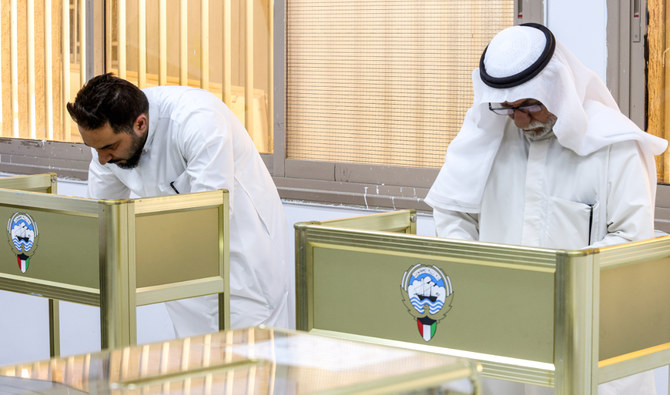

KUWAIT CITY: Opposition lawmakers won a majority in Kuwait’s parliament with only one woman elected, results showed on Wednesday, after the Gulf state’s seventh general election in just over a decade.
The opposition figures include conservatives and independent politicians not tied to the ruling family who are pushing for a raft of reforms.
The vote on Tuesday came after Kuwait’s constitutional court in March annulled the results of last year’s election — in which the opposition made significant gains — and reinstated the previous parliament elected in 2020.
Opposition lawmakers won 29 of the legislature’s 50 seats, according to results published by the official Kuwait News Agency. Only one woman was elected — opposition candidate Janan Bushehri.
The makeup of the new parliament is very similar to the one elected last year and later annulled, with all but 12 of its 50 members retaining their seats.
This has sparked concerns that the legislature may once again find itself locked in disputes with the Cabinet, further deepening a political crisis that has delayed reforms and hampered growth.
“The government has to contend with a more combative parliament than the already combative 2022 version,” said Bader Al-Saif, assistant history professor at Kuwait University. “Therefore, expect bumps in the road unless radical reforms unfold,” he said.
Longtime speaker Marzouq Al-Ghanim and Ahmed Al-Saadoun, who replaced him last year, both return to parliament. Saadoun is expected to run again for the post of speaker.
Parliament’s first session is scheduled to take place on June 20.
“We are celebrating today the (victory of the) reformist approach,” opposition lawmaker Adel Al-Damkhi told reporters after the results were announced.
“The election results are an indication of the awareness of the Kuwaiti people.”
Turnout reached 50 percent one hour before polls closed, according to the Kuwait Transparency Society, a nongovernment group. Last year’s election saw turnout of 63 percent.
Since Kuwait adopted a parliamentary system in 1962, the legislature has been dissolved around a dozen times.
Continual standoffs between the branches of government have prevented lawmakers from passing economic reforms, while repeated budget deficits and low foreign investment have added to an air of gloom.
Bushehri, the new parliament’s sole female member, said she expected it “to seek stability and move ahead on outstanding issues, whether political or economic.”
Kuwait’s Emir Sheikh Nawaf Al-Ahmad Al-Sabah congratulated the incoming deputies and called on them to “carry the responsibility of representing the people and ... realize their aspiration for a better future,” according to KUNA.
Kuwait, which borders Iraq, boasts 7 percent of global crude reserves. It has little debt and one of the strongest sovereign wealth funds in the world.