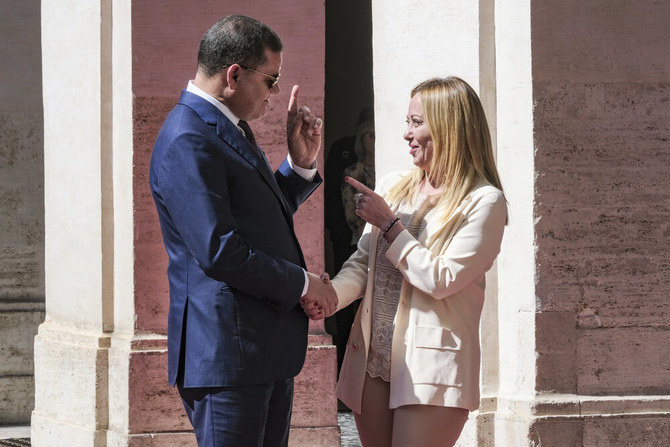
ROME: Italian authorities consider political stability in Libya “a priority for Italy’s national security,” Prime Minister Giorgia Meloni told Abdul Hamid Dbeibah, her counterpart in Libya’s transitional government, on Wednesday.
It came during a lengthy meeting in Rome, during which enhanced joint efforts to tackle illegal migration and cooperation in the fields of energy and waste management were the core issues they discussed, sources said.
Meloni said that Libya “remains a strategic economic partner for Italy.” She also stressed how important it is “to hold Libyan presidential and parliamentary elections as soon as possible,” and added that “Italy will continue to work to guarantee the success of the United Nations mediation.”
Sources in the Italian prime minister’s office told Arab News that Dbeibah was accompanied by the Libyan ministers of foreign affairs, interior, transport and communications.
Other representatives of the Italian government included deputy premiers Antonio Tajani, who is also the foreign minister, and Matteo Salvini, Minister of Business and Made in Italy Adolfo Urso, and Interior Minister Matteo Piantedosi.
Piantedosi and his Libyan counterpart signed a memorandum of understanding for strengthening security cooperation.
On the sidelines of the meeting, an agreement for joint initiatives to reduce greenhouse gas emissions was signed by Claudio De Scalzi, the CEO of Italian energy company ENI, and a representative of the Libya’s National Oil Corporation.
In addition, Telecom Italia Sparkle and the Libyan Post Telecommunications and Information Technology Company signed a memorandum of understanding for an underwater data cable linking the two countries.

Political stability of Libya is a ‘priority for Italy’s national security,’ says Meloni
Short Url
https://arab.news/p2gyt
Political stability of Libya is a ‘priority for Italy’s national security,’ says Meloni
- The comment from the Italian prime minister came during a lengthy meeting with Abdul Hamid Dbeibah, her counterpart in Libya’s transitional government
- Giorgia Meloni said Libya ‘remains a strategic economic partner for Italy’ and stressed the importance of holding presidential and parliamentary elections in Libya ‘as soon as possible’
Rubio warns Iraq on Iran ties as Al-Maliki sets return
WASHINGTON: US Secretary of State Marco Rubio warned Iraq on Sunday against a pro-Iranian government as the expected return of Nouri Al-Maliki as prime minister stirs Washington’s concern.
Maliki, who left power in 2014 following heated pressure from the United States, has been chosen by Iraq’s largest Shiite bloc, which would put him in line to be nominated prime minister.
Rubio, in a telephone call with incumbent Prime Minister Mohammed Shia Al-Sudani, voiced hope the next government will work to make Iraq “a force for stability, prosperity and security in the Middle East.”
“The secretary emphasized that a government controlled by Iran cannot successfully put Iraq’s own interests first, keep Iraq out of regional conflicts or advance the mutually beneficial partnership between the United States and Iraq,” Rubio said, according to State Department spokesman Tommy Pigott.
A pro-Iranian government in Iraq would be a rare boon for Tehran’s clerical state after it suffered major setbacks at home and in the region.
The Islamic republic has killed thousands of Iranians since mass protests erupted in late December.
Since the October 7, 2023 attacks, Israel has hit Iran both with strikes inside the country and heavy blows against Tehran’s Lebanese ally Hezbollah, while Iran lost its main Arab ally with the fall of Bashar Assad in Syria.
An Iraqi political source told AFP that the United States had conveyed that it “holds a negative view of previous governments led by former prime minister Maliki.”
In a letter, US representatives said that while the selection of the prime minister is an Iraqi decision, “the United States will make its own sovereign decisions regarding the next government in line with American interests.”
The United States wields key leverage over Iraq as the country’s oil export revenue is largely held at the Federal Reserve Bank in New York, in an arrangement reached after the 2003 US invasion that toppled Saddam Hussein.
Chief among US demands is that Iraq prevent a resurgence of Shiite armed groups backed by Iran. Sudani, who took office in 2022, has won US confidence through his delicate efforts to curb violence by the groups.
Maliki initially took office in 2006 with support of the United States as he strongly backed US military efforts against Al-Qaeda in Iraq and other Sunni militants.
But the United States eventually soured on Maliki, believing he pushed an excessively sectarian agenda that helped give rise to the Islamic State extremist movement.
Iraq’s parliament meets Tuesday to elect a new president, who holds a largely ceremonial role but will appoint a prime minister.
Maliki, who left power in 2014 following heated pressure from the United States, has been chosen by Iraq’s largest Shiite bloc, which would put him in line to be nominated prime minister.
Rubio, in a telephone call with incumbent Prime Minister Mohammed Shia Al-Sudani, voiced hope the next government will work to make Iraq “a force for stability, prosperity and security in the Middle East.”
“The secretary emphasized that a government controlled by Iran cannot successfully put Iraq’s own interests first, keep Iraq out of regional conflicts or advance the mutually beneficial partnership between the United States and Iraq,” Rubio said, according to State Department spokesman Tommy Pigott.
A pro-Iranian government in Iraq would be a rare boon for Tehran’s clerical state after it suffered major setbacks at home and in the region.
The Islamic republic has killed thousands of Iranians since mass protests erupted in late December.
Since the October 7, 2023 attacks, Israel has hit Iran both with strikes inside the country and heavy blows against Tehran’s Lebanese ally Hezbollah, while Iran lost its main Arab ally with the fall of Bashar Assad in Syria.
An Iraqi political source told AFP that the United States had conveyed that it “holds a negative view of previous governments led by former prime minister Maliki.”
In a letter, US representatives said that while the selection of the prime minister is an Iraqi decision, “the United States will make its own sovereign decisions regarding the next government in line with American interests.”
The United States wields key leverage over Iraq as the country’s oil export revenue is largely held at the Federal Reserve Bank in New York, in an arrangement reached after the 2003 US invasion that toppled Saddam Hussein.
Chief among US demands is that Iraq prevent a resurgence of Shiite armed groups backed by Iran. Sudani, who took office in 2022, has won US confidence through his delicate efforts to curb violence by the groups.
Maliki initially took office in 2006 with support of the United States as he strongly backed US military efforts against Al-Qaeda in Iraq and other Sunni militants.
But the United States eventually soured on Maliki, believing he pushed an excessively sectarian agenda that helped give rise to the Islamic State extremist movement.
Iraq’s parliament meets Tuesday to elect a new president, who holds a largely ceremonial role but will appoint a prime minister.
© 2026 SAUDI RESEARCH & PUBLISHING COMPANY, All Rights Reserved And subject to Terms of Use Agreement.