

Pakistan Hajj flight operation to Madinah ends, flights to Jeddah continue

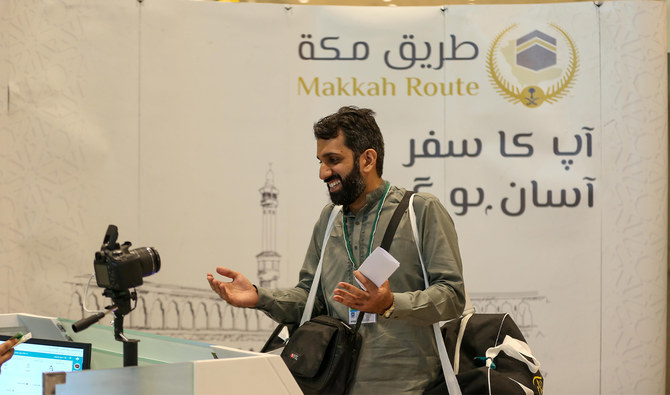
The picture posted on June 7, 2023 shows a Pakistani pilgrim at the immigration counter under Route to Makkah initiative at Islamabad International Airport. (SPA)
Short Url
Updated 07 June 2023
Follow

Pakistan Hajj flight operation to Madinah ends, flights to Jeddah continue

  • Over 46,000 Pakistanis pilgrims have reached Saudi Arabia since May 22
  • 30,000 Pakistani pilgrims are in Makkah while 16,000 are in Madinah

ISLAMABAD: Pakistan’s religious affairs ministry said on Wednesday the country’s Hajj flight operations to Madinah had ended, while flights carrying pilgrims to Jeddah en route to Makkah would continue until June 21. 

Pakistan launched a special flight operation for aspiring Hajjis on May 22. The first group of flights were directed to Madinah, where people performing Hajj under the government scheme spent approximately eight days before traveling onwards to Makkah. Flights to Jeddah started this week.

This January, Saudi Arabia reinstated Pakistan’s pre-pandemic Hajj quota, allowing 179,210 pilgrims from the South Asian country to participate in the annual Islamic religious ritual. The kingdom also removed the upper age limit of 65 years.

Out of Pakistan’s total Hajj quota, approximately 80,000 pilgrims will undertake the spiritual journey through a government scheme, while the remaining are using private tour operators.

“The series of flights from Pakistan to Madinah has ended,” the religious affairs ministry said in a statement released on Wednesday. “All government Hajj flights will now land in Jeddah until June 21.”

“The arrival of private Hajj scheme pilgrims has also begun, with more than 3,000 pilgrims reaching Makkah.” 

So far, over 46,000 Pakistani pilgrims have already arrived in the kingdom, with approximately 30,000 of them in Makkah and 16,000 in Madinah.

On Tuesday, the government announced the establishment of a central control room in Makkah, overseen by its Hajj mission.

“The control room will manage transportation from Jeddah airport to Makkah, as well as other logistics in Makkah and Madinah such as residence management, medical facilities, food, and other necessities,” Muhammad Umer Butt, a ministry spokesperson, told Arab News from Saudi Arabia.

The government has also made other special arrangements, including the establishment of two hospitals and twelve dispensaries in Makkah and Madinah, to ensure the well-being of pilgrims.


Pakistan reviews austerity measures amid Middle East crisis, urges strict nationwide implementation

Updated 11 March 2026
Follow

Pakistan reviews austerity measures amid Middle East crisis, urges strict nationwide implementation

  • Deputy Prime Minister Ishaq Dar chairs review meeting of austerity steps
  • Officials briefed on salary cuts, school closures, four‑day week, petrol conservation

ISLAMABAD: Pakistan’s government on Wednesday assessed progress on a sweeping set of austerity measures introduced to mitigate the country’s economic strain from sharply rising global oil prices and supply disruptions linked to the ongoing war in the Middle East.

Prime Minister Shehbaz Sharif this week announced a series of austerity steps, including a four‑day work week for government offices, requiring 50  percent of staff to work from home, cutting fuel allowances for official vehicles by half, grounding up to 60  percent of the government fleet and closing all schools for two weeks to conserve fuel amid the global oil crisis.

The measures were unveiled in response to global oil market volatility triggered by the conflict involving the United States, Israel and Iran, which has disrupted supply routes such as the Strait of Hormuz and pushed crude prices sharply higher, straining Pakistan’s heavily import‑dependent energy sector.

“The meeting stressed the importance of strict and transparent adherence to the austerity measures, promoting fiscal responsibility and prudent use of public resources,” Deputy Prime Minister and Foreign Minister Senator Mohammad Ishaq Dar said in a statement.

He was chairing a meeting of the Committee for Monitoring and Implementation of Conservation and Additional Austerity Measures, constituted under the directions of the PM, bringing together federal and provincial officials to review execution of the broad cost‑cutting plan. 

Dar emphasized the government’s commitment to enforcing the PM’s austerity steps nationwide. The committee’s review also covered reductions in departmental expenditure, deductions from salaries of senior officials earning over Rs. 300,000 ($1,120), and coordination with provincial administrations to ensure uniform implementation of the plan.

Participants at the meeting reiterated that all ministries and divisions must continue strict monitoring and reporting, with transparent oversight mechanisms, as Pakistan navigates the economic pressures from the prolonged Middle East crisis and its fallout on global energy and trade markets.