

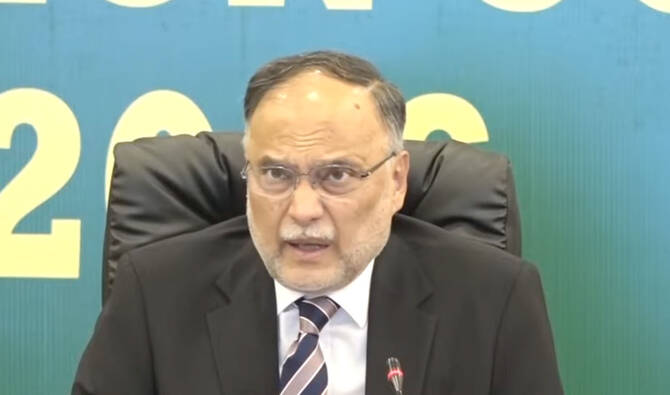

ISLAMABAD: Pakistan has little room to fund new development projects in the upcoming fiscal year, Planning Minister Ahsan Iqbal said on Monday, warning that budget constraints would force the government to reject roughly Rs3 trillion ($10.7 billion) worth of project demands despite the country’s need for greater investment in infrastructure and economic growth.
The comments offer one of the clearest indications yet of the fiscal pressures shaping Pakistan’s federal budget for fiscal year 2026-27, which is expected later this week. While the South Asian nation has made progress in stabilizing its economy under a $7 billion International Monetary Fund (IMF) program after narrowly avoiding a sovereign default in 2023, officials say limited fiscal space continues to constrain public spending.
Pakistan’s Public Sector Development Program (PSDP), the federal government’s main vehicle for funding highways, dams, energy projects, schools, hospitals and other long-term infrastructure, has been allocated Rs1.126 trillion ($4.0 billion) for the next fiscal year.
According to Iqbal, after accounting for existing commitments and financing obligations, only about Rs165 billion ($589 million) remains available within the PSDP. Once a Rs180 billion ($643 million) reduction carried forward from the previous year is factored in, the development budget effectively moves into a deficit position.
“And if out of this 165 billion, you deduct the 180 billion rupees of the cut that has been imposed, then the PSDP goes into a deficit of negative 15 billion rupees,” he said while addressing a meeting of the Annual Plan Coordination Committee, which finalizes development priorities before the federal budget is presented.
“There is hardly anything you can give to any new project.”
Development spending is widely viewed as a key driver of economic growth because it finances infrastructure and public investment that can improve productivity, create jobs and support private-sector activity. However, Pakistan’s development budgets have come under pressure in recent years as the government seeks to reduce fiscal deficits, meet IMF targets and manage rising debt-servicing costs.
Iqbal said ministries had submitted requests for approximately Rs4.097 trillion ($14.6 billion) in development funding, including Rs3.377 trillion ($12.1 billion) required to continue existing projects at their current pace and proposals for new schemes worth about Rs720 billion ($2.6 billion).
He added that ministries had also submitted unapproved project proposals worth another Rs5.5 trillion ($19.6 billion) for possible future consideration.
“Which means that almost, you know, we will have to reject the demands of 3 trillion, we will have to disapprove them, and we have to selectively make an allocation of only 1,126 billion out of 4,000 billion,” he said.
“This is a task which is very unpleasant.”
The planning minister said many of the projects seeking funding were important for the country’s development but could not be accommodated within the available budget.
“This is a very big dilemma of the Ministry of Planning, that we are forced to make our allocations within shrinking development budgets,” he said.
Iqbal said much of the PSDP allocation had already been committed to existing obligations, including Rs125 billion ($446 million) for the N-25 highway in Balochistan, a major road project that the government has designated as a priority. Other allocations include funding for development projects in Balochistan, Azad Jammu and Kashmir, Gilgit-Baltistan and the formerly tribal districts along the Afghan border.
He also said the government must provide local-currency financing for foreign-funded development projects backed by institutions such as the World Bank and Asian Development Bank. Under these arrangements, Pakistan contributes part of the financing in rupees while international lenders provide funding in foreign currencies.
Iqbal noted that after excluding certain allocations, the effective PSDP stood at roughly Rs1 trillion ($3.6 billion), which he said was broadly the same level as in 2018 despite years of inflation, population growth and rising infrastructure needs.
“That there is not much of development, and this is not, I would say, a happy state for any nation because we need to invest more in development,” he said.


