US vice president Kamala Harris: Israel needs ‘independent judiciary’

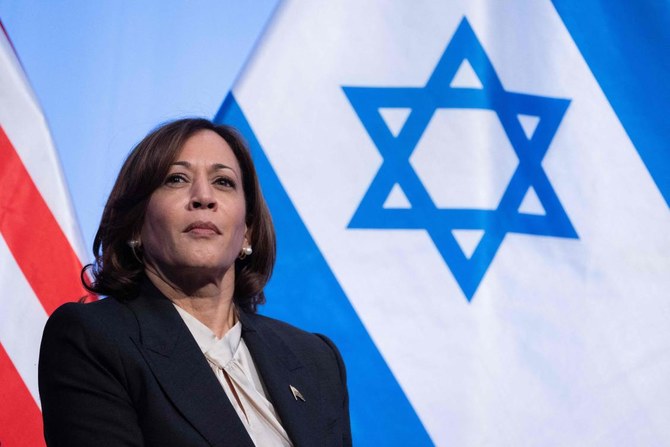
US vice president Kamala Harris said Israel’s democracy requires ‘an independent judiciary’ during a speech celebrating the 75th anniversary of Israel’s founding hosted by the country’s embassy in Washington. (AFP)
Short Url
Updated 07 June 2023
Follow

US vice president Kamala Harris: Israel needs ‘independent judiciary’

  • Israeli foreign minister Eli Cohen: Harris was perhaps not fully informed about the details of the judicial changes his government was seeking

WASHINGTON: US vice president Kamala Harris said on Tuesday that Israel’s democracy requires “an independent judiciary,” wading into the controversy over Prime Minister Benjamin Netanyahu’s proposed judicial overhaul that has drawn mass protests in Israel.
“America will continue to stand for the values that have been the bedrock of the US-Israel relationship, which includes continuing to strengthen our democracies, which as the (Israeli) ambassador has said, are both built on strong institutions, checks and balances, and I’ll add: an independent judiciary,” Harris said.
The vice president spoke at a reception celebrating the 75th anniversary of Israel’s founding hosted by the country’s embassy in Washington. Her remarks on the judiciary drew applause.
Harris also reiterated the Biden administration’s “ironclad commitment to the security of Israel.”
Israeli foreign minister Eli Cohen said Harris was perhaps not fully informed about the details of the judicial changes his government was seeking, which were intended, he said, to ensure a strong and independent judiciary which was more balanced.
“If you ask her what troubles her about the reform, she may not be able to cite even one clause that bothers her,” Cohen told Israel’s public broadcaster Kansas “I don’t know whether she read the bill, my estimation is that she has not.”
Weeks of unprecedented street demonstrations followed Netanyahu’s proposed package of reforms of the Supreme Court, which members of his religious-nationalist coalition accuse of overreach and elitism.
Under pressure at home and abroad, including from US President Joe Biden’s administration, Netanyahu has suspended the overhaul to try to negotiate a consensus with the political opposition.
Critics see a threat to independence of the courts by the prime minister, who is on trial on graft charges that he denies.
Top economists and national security veterans have warned of fallout, saying an independent court system is crucial to Israel’s democratic norms and economic strength.
Before Harris spoke, Israeli president Isaac Herzog said in a video address to the crowd that he planned to visit the White House and address a joint session of the US Congress “in the near future.” The trip is expected in July.
Biden has yet to extend a White House invitation to Netanyahu, despite Israel’s status as a key Middle East ally.
The two leaders have had chilly relations since Biden took office. Biden had pressed Netanyahu in recent months to drop the judicial overhaul plan.
Netanyahu, who was prime minister for three years in the 1990s and then from 2009 to 2021, took office again in December to start his sixth term.


First responders enter devastated Aleppo neighborhood after days of deadly fighting

Updated 12 January 2026
Follow

First responders enter devastated Aleppo neighborhood after days of deadly fighting

  • The US-backed SDF, which have played a key role in combating the Daesh group in large swaths of eastern Syria, are the largest force yet to be absorbed into Syria’s national army

ALEPPO, Syria: First responders on Sunday entered a contested neighborhood in Syria’ s northern city of Aleppo after days of deadly clashes between government forces and Kurdish-led forces. Syrian state media said the military was deployed in large numbers.
The clashes broke out Tuesday in the predominantly Kurdish neighborhoods of Sheikh Maqsoud, Achrafieh and Bani Zaid after the government and the Syrian Democratic Forces, the main Kurdish-led force in the country, failed to make progress on how to merge the SDF into the national army. Security forces captured Achrafieh and Bani Zaid.
The fighting between the two sides was the most intense since the fall of then-President Bashar Assad to insurgents in December 2024. At least 23 people were killed in five days of clashes and more than 140,000 were displaced amid shelling and drone strikes.
The US-backed SDF, which have played a key role in combating the Daesh group in large swaths of eastern Syria, are the largest force yet to be absorbed into Syria’s national army. Some of the factions that make up the army, however, were previously Turkish-backed insurgent groups that have a long history of clashing with Kurdish forces.
The Kurdish fighters have now evacuated from the Sheikh Maqsoud neighborhood to northeastern Syria, which is under the control of the SDF. However, they said in a statement they will continue to fight now that the wounded and civilians have been evacuated, in what they called a “partial ceasefire.”
The neighborhood appeared calm Sunday. The United Nations said it was trying to dispatch more convoys to the neighborhoods with food, fuel, blankets and other urgent supplies.
Government security forces brought journalists to tour the devastated area, showing them the damaged Khalid Al-Fajer Hospital and a military position belonging to the SDF’s security forces that government forces had targeted.
The SDF statement accused the government of targeting the hospital “dozens of times” before patients were evacuated. Damascus accused the Kurdish-led group of using the hospital and other civilian facilities as military positions.
On one street, Syrian Red Crescent first responders spoke to a resident surrounded by charred cars and badly damaged residential buildings.
Some residents told The Associated Press that SDF forces did not allow their cars through checkpoints to leave.
“We lived a night of horror. I still cannot believe that I am right here standing on my own two feet,” said Ahmad Shaikho. “So far the situation has been calm. There hasn’t been any gunfire.”
Syrian Civil Defense first responders have been disarming improvised mines that they say were left by the Kurdish forces as booby traps.
Residents who fled are not being allowed back into the neighborhood until all the mines are cleared. Some were reminded of the displacement during Syria’s long civil war.
“I want to go back to my home, I beg you,” said Hoda Alnasiri.