

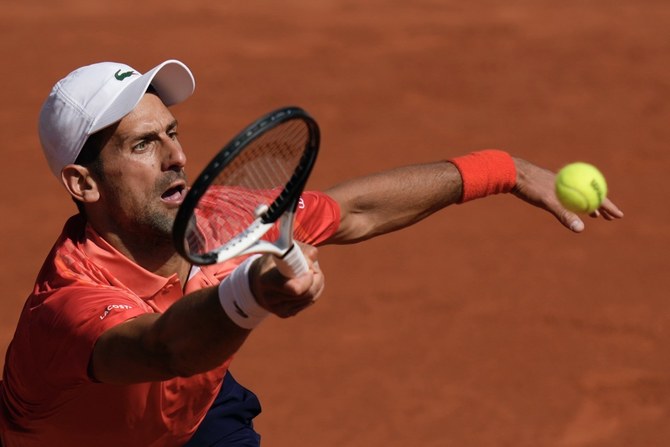

PARIS: Novak Djokovic, in his words, felt “quite sluggish, quite slow” for nearly two full sets against Karen Khachanov in the French Open quarterfinals Tuesday.
Afterward, Djokovic called it his worst stretch of the tournament, a fair assessment. He dropped the opening set, something he hadn’t done at Roland Garros this year. As the second went to a tiebreaker in Court Philippe Chatrier, he knew it was vital to step up his game, bring forth his best.
It’s one thing to seek perfection; it’s another entirely to deliver. As if merely wanting so made it so, Djokovic did what he’s done before at crucial moments over the years en route to 22 Grand Slam titles.
Managing to choose the right shot every time, managing to put each ball precisely where he intended, Djokovic threw a shutout of a tiebreaker to point himself toward what would become a 4-6, 7-6 (0), 6-2, 6-4 victory over the 11th-seeded Khachanov.
Djokovic, who will meet No. 1 Carlos Alcaraz in a much-anticipated semifinal Friday, found one word to describe that segment of the match: “Amazing.”
Alcaraz beat Djokovic on clay at the Madrid Masters last year in their only previous encounter, and the 20-year-old from Spain got past No. 5 Stefanos Tsitsipas 6-2, 6-1, 7-6 (5) on Tuesday night.
“Since the draw came out, everyone was expecting that match — the semifinal against Novak. Myself, as well. I really want to play that match,” Alcaraz said. “Since last year, I really wanted to play again against Novak.”
No. 2 seed Aryna Sabalenka and unseeded Karolina Muchova both reached the women’s semifinals by winning earlier in the day. Sabalenka, the reigning champion at the Australian Open, eliminated Elina Svitolina 6-4, 6-4, then appeared at a news conference for the first time in nearly a week. Muchova defeated 2021 runner-up Anastasia Pavlyuchenkova 7-5, 6-2.
How does Djokovic approach a tiebreaker?
“It’s kind of a mentality of (locking down): ‘OK, I’m present, I’m focused only on the next point and I have to really think clearly about what I want to do against ... a given opponent. It worked really well for me,” said Djokovic, a 36-year-old from Serbia who has spent more weeks ranked No. 1 than anyone in his sport’s history and is currently No. 3. “It worked really well for me.”
Well, there’s an understatement.
“Every point was perfectly scripted for me, so to say. Yeah, sometimes it works; sometimes it doesn’t,” he said. “I was lucky that, throughout my career, I have a very good and positive score in the tiebreaks. My opponents know that, and I know that. So, I think, mentally that serves me well.”
Indeed, he is 307-162, a winning percentage of .655, in those set-deciders now played at 6-all at every major. In 2023, it’s 14-4, including 5-0 in Paris. And get this: Those tiebreakers at the 2023 French Open have been comprised of 47 total points — and he has made a grand total of zero unforced errors.
On an 80-degree afternoon, Djokovic brought that brand of make-no-mistakes tennis to the next set, too, against Khachanov, a semifinalist at the US Open last September and the Australian Open this January.
“The energy of the court shifted to my side. I felt the momentum. I started releasing and relaxing through my shots a bit more,” Djokovic said, pantomiming a backhand swing, “and going for it more, with more confidence. And he backed up a bit.”
On the 10th point of the third set’s opening game, Djokovic flubbed a backhand. But he then would not commit an unforced error the rest of the way in that set, compiling 19 winners in that span.
Whenever an answer was required, Djokovic found one.
“It always feels like he finds a way ... to make you (in) trouble,” Khachanov said. “He’s always there. He’s always pushing, and you know this.”
After Khachanov wildly celebrated his best shot of the match — a back-to-the-net ‘tweener that drew a netted volley from Djokovic, who bowed his head — by wind-milling his arms and shouting and yelling, the perfect response came next. Djokovic hit a 128 mph (206 kph) serve followed by a forehand winner, and a 130 mph (209 kph) serve followed by a drop shot winner to take that game, then pointed his left index finger toward the azure sky.
When Djokovic played a shaky game that ended with a double-fault to suddenly make it 4-all in the fourth — “A little bit of a scare,” he said — he turned back into that vibrant version of himself.
Djokovic collected the remaining eight points — breaking at love, then holding at love — and was on his way to a 12th semifinal at the French Open (among men, only Rafael Nadal, with 15, has more; the 14-time champion is currently sidelined by a hip injury) and 45th at all Grand Slam events (only the retired Roger Federer, with 46, has more).
“It’s exactly,” Djokovic said, “where I want to be.”
Alcaraz progressed to his second major semifinal — the other came when he won the 2022 US Open — by outclassing two-time Slam runner-up Tsitsipas in every possible manner until stumbling slightly near the finish line.
It was so lopsided for much of the evening that fans roared, and Tsitsipas raised his arms to acknowledge their reaction, when Alcaraz’s third-set edge was trimmed from 3-0 to 3-1. Soon after, at 5-2, Alcaraz held two match points that he frittered away; he got broken for the first time to make it 5-3; and another match point came and went at 5-4.
Not until his sixth match point of the contest did Alcaraz finally convert, with a backhand volley winner.
Like Djokovic hours earlier, Alcaraz was superior when he needed to be.


