

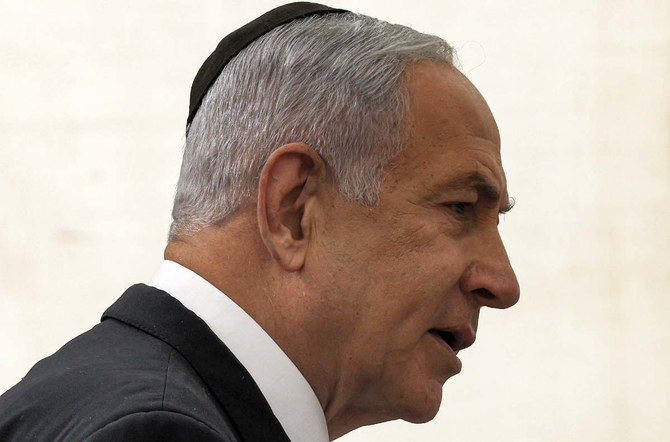

JERUSALEM: Israeli Prime Minister Benjamin Netanyahu ramped up threats to attack Iranian nuclear facilities on Sunday, convening a rare cabinet war drill after he accused UN inspectors of failing to confront Tehran.
With Iran having enriched enough uranium to 60 percent fissile purity for two nuclear bombs, if refined further — something it denies wanting or planning — Israel has redoubled threats to launch preemptive military strikes if international diplomacy fails. Israel has long maintained that for diplomacy to succeed, Iran must be faced with a credible military threat.
“We are committed to acting against Iran’s nuclear (drive), against missile attacks on Israel and the possibility of these fronts joining up,” Netanyahu said in a video statement from Israel’s underground command bunker at its military headquarters in Tel Aviv.
The possibility of multiple fronts, Netanyahu said while surrounded by security cabinet ministers and defense chiefs, requires Israel’s leadership “consider, if possible consider ahead of time,” its major decisions.
Netanyahu’s office issued footage of the drill. The publicity around the preparations appeared to depart from Israel’s 1981 strike on an Iraqi nuclear reactor and a similar sortie in Syria in 2007, carried out without forewarning.
UN WATCHDOG SAID IRAN PROVIDED SATISFACTORY ANSWER
Earlier, Netanyahu levelled sharp criticism of the International Atomic Energy Agency (IAEA), following a report last week by the UN watchdog that Iran had provided a satisfactory answer on one case of suspect uranium particles and re-installed some monitoring equipment originally put in place under a now-defunct 2015 nuclear deal.
“Iran is continuing to lie to the International Atomic Energy Agency. The agency’s capitulation to Iranian pressure is a black stain on its record,” Netanyahu told his cabinet in televised remarks. The watchdog risked politicization that would lose it its significance on Iran, he said.
The IAEA declined to comment.
On Wednesday, the agency reported that after years of investigation and lack of progress, Iran had given a satisfactory answer to explain one of three sites at which uranium particles had been detected.
Those particles could be explained by the presence of a onetime Soviet-operated mine and lab there and the IAEA had no further questions, a senior diplomat in Vienna said.
In an apparent reference to this, Netanyahu said Iran’s explanations were “technically impossible.”
However, the Vienna diplomat also said the IAEA’s assessment remained that Iran carried out explosives testing there decades ago that was relevant to nuclear weapons.
After then US President Donald Trump quit the Iran nuclear deal in 2018, Tehran ramped up uranium enrichment. Israeli and Western officials say it could switch from enrichment at 60 percent fissile purity to 90 percent — weapons-grade — within a few weeks.
In a 2012 UN speech, Netanyahu deemed 90 percent enrichment by Iran a “red line” that could trigger preemptive strikes.
Military experts are divided, however, on whether Israel — whose advanced military is believed to be nuclear-armed — has the conventional clout to deliver lasting damage to Iranian targets that are distant, dispersed and well-defended.
Focussing domestic attention on Iran might provide Netanyahu with respite from a months-long crisis over his proposals to overhaul Israel’s judiciary. But opinion polls showed that both those concerns are trumped, for Israelis, by high living costs.


