

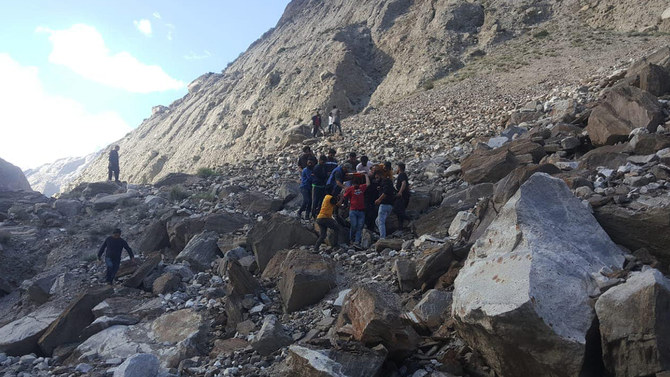
Landslide kills two in Pakistan’s northern Hunza district

Volunteers carry the bodies of victims after a landslide kills two in Pakistan’s northern Hunza district on June 2, 2023. (Photo courtesy: Twitter/pamirtimes)
Short Url
Updated 04 June 2023
Follow

Landslide kills two in Pakistan’s northern Hunza district

  • The incident took place when the two people were cleaning a water channel in the Hassan Abad village
  • Soaring temperatures triggered a glacial lake outburst flood last year, destroying a bridge in the same area

KHAPLU, Gilgit-Baltistan: At least two people were killed and one injured in a landslide while they were cleaning a water channel near the village of Hassan Abad in the northern Hunza district of Gilgit-Baltistan, confirmed police and medical officials in the area on Sunday.

Pakistan is highly vulnerable to climate change and ranks eighth among countries most affected by extreme weather, according to a study conducted by the environmental protection group Germanwatch.

Last year, soaring temperatures triggered a glacial lake outburst flood, destroying a bridge playing vital trade and transportation role in the same village of Hassan Abad.

“Two people were killed while one was injured in Hassan Abad,” Senior Superintendent Police (SSP) Shahmir Khalid said during a phone conversation with Arab News from the Hunza district. “The incident took place today. Both people who lost their lives belonged to the adjoining town of Ali Abad. They were cleaning the water channel in Hassan Abad when the landslide hit them.”

The SSP mentioned that many villagers in the area participated in the annual cleaning of the water channel to maintain a smooth and efficient irrigation system.

“Today, they were performing the same activity when the incident happened,” he said.

Dr. Muhammad Inamullah, deputy medical superintendent at the District Headquarters Hospital in Hunza, said the injured man was out of danger.

“The incident took place between 2 and 2:30 pm,” he continued. “The deceased suffered head injuries. The condition of the injured person is stable, and he is currently receiving treatment at the hospital.”

According to the Gilgit-Baltistan Disaster Management Authority, there were 113 reported events of climate-induced disasters and floods in the region last year, resulting in the loss of 23 lives.

Last month, an avalanche in the Shounter Top area of the Astore district in Pakistan’s northern areas claimed the lives of at least nine people, while nearly 25 others were injured.


Pakistan, China ink 24 agreements to develop digital corridor for IT cooperation

Updated 4 sec ago
Follow

Pakistan, China ink 24 agreements to develop digital corridor for IT cooperation

  • Both countries sign one government-to-government, seven government-to-business and 16 business-to-business MoUs
  • Digital corridor will create new avenues for Pakistani tech companies, expand cooperation with China in ICT, says state media

ISLAMABAD: Pakistan and China have signed 24 agreements to develop a digital corridor aimed at enhancing information technology (IT) cooperation between the two states, state-run media reported on Monday. 

The memoranda of understanding between the two sides were signed in Beijing, according to the state-owned Associated Press of Pakistan (APP). 

The MoUs include one government-to-government, seven government-to-business and 16 business-to-business agreements.

“The initiative focuses on developing an innovative and pragmatic digital corridor to enhance cooperation in the IT industry,” APP reported. 

APP said the digital corridor will create new avenues for Pakistani tech companies and expand bilateral cooperation with China in the information and communication technology infrastructure development.

The development is in line with Pakistan’s recent efforts to boost IT exports and enhance digital cooperation with regional allies. 

In November, Pakistan highlighted the “Digital Silk Road” as the next major phase of the China–Pakistan Economic Corridor (CPEC) while proposing new technology partnerships with Beijing, including joint ventures in 5G/6G, hardware manufacturing and ICT components. 

Launched in 2015, CPEC is a multibillion-dollar connectivity program linking western China to the Arabian Sea. The initiative has historically focused on energy projects, highways, power plants and the Gwadar port, with committed investments estimated at around $60 billion. 

As the two countries enter CPEC’s second phase, cooperation is expanding beyond physical infrastructure into technology, digital governance, manufacturing and skills development.

The Digital Silk Road is Beijing’s framework for cross-border connectivity in fiber, cloud services, data routing, smart manufacturing and emerging technologies. It is increasingly positioned as the backbone of CPEC’s next stage.