

50 Daesh terrorists, 168 family members repatriated from Syria to Iraq

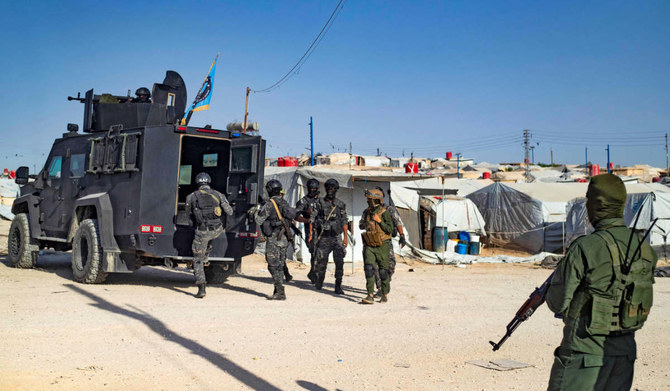
A picture shows the Kurdish-run al-Hol camp, which holds relatives of suspected Daesh group fighters in the northeastern Hasakeh governorate, during a security operation by the Kurdish Asayish security forces and the special forces of the Syrian Democratic Forces, on August 26, 2022. (AFP)
Short Url
Updated 04 June 2023
Follow

50 Daesh terrorists, 168 family members repatriated from Syria to Iraq

  • Al-Hol camp, in Kurdish-controlled northeast Syria, is home to about 50,000 people including family members of suspected terrorists

BAGHDAD: Fifty Daesh terrorists and 168 Iraqi members of terrorist families were repatriated from Syria to Iraq on Saturday, an Iraqi official said.
Iraqi authorities “received 50 members of the Daesh from the Syrian Democratic Forces (SDF),” said the source who spoke on condition of anonymity.
The SDF are the Kurds’ de facto army in the area, and led the battle that dislodged Daesh group fighters from the last scraps of their Syrian territory in 2019.
They will “be the subject of investigations and will face Iraqi justice,” they added.
According to conflict monitor the Syrian Observatory for Human Rights they were detained in Hasakah, northeast Syria.
Additionally, 168 relatives of Daesh-group members were repatriated from Syria’s Al-Hol camp to be relocated to Al-Jadaa camp south of Mosul, the Iraqi official added, where they will undergo psychiatric treatment.
“Once we receive the assurances of their tribal leaders that they will not face reprisals, they will be sent home.”
Al-Hol camp, in Kurdish-controlled northeast Syria, is home to about 50,000 people including family members of suspected terrorists.
Among them are displaced Syrians, Iraqi refugees as well as more than 10,000 foreigners originally from some 60 countries.
In March, UN Secretary-General Antonio Guterres called for the swift repatriation of foreigners held in Al-Hol.
Nearly half of the camp’s population is under the age of 12 and residents are “deprived of their rights, vulnerable, and marginalized,” Guterres said in a statement during a visit to Iraq.
“I have no doubt to say that the worst camp that exists in today’s world is Al-Hol, with the worst possible conditions for people and with enormous suffering for the people that have been stranded there for years,” Guterres said.
Since May 2021, hundreds of families have been transferred from Al-Hol to Al-Jadaa in Iraq, with a number of those going on to flee.
The repatriation to Iraq of relatives of fighters who joined the ultra-radical group that controlled one-third of Iraq between 2014 and 2017 has sparked opposition.
In December 2021, Iraqi authorities announced plans to close Al-Jadaa.
But little progress has been made and the relocation of displaced people to their home regions has proven challenging and prompted opposition from local people.


Hundreds mourn in Syria’s Homs after deadly mosque bombing

Updated 55 min 14 sec ago
Follow

Hundreds mourn in Syria’s Homs after deadly mosque bombing

  • Officials have said the preliminary investigations indicate explosive devices were planted inside the mosque but have not yet publicly identified a suspect

HOMS: Hundreds of mourners gathered Saturday despite rain and cold outside of a mosque in the Syrian city of Homs where a bombing the day before killed eight people and wounded 18.

The crowd gathered next to the Imam Ali ibn Abi Talib Mosque in the Wadi Al-Dhahab neighborhood, where the population is predominantly from the Alawite minority, before driving in convoys to bury the victims.

Officials have said the preliminary investigations indicate explosive devices were planted inside the mosque but have not yet publicly identified a suspect.

A little-known group calling itself Saraya Ansar Al-Sunna claimed responsibility for the attack in a statement posted on its Telegram channel, in which it indicated that the attack intended to target members of the Alawite sect, an offshoot of Shia Islam whom hard-line Islamists consider to be apostates.

The same group had previously claimed a suicide attack in June in which a gunman opened fire and then detonated an explosive vest inside a Greek Orthodox church in Dweil’a, on the outskirts of Damascus, killing 25 people as worshippers prayed on a Sunday.

A neighbor of the mosque, who asked to be identified only by the honorific Abu Ahmad (“father of Ahmad“) out of security concerns, said he was at home when he heard the sound of a “very very strong explosion.”

He and other neighbors went to the mosque and saw terrified people running out of it, he said. They entered and began trying to help the wounded, amid blood and scattered body parts on the floor.

While the neighborhood is primarily Alawite, he said the mosque had always been open to members of all sects to pray.

“It’s the house of God,” he said. “The mosque’s door is open to everyone. No one ever asked questions. Whoever wants to enter can enter.”

Mourners were unable to enter the mosque to pray Saturday because the crime scene remained cordoned off, so they prayed outside.

Some then marched through the streets chanting “Ya Ali,” in reference to the Prophet Muhammad’s cousin and son-in-law whom Shiite Muslims consider to be his rightful successor.