

Gaza Strip’s Palestinians polarized by unorthodox watermelon delicacy

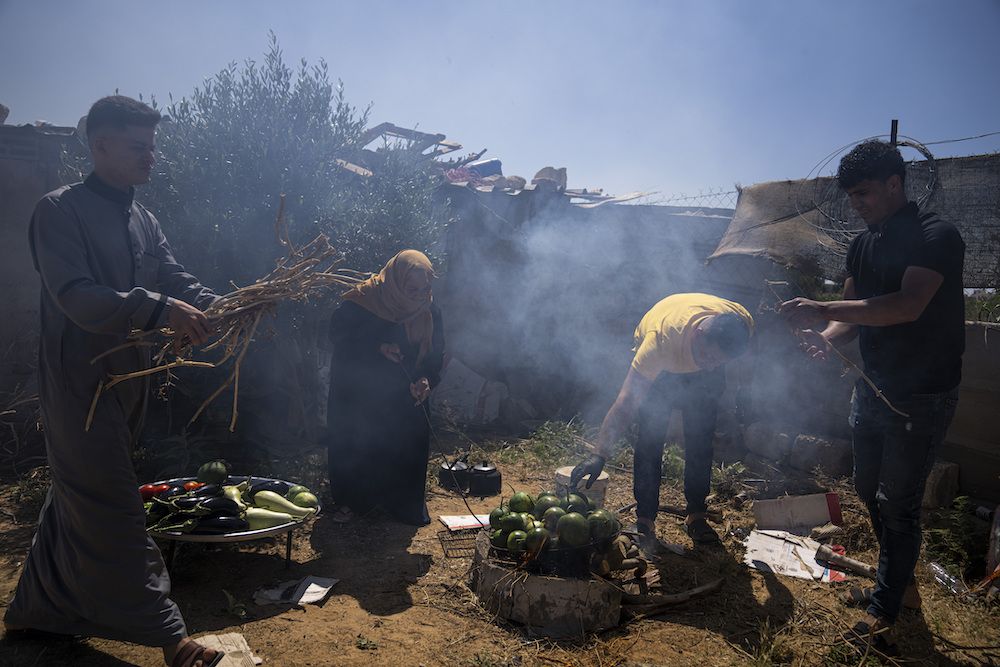
A group of Palestinians cook roast watermelons as they prepare to make "Lasima," a dish that is popular in the southern Gaza Strip but shunned in its north, at a garden in Khuzaa. Locals call it "watermelon salad." But this seasonal delicacy is far from the sweet, refreshing taste the name evokes. (AP)
Short Url
Updated 01 June 2023
Follow

Gaza Strip’s Palestinians polarized by unorthodox watermelon delicacy

  • The dish originated more than 100 years ago with Bedouin Arab tribes in the neighboring Sinai desert in Egypt
  • Lasima is available just two months a year, it is made with melons that are picked when they are small and not yet ripe

KHUZAA: Locals call it “watermelon salad.” But this delicacy popular in the southern Gaza Strip at this time of year is far from the sweet, refreshing taste the name evokes.
“Lasima,” “Ajar,” or “Qursa” are different names for the hot, savory meal that takes hours to prepare. There’s watermelon inside, but one can hardly taste it.
In a territory that prides itself on its culinary traditions, Lasima is surprisingly divisive. Residents in southern Gaza love the dish. Just a few kilometers (miles) to the north, people shun it as unclean, due to its hands-on preparation.
Lasima is available just two months a year. It is made with melons that are picked when they are small and not yet ripe. They are roasted on a fire and peeled, and the soft flesh is mixed with roasted eggplants and thinly sliced tomatoes, lemon, garlic, onion and olive oil. Then it is eaten with a special dough baked in the ashes of the fire.
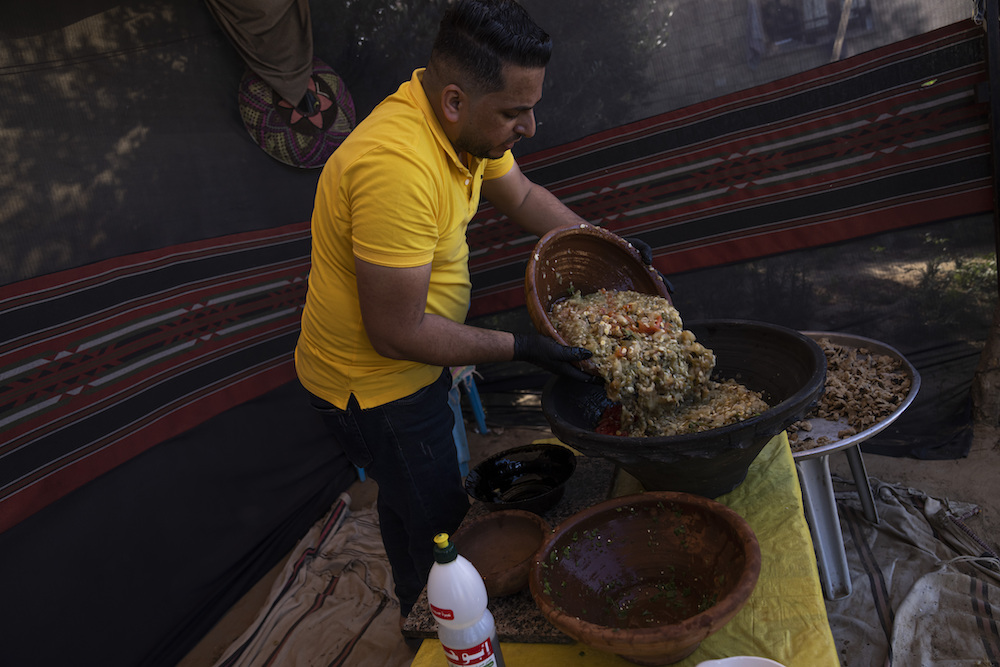
The name “Ajar,” or “unripe” in Arabic, refers to the baby melons. “Qursa” is the word for the thick dough. “Lasima,” which means “messy,” refers to the sloppy meal served in a large clay bowl.
Many say the dish originated more than 100 years ago with Bedouin Arab tribes in the neighboring Sinai desert in Egypt.
Others claim it’s a traditional Palestinian food. There is little evidence to support this claim, however. The food is popular only in southern Gaza, near the Sinai border. Farther north, the meal is barely known.
Amona Abu Rjila, 70, of Khuzaa, says it’s a little of each. She says she remembers her parents and grandfathers making it outdoors in the watermelon season. “It’s a traditional Palestinian dish with Bedouin roots,” she said.
Farther north, few would agree with her. Those familiar with the dish object to its preparation, with the ingredients typically mushed together with bare hands, as unclean.
On a recent day, a group of friends gathered in a yard adjacent to Israel’s frontier with Gaza. They diced the vegetables and roasted the ingredients in a fire. When the flames faded and the vegetables were charred, the thick dough was buried in the ash.
Abdelkarim Al-Satari, 33, a jobless accountant, started mixing the Lasima. He shredded the dough and put all the ingredients in the large bowl, squeezing everything with his fist. Wary of the onlookers, he put on black cooking gloves.
“In every season, people call me to make Lasima for them about 20 times,” he said.

To challenge the dish’s negative image, social media content creator Mohammed Aborjela brought the meal in smaller clay pots and offered samples to random passers-by in Gaza City.
Most of the respondents in a nearly two-minute video said they’d never heard of it, but all who tried it liked it.
The video attracted over 1,000 comments — many of them baffled northerners who were intrigued about the taste but turned off by the preparation methods.
“The way it’s made, especially by some men, is not appealing for the eyes,” said Nada Azzam, a Gaza City woman.
She said she has never tried Lasima. But after watching a video of women making it with “clean cooking means,” she vowed to give it a taste.


Ceasefire with Kurdish-led force extended for another 15 days, Syrian army says

Updated 25 January 2026
Follow

Ceasefire with Kurdish-led force extended for another 15 days, Syrian army says

  • The defense ministry said the extension was in support of an operation by US forces to transfer accused Daesh militants to Iraq
  • The Kurdish-led Syrian Democratic Forces confirmed the ceasefire extension

RAQQA, Syria: Hours after the expiration of a four-day truce between the Syrian government and Kurdish-led fighters Saturday, Syria’s defense ministry announced the ceasefire had been extended by another 15 days.
The defense ministry said in a statement that the extension was in support of an operation by US forces to transfer accused Daesh militants who had been held in prisons in northeastern Syria to detention centers in Iraq.
The Kurdish-led Syrian Democratic Forces confirmed the ceasefire extension.
“Our forces affirm their commitment to the agreement and their dedication to respecting it, which contributes to de-escalation, the protection of civilians, and the creation of the necessary conditions for stability,” the group said in a statement.
Over the past three weeks, there have been intense clashes between government forces and the SDF, in which the SDF lost large parts of the area they once controlled.
Earlier in the day, the Kurdish-led force called on the international community to prevent any escalation.
The end of the truce came as government forces have been sending reinforcements to Syria’s northeast.
Syria’s interim government signed an agreement last March with the SDF for it to hand over territory and to eventually merge its fighters with government forces. In early January, a new round of talks failed to make progress over the merger, leading to renewed fighting between the two sides.
A new version of the accord was signed last weekend, and a four-day ceasefire was declared Tuesday. Part of the new deal is that SDF members will have to merge into the army and police forces as individuals.
The SDF said in a statement Saturday that military buildups and logistical movements by government forces have been observed, “clearly indicating an intent to escalate and push the region toward a new confrontation.” The SDF said it will continue to abide by the truce.
On Saturday, state TV said authorities on Saturday released 126 boys under the age of 18 who were held at the Al-Aqtan prison near the northern city of Raqqa that was taken by government forces Friday. The teenagers were taken to the city of Raqqa where they were handed over to their families, the TV station said.
The prison is also home to some of the 9,000 members of the Daesh group who are held in northeastern Syria. Most of them remain held in jails run by the SDF. Government forces have so far taken control of two prisons while the rest are still run by the SDF.
Earlier this week, the US military said that some 7,000 Daesh detainees will be transferred to detention centers in neighboring Iraq.
On Wednesday, the US military said that 150 prisoners have been taken to Iraq.