

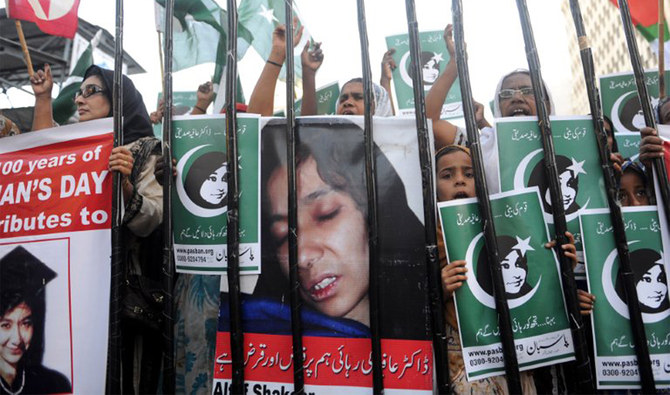

KARACHI: Pakistani neuroscientist Dr. Aafia Siddiqui, who has been in a high-security US prison on terrorism charges for nearly two decades, is suffering from the “worst monitoring” with security keeping a check even on her visits to the bathroom, Pakistani Senator Mushtaq Ahmed Khan said on Wednesday.
Siddiqui gained international attention after she was arrested in 2003 and was later convicted by a US court for attempting to kill US military personnel in Afghanistan and was sentenced to 86 years in prison. The US also suspected her of having connections to Al-Qaeda.
Senator Khan helped arrange an emotional meeting between Siddiqui and her sister Dr. Fowzia Siddiqui after 20 years in Houston. Khan said the meeting took place under strict surveillance and limitations where they weren’t even allowed to hug each other.
“She is facing the worst type of monitoring, as six people accompany her round the clock,” Khan told Arab News over the phone from Houston. “Everything, even if she goes to the bathroom, is being monitored.”
“She has been chained and put on a list of dangerous inmates,” Khan added.
Earlier, Khan took to Twitter to share details about the meeting, saying that it lasted for two-and-a-half hours.
“Dr. Fouzia was not allowed to hug or shake hands with Aafia. Dr. Fowzia was also not allowed to show Dr. Aafia pictures of her children. [The meeting took place] in one of the prison rooms where there was a thick glass wall in the middle and they could see each other through it,” Khan wrote.
Fowzia Siddiqui has been tirelessly campaigning for her sister’s freedom for years. Her efforts also gained global recognition after numerous human rights organizations and individuals raised their voices in support of her cause.
The Pakistani senator informed that her health had also deteriorated in captivity, adding she had developed hearing impairment after suffering an injury to her head.
Khan said the overall situation was alarming, though it had now become possible for people to meet the Pakistani scientist in prison.
“It is necessary now for the people to raise their voice and force the [Pakistani] rulers to take up the issue of Aafia’s release with the American government,” he added.
Khan will also meet Siddiqui in prison on Thursday. He will accompany Dr. Fowzia Siddiqui and Clive Stafford-Smith, a British attorney who works on civil rights issues and helped Guantanamo detainees in the past.
A statement issued by Afia Movement, a campaign that demands freedom for the jailed neuroscientist, said Siddiqui’s sister was not even allowed to share pictures of her nephew and niece with her sister.
“Dr. Fowzia was stopped from sharing photos of Afia’s son and daughter with her. Both children are now above twenty years,” the statement reads.
“Afia informed her sister about incidents that happened to her and her children in 2003,” the statement reads, adding the children were “permanently frozen” during their “kidnapping in Karachi.”
The statement added that Siddiqui had been weeping silently in the car following her meeting with Fowzia Siddiqui. Despite it being very upsetting, Smith said it was an honor to be present in the meeting between the two sisters.
“The importance of this meeting is that how can we bring Afia home after getting out of his hell,” Smith said.
Smith earlier tweeted about the emotional reunion of the two sisters, describing the interaction as “tough 2.5 hours” for Fowzia Siddiqui.
“I miss my family every day,” he quoted the Pakistani scientist as saying in a graphic that accompanied his social media post. “My mother, my father, you [my sister], my children, I think of them all the time.”
Last year in July, the two sisters lost their mother, though Khan said Aafia Siddiqui was still not aware of the tragic development.


