

Charity slams EU’s ‘staggering neglect of Afghans’ after just 271 resettled in 2022

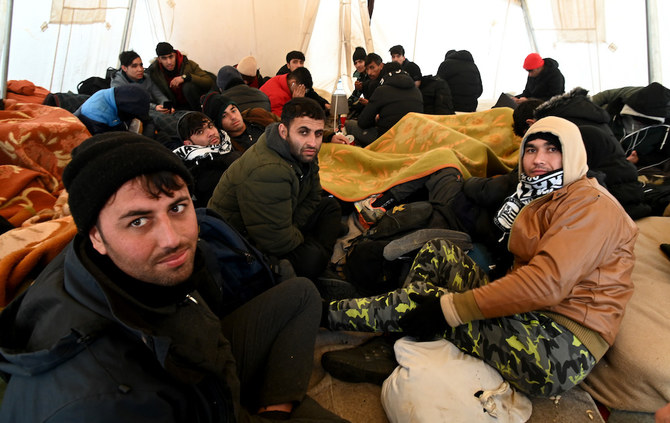
Above, migrants in transit, mostly from Afghanistan, rest in a tent near the railway station in Rijeka on the Adriatic coast in western Croatia on Feb. 6, 2023. (AFP)
Short Url
Updated 31 May 2023
Follow

Charity slams EU’s ‘staggering neglect of Afghans’ after just 271 resettled in 2022

  • International Rescue Committee: Many remain trapped in ‘prison-like’ conditions in Greece
  • Charity: Since fall of Kabul, some member states have failed to resettle a single Afghan

LONDON: Only 271 out of 270,000 Afghans judged as needing protection were resettled in the EU last year, with a charity criticizing member states for failing refugees, The Guardian reported on Wednesday.

The International Rescue Committee said the figures represent “staggering neglect” of Afghan refugees, with EU member states falling short of meeting their resettlement pledges.

Many of the Afghans remain in “prison-like” conditions in border centers across the Greek islands, a common entry point into Europe for refugees.

The charity said a program launched by Germany in 2021 to resettle up to 1,000 Afghans per month has failed to accept a single person, while Italy has only accepted half the number of refugees it pledged to welcome.

From 2021 to 2022, amid the Taliban takeover of Afghanistan, about 41,500 Afghans were fast-tracked into EU member-state entry programs.

But the IRC described the response as “vastly insufficient,” adding that since the fall of Kabul, some EU states have failed to resettle a single Afghan.

A report by the charity warned that Afghans seeking refuge in Europe still lack legal pathways to resettlement.

IRC CEO David Miliband said: “This report highlights staggering neglect of Afghans by the member states of the EU, which puts them at risk at every step of their journeys in search of protection.

“While some states’ well-intentioned plans to bring Afghans to safety have hit repeated delays and obstacles, other countries have failed to make any pledges at all, or to guarantee adequate protection and inclusion for the tiny proportion of Afghan refugees who manage to reach Europe.”

The report also warned that a study from January to March this year showed that more than 90 percent of the Afghans in contact with IRC teams on the Greek island of Lesbos and the capital Athens were suffering from anxiety. A further 86 percent also demonstrated symptoms of depression, the charity added.

Miliband drew comparisons between EU member-state treatment of Ukrainian and Afghan refugees, saying acceptance of the former demonstrated the capacity of states to resettle the latter.

He added: “There is simply no excuse for treating Afghans, and refugees forced from their homes elsewhere, any differently.”

However, the report excluded other pathways that some EU states have launched to accept refugees through other means.

Germany accepted about 286,000 Afghans in 2022, the country’s national statistics office said in March.

The IRC called for EU member states to target Afghan resettlement numbers of 42,500 each over the next five years.

Zahra, 60, a refugee who waited two and a half years for resettlement in Germany, told the charity: “Waiting for an answer was a very difficult and anxious time for me, as I was without my two children in this foreign country whose culture I did not know.

“I had no choice but to wait and hope that one day I would be able to offer my children a safe life here.”


In show of support, Canada, France open consulates in Greenland

Updated 06 February 2026
Follow

In show of support, Canada, France open consulates in Greenland

  • Decisions taken in a strong show of support for Greenland government amid threats by US President Trump to seize the island

COPENHAGEN, Denmark: Canada and France, which both adamantly oppose Donald Trump’s wish to control Greenland, will open consulates in the Danish autonomous territory’s capital on Friday, in a strong show of support for the local government.
Since returning to the White House last year, Trump has repeatedly insisted that Washington needs to control the strategic, mineral-rich Arctic island for security reasons.
The US president last month backed off his threats to seize Greenland after saying he had struck a “framework” deal with NATO chief Mark Rutte to ensure greater American influence.
A US-Denmark-Greenland working group has been established to discuss ways to meet Washington’s security concerns in the Arctic, but the details of the talks have not been made public.
While Denmark and Greenland have said they share Trump’s security concerns, they have insisted that sovereignty and territorial integrity are a “red line” in the discussions.
“In a sense, it’s a victory for Greenlanders to see two allies opening diplomatic representations in Nuuk,” said Jeppe Strandsbjerg, a political scientist at the University of Greenland.
“There is great appreciation for the support against what Trump has said.”
French President Emmanuel Macron announced Paris’s plans to open a consulate during a visit to Nuuk in June, where he expressed Europe’s “solidarity” with Greenland and criticized Trump’s ambitions.
The newly-appointed French consul, Jean-Noel Poirier, has previously served as ambassador to Vietnam.
Canada meanwhile announced in late 2024 that it would open a consulate in Greenland to boost cooperation.
The opening of the consulates is “a way of telling Donald Trump that his aggression against Greenland and Denmark is not a question for Greenland and Denmark alone, it’s also a question for European allies and also for Canada as an ally, as a friend of Greenland and the European allies also,” Ulrik Pram Gad, Arctic expert at the Danish Institute of International Studies, told AFP.
“It’s a small step, part of a strategy where we are making this problem European,” said Christine Nissen, security and defense analyst at the Europa think tank.
“The consequences are obviously not just Danish. It’s European and global.”

Recognition

According to Strandsbjerg, the two consulates — which will be attached to the French and Canadian embassies in Copenhagen — will give Greenland an opportunity to “practice” at being independent, as the island has long dreamt of cutting its ties to Denmark one day.
The decision to open diplomatic missions is also a recognition of Greenland’s growing autonomy, laid out in its 2009 Self-Government Act, Nissen said.
“In terms of their own quest for sovereignty, the Greenlandic people will think to have more direct contact with other European countries,” she said.
That would make it possible to reduce Denmark’s role “by diversifying Greenland’s dependence on the outside world, so that it is not solely dependent on Denmark and can have more ties for its economy, trade, investments, politics and so on,” echoed Pram Gad.
Greenland has had diplomatic ties with the European Union since 1992, with Washington since 2014 and with Iceland since 2017.
Iceland opened its consulate in Nuuk in 2013, while the United States, which had a consulate in the Greenlandic capital from 1940 to 1953, reopened its mission in 2020.
The European Commission opened its office in 2024.