EU agrees tougher rules for irregular migrants

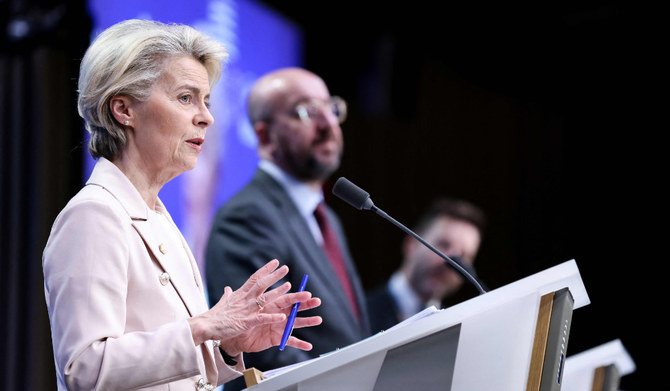
European Commission President Ursula von der Leyen (L) and European Commission President Charles Michel hold a press conference at the end of an extraordinary meeting of a EU leaders Summit at The European Council Building in Brussels on February 10, 2023. (AFP)
Short Url
Updated 11 February 2023
Follow

EU agrees tougher rules for irregular migrants

  • Pilot projects relying on the EU’s border patrol, asylum and police cooperation agencies will look to instil fast and fair asylum procedures at the bloc’s external borders

BRUSSELS: EU leaders have agreed tougher rules aimed at making it easier to expel asylum-seekers whose refugee applications are denied, European Commission chief Ursula von der Leyen said on Friday.
The measures are a response to increasing European concern over rising irregular immigration that has become a hot-button issue in several member countries.
That problem is “a European challenge that requires a European response,” EU leaders said in a final document at the end of a 16-hour summit looking at that and other topics.
The low numbers of failed asylum-seekers being returned to their home countries is a central preoccupation for the EU.
The bloc is already hosting millions of refugees from conflicts in Ukraine, Syria and Afghanistan, while facing asylum claims from citizens of safer countries such as Bangladesh,Turkiye and Tunisia, many of whom end up being deemed economic migrants ineligible for asylum.
Von der Leyen said “pilot projects” relying on the EU’s border patrol, asylum and police cooperation agencies would look to instil “fast and fair asylum procedures” at the bloc’s external borders.
The EU leaders called on the commission “to immediately mobilize substantial EU funds” to reinforce that external border with “protection capabilities and infrastructure, means of surveillance, including aerial surveillance, and equipment,” according to the summit document.
That decision came after some EU countries, notably Austria, had pushed the commission to pay for reinforced fences designed to keep irregular migrants crossing from neighboring non-EU nations such as Turkiye.
Von der Leyen has repeatedly said EU funds would not pay for fences.
But EU officials and diplomats pointed out that, if Brussels paid for cameras, watch towers and other infrastructure along the external border, that would free up countries to pour their national budgets into paying for fences.
The summit also reached agreement on a “principle” under which one EU country can use a court decision in another EU member state to return an irregular migrant to their home country.
That would try to prevent “asylum shopping” whereby migrants go to a different country to apply to stay after being turned down in an initial one.
The EU leaders also agreed “to increase the use of the safe-country concepts” that will open the way to the bloc formulating a common list, von der Leyen said.
Her remarks came as Britain and its former Mediterranean colony Malta signed a wide-ranging cooperation agreement covering areas including security and defense, migration, education, health and trade.
The agreement was signed during a short visit to the island by British Foreign Secretary James Cleverly, who met Foreign Minister Ian Borg.
Britain and Malta have worked together on migration.
Malta is on the main migration route across the Mediterranean from Libya to Europe, with many migrants then attempting to carry on to the UK.
“We want to prevent people traffickers from harvesting money from some of the most desperate people in the world,” Cleverly said.


Trump is threatening to block a new bridge between Detroit and Canada from opening

Updated 10 sec ago
Follow

Trump is threatening to block a new bridge between Detroit and Canada from opening

  • Trump’s threat comes as the relationship between the US and Canada increasingly sours during the US president’s second term

WASHINGTON: President Donald Trump on Monday threatened to block the opening of a new Canadian-built bridge across the Detroit River, demanding that Canada turn over at least half of the ownership of the bridge and agree to other unspecified demands in his latest salvo over cross-border trade issues.
“We will start negotiations, IMMEDIATELY. With all that we have given them, we should own, perhaps, at least one half of this asset,” Trump said in a lengthy social media post, complaining that the United States would get nothing from the bridge and that Canada did not use US steel to built it.
The Gordie Howe International Bridge, named after a Canadian hockey star who played for the Detroit Red Wings for 25 seasons, had been expected to open in early 2026, according to information on the project’s website. The project was negotiated by former Michigan Gov. Rick Snyder — a Republican — and paid for by the Canadian government to help ease congestion over the existing Ambassador Bridge and Detroit-Windsor tunnel. Work has been underway since 2018.
It’s unclear how Trump would seek to block the bridge from being opened, and the White House did not immediately return a request for comment on more details. The Canadian Embassy in Washington also did not immediately return a request for comment.
Trump’s threat comes as the relationship between the US and Canada increasingly sours during the US president’s second term. The United States-Mexico-Canada trade agreement is up for review this year, and Trump has been taking a hard-line position ahead of those talks, including by issuing new tariff threats.
Canadian Prime Minister Mark Carney, meanwhile, has spoken out on the world stage against economic coercion by the United States.
Sen. Elissa Slotkin, D-Michigan, said the Canadian-funded project is a “huge boon” to her state and its economic future. “You’ll be able to move cargo from Montreal to Miami without ever stopping at a street light,” Slotkin told The Associated Press.
“So to shoot yourself in the foot and threaten the Gordie Howe Bridge means that this guy has completely lost the plot on what’s good for us versus just what’s spite against the Canadians,” Slotkin said.
Michigan, a swing state that Trump carried in both 2016 and 2024, has so far largely avoided the brunt of his second-term crackdown, which has targeted blue states with aggressive immigration raids and cuts to federal funding for major infrastructure projects.
Trump and Democratic Gov. Gretchen Whitmer have also maintained an unusually cordial relationship, with the president publicly praising her during an Oval Office appearance last April. The two also shared a hug last year ahead of Trump’s announcement of a new fighter jet mission for an Air National Guard base in Michigan.
While Canada paid for the project, the bridge will be operated under a joint ownership agreement between Michigan and Canada, said Stacey LaRouche, press secretary to Whitmer.
“This is the busiest trade crossing in North America,” LaRouche said, saying the bridge was “good for Michigan workers and it’s good for Michigan’s auto industry” as well as being a good example of bipartisan and international cooperation.
“It’s going to open one way or another, and the governor looks forward to attending the ribbon-cutting,” LaRouche said.
Rep. Shri Thanedar, the Democratic House representative of Detroit, said blocking the bridge would be “crazy” and said Trump’s attacks on Canada weren’t good for business or jobs. “The bridge is going to help Michigan’s economy. There’s so much commerce between Michigan and Canada. They’re one of our biggest partners,” Thanedar said.
Democratic Rep. Debbie Dingell of Ann Arbor brushed aside the president’s threat, saying she’s looking forward to the bridge’s opening later in the spring. “And I’ll be there,” Dingell said.
“That bridge is the biggest crossing in this country on the northern border. It’s jobs. It’s about protecting our economy. It was built with union jobs on both sides,” said Dingell. “It’s going to open. Canada is our ally.”