

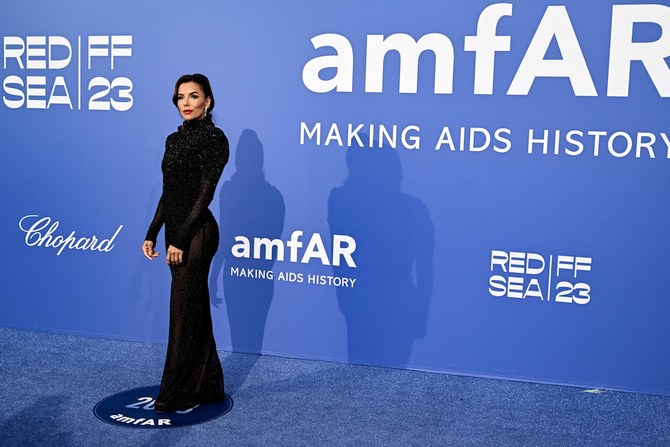
Saudi Arabia’s Red Sea Film Festival co-sponsors amfAR gala in Cannes

Eva Longoria attended the event. (AFP)
Short Url
Updated 26 May 2023
Follow

Saudi Arabia’s Red Sea Film Festival co-sponsors amfAR gala in Cannes

  • Event raises funds for HIV, AIDS research, education
  • Auction of car, jewelry, artwork brings in millions

DUBAI: Saudi Arabia’s Red Sea Film Festival was one of the main sponsors at the star-studded amfAR gala, held during the Cannes Film Festival on Thursday.

Guests included Riyadh-based Argentinian model Georgina Rodriguez, Eva Longoria, Fan Bingbing, Rebel Wilson, Elsa Hosk, Heidi Klum, Coco Rocha and Winne Harlow, who all posed up a storm in front of the Saudi Film Festival’s insignia on the red carpet.

The event, which raises money for AIDS research, took place at the famous Hotel Du Cap, Eden Roc.

In addition, Bebe Rexha and Adam Lambert performed at the event.

“I’m very honored to be singing tonight for this cause and seeing amazing people on the carpet and … beautiful fashion all in the name of raising money for HIV, AIDS, research,” Lambert told AP before the gala.

The auction featured an array of artwork, diamond jewels, and experiences.

The centerpiece was an Aston Martin sports car, the first of its type in the world, which was auctioned off by Longoria for $1.6 million.

The engine cover has the signatures of F1 drivers Lance Stroll and Fernando Alonso and the car will be presented at a grand prix of the buyer’s choice.

Other top lots included a pair of white gold Chopard earrings set with diamonds and emeralds, sold for $295,000, and a Damien Hirst portrait of Leonardo DiCaprio that went for $1.29 million.

DiCaprio, an amfAR regular, slipped in undetected by cameras to enjoy the entertainment, but did not come to the stage to present the winning bidder with his prize.

AmfAR, the Foundation for AIDS Research, is a nonprofit organization dedicated to the support of AIDS research, HIV prevention, treatment education, and advocacy. Since 1985, amfAR has invested nearly $600 million in its programs and has awarded more than 3,500 grants to research teams worldwide.


Decoding villains at an Emirates LitFest panel in Dubai

Updated 25 January 2026
Follow

Decoding villains at an Emirates LitFest panel in Dubai

DUBAI: At this year’s Emirates Airline Festival of Literature in Dubai, a panel on Saturday titled “The Monster Next Door,” moderated by Shane McGinley, posed a question for the ages: Are villains born or made?

Novelists Annabel Kantaria, Louise Candlish and Ruth Ware, joined by a packed audience, dissected the craft of creating morally ambiguous characters alongside the social science that informs them. “A pure villain,” said Ware, “is chilling to construct … The remorselessness unsettles you — How do you build someone who cannot imagine another’s pain?”

Candlish described character-building as a gradual process of “layering over several edits” until a figure feels human. “You have to build the flesh on the bone or they will remain caricatures,” she added.

The debate moved quickly to the nature-versus-nurture debate. “Do you believe that people are born evil?” asked McGinley, prompting both laughter and loud sighs.

Candlish confessed a failed attempt to write a Tom Ripley–style antihero: “I spent the whole time coming up with reasons why my characters do this … It wasn’t really their fault,” she said, explaining that even when she tried to excise conscience, her character kept expressing “moral scruples” and second thoughts.

“You inevitably fold parts of yourself into your creations,” said Ware. “The spark that makes it come alive is often the little bit of you in there.”

Panelists likened character creation to Frankenstein work. “You take the irritating habit of that co‑worker, the weird couple you saw in a restaurant, bits of friends and enemies, and stitch them together,” said Ware.

But real-world perspective reframed the literary exercise in stark terms. Kantaria recounted teaching a prison writing class and quoting the facility director, who told her, “It’s not full of monsters. It’s normal people who made a bad decision.” She recalled being struck that many inmates were “one silly decision” away from the crimes that put them behind bars. “Any one of us could be one decision away from jail time,” she said.

The panelists also turned to scientific findings through the discussion. Ware cited infant studies showing babies prefer helpers to hinderers in puppet shows, suggesting “we are born with a natural propensity to be attracted to good.”

Candlish referenced twin studies and research on narrative: People who can form a coherent story about trauma often “have much better outcomes,” she explained.

“Both things will end up being super, super neat,” she said of genes and upbringing, before turning to the redemptive power of storytelling: “When we can make sense of what happened to us, we cope better.”

As the session closed, McGinley steered the panel away from tidy answers. Villainy, the authors agreed, is rarely the product of an immutable core; more often, it is assembled from ordinary impulses, missteps and circumstances. For writers like Kantaria, Candlish and Ware, the task is not to excuse cruelty but “to understand the fragile architecture that holds it together,” and to ask readers to inhabit uncomfortable but necessary perspectives.