

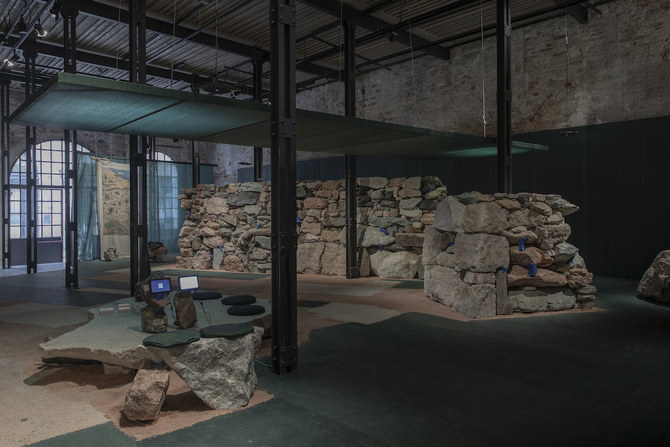

VENICE: The theme of this year’s Venice Architecture Biennale is “Laboratory of the Future.” The United Arab Emirates’ response is “Aridly Abundant,” a pavilion filled with a series of separated stone walls made of colored, cut rocks.
Curated by Faysal Tabbarah, the pavilion challenges preconceptions around the arid desert land common in the Arabian Peninsula. “Aridly Abundant” investigates what possibilities arise when you stop seeing these dry, hot landscapes as places lacking potential and resources and instead view them as places of abundance.
“Our aim is to change perspectives of arid landscapes as devoid of value and reimagine them as an abundant source of knowledge and resources, by investigating an alternative and contemporary building system rooted in the UAE’s cultural and material environment,” Tabbarah said in a statement.

Aridly Abundant, 2023. (Image Courtesy of National Pavilion UAE – La Biennale di Venezia)
“Our research integrates land-based practices with contemporary technology such as 3D scanning and 3D printing to present the potential of stone construction as an adaptable and sustainable form of architecture for countries affected by climate change to explore and adapt to their own environments,” he added.
Tabbarah, an associate professor of architecture at the American University of Sharjah, worked on the project with his curatorial research team of AUS alumni. The curator’s team also includes three interns from National Pavilion UAE’s Venice Internship Program.
“Innovative building techniques suggest that there have been historical land-based practices in arid landscapes that we can still uncover,” Tabbarah told Arab News. “The exhibition looks at what materials arid landscapes give us that we can build with.”

Aridly Abundant, 2023. (Image Courtesy of National Pavilion UAE – La Biennale di Venezia)
As Tabbarah underlines, given the threat of climate change there are likely to be more arid landscapes in the world in the future. “How can we prepare for this new condition?” he asks. In response, the National Pavilion UAE looks to address misconceptions that arid landscapes are spaces of scarcity and instead strives to highlight them as places with thriving ecosystems.
Historically, the Arabian desert has supported life in water-scarce environments, and Tabbarah and his team looked at how such landscapes can be adapted and learned from in the face of our planet’s greatest challenge.
“We used materials that we found in the Al-Hajar Mountain range that are completely unprocessed historical materials,” Tabbarah explained.

Faysal Tabbarah. (Supplied)
The stones in the exhibition reflect the multitude of ways that buildings were historically assembled in Al-Hajar, including blurring, tethering and dry stacking to build spaces.
The UAE Pavilion also commissioned Emirati artist and photographer Reem Falaknaz to document the environment of Al-Hajar. She traveled through the mountains for research and has produced photographs and audio-visual material, as well as a large-scale drawing, based on her experience. The drawing highlights the relationship between the stone assemblies in the exhibition space with her visual vignettes.

Photo taken by Faysal Tabbarah during field research in Al-Hajjar. (Image Courtesy of National Pavilion UAE La Biennale di Venezia & Faysal Tabbarah)
To demonstrate that the tactics found in the UAE can used in other contexts, the assembly methods have been applied to discarded stone fragments from quarries located in the Veneto region.
This is the mission, like that of the Venice Architecture Biennale, of the UAE Pavilion: to connect local cultures and environments with those of the wider world through architecture.
As His Highness Sheikh Salem Al-Qassimi, the UAE’s Minister of Culture and Youth said at the pavilion’s opening: “The National Pavilion reflects the creative scene in our country and demonstrates how art from the UAE is being noticed and appreciated by artists and culture-bearers from around the world, acting as a bridge from the UAE to other cultures worldwide.”


