- Solemn ceremony honored the more than 4,200 peacekeepers who have died since 1948
- Peacekeepers failed to prevent the 1995 massacre of at least 8,000 mostly Muslim men and boys at Srebrenica
UNITED NATIONS: Over the past 75 years, the United Nations has sent more than 2 million peacekeepers to help countries move away from conflict, with successes from Liberia to Cambodia and major failures in former Yugoslavia and Rwanda. Today, it faces new challenges in the dozen hotspots where UN peacekeeping has operations, including more violent environments, fake news campaigns and a divided world that is preventing its ultimate goal: successfully restoring stable governments.
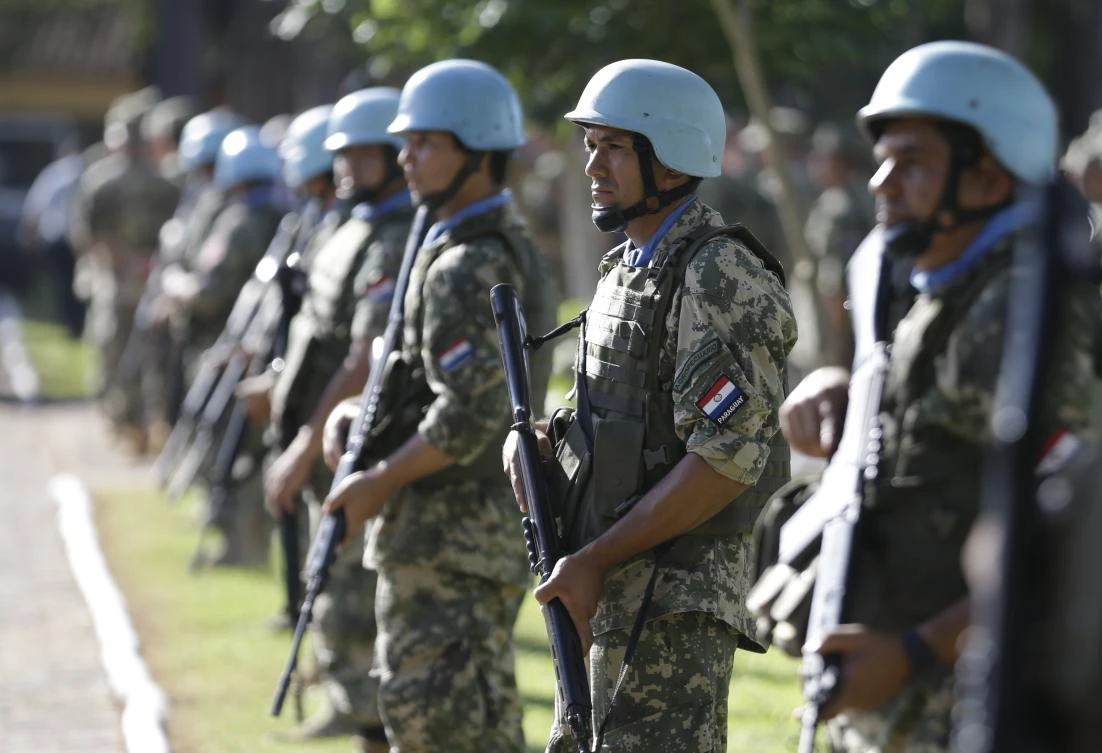
The organization marked the 75th anniversary of UN peacekeeping and observed the International Day of United Nations Peacekeepers on Thursday with a solemn ceremony honoring the more than 4,200 peacekeepers who have died since 1948, when a historic decision was made by the UN Security Council to send military observers to the Middle East to supervise implementation of Israeli-Arab armistice agreements. For the 103 peacekeepers added to the list in 2022, medals were accepted by ambassadors from their 39 home countries.
UN Secretary-General Antonio Guterres asked the hundreds of uniformed military officers and diplomats at the ceremony to stand for a moment of silence in their memory. And at the start of a UN Security Council meeting on peace in Africa, all those in the chamber stood in silent tribute to the fallen peacekeepers.
The secretary-general told the ceremony after laying a wreath at the Peacekeepers Memorial that what began 75 years ago “as a bold experiment” in the Mideast “is now a flagship enterprise of our organization.” For civilians caught in conflict, he said, peacekeepers are “a beacon of hope and protection.”
UN peacekeeping operations have grown dramatically. At the end of the Cold War in the early 1990s, there were 11,000 UN peacekeepers. By 2014, there were 130,000 in 16 far-flung peacekeeping operations. Today, 87,000 men and women serve in 12 conflict areas in Africa, Asia, Europe and the Middle East.
There have been two kinds of successes, UN peacekeeping chief Jean-Pierre Lacroix said in an interview Wednesday with The Associated Press. Those are the long list of countries that have returned to a reasonable degree of stability with the support of UN peacekeeping, including Liberia, Sierra Leone, Ivory Coast, Mozambique, Angola and Cambodia, and the countries where peacekeepers are not only monitoring but preserving cease-fires like in southern Lebanon and Cyprus.
As for failures, he pointed to the failure of UN peacekeepers to prevent the 1994 Rwanda genocide, which killed at least 800,000 ethnic Tutsis and Hutus, and the 1995 massacre of at least 8,000 mostly Muslim men and boys at Srebrenica during the war in Bosnia, Europe’s only acknowledged genocide since the Holocaust during World War II.
The UN’s reputation has also been tarnished by numerous allegations that peacekeepers charged with protecting civilians sexually abused women and children, including in Central African Republic and Congo. Another high-profile blunder was the cholera epidemic in Haiti that began in 2010 after UN peacekeepers introduced the bacteria into the country’s largest river by sewage runoff from their base.
Despite that, Richard Gowan, the International Crisis Group’s UN director, said “UN peacekeeping has a surprisingly decent track record.”
While many people understandably focus on the Rwanda and Srebrenica disasters, he said, “the UN has done a good job of tamping down crises, protecting civilians and rebuilding broken states in cases from the Suez crisis in the 1950s to Liberia in the 2000s.”
Looking ahead, the UN’s Lacroix said the major challenge peacekeeping is facing is the divided international community and especially divisions in the UN Security Council, which must approve its missions.
“The result of that is that we’re not able to achieve what I call the ultimate goal of peacekeeping — to be deployed, support a political process that moves forward, and then gradually roll down when that political process is completed,” he said. “We cannot do that because peace processes are not moving, or they’re not going fast enough.”
The result is that “we have to essentially be content with what I call the intermediate goal of peacekeeping — preserving cease-fires, protecting civilians, we protect hundreds of thousands of them … and doing our best, of course, to support political efforts wherever we can,” the undersecretary-general for peace operations said.
Lacroix pointed to other challenges peacekeepers are facing: The environment in which they are operating is more violent and dangerous and attacks are more sophisticated. Fake news and disinformation “is a massive threat to the population and the peacekeepers.” And old and new drivers of conflict — including transnational criminal activities, trafficking, drugs, weapons, the illegal exploitation of natural resources, and the impact of climate change exacerbating competition between herders and farmers — are also having an “absolutely massive influence.”
The UN needs to better address all the challenges, he said. And it needs to keep improving the impact of peacekeeping and implement its initiatives on performance, combating fake news, improving safety and security, and recruiting more women to be peacekeepers.
The Crisis Group’s Gowan told AP it’s pretty clear that the UN is “trapped” in some countries like Mali and Congo where there aren’t enough peacekeepers to halt recurring cycles of violence. Some African governments, including Mali’s, are turning to private security providers like Russia’s Wagner Group to fight insurgents, he said.
“I think we should be wary of dumping UN operations outright,” Gowan said. “We have learned the hard way in cases like Afghanistan that even heavily armed Western forces cannot impose peace. The UN’s track record may not be perfect, but nobody else is much better at building stability in turbulent states.”