SREBRENICA: The remains of 50 victims of the Srebrenica genocide were laid to rest Monday as thousands of people commemorated the 27th anniversary of the atrocity, which most Serbs and their leaders still refuse to recognize in ethnically divided Bosnia.
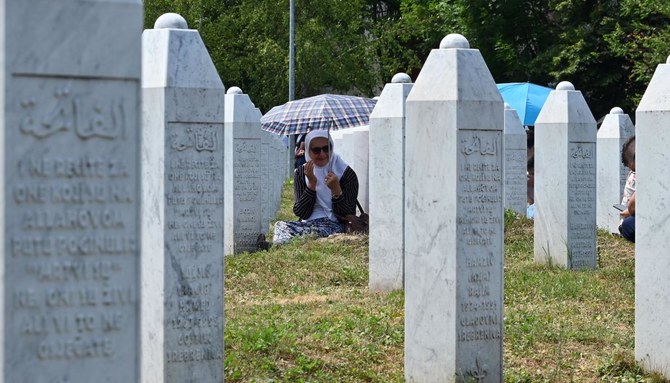
After a joint prayer, the remains of more recently identified victims of Europe’s worst massacre since World War II were buried alongside 6,671 others in a joint funeral at a memorial site, just outside the ill-fated town.
They included Samir and Semir Hasanovic, 19-year-old twin brothers of Sebiba Avdic who also lost her husband, father, another brother and several other close relatives in the atrocity.
“All I had is here,” Avdic said in tears pointing her hand toward the graves with white tombstones.
Some 8,000 Muslim men and boys from Srebrenica were killed by Bosnian Serbs forces in July 1995, after they captured the eastern town. It was an act of genocide under international law.
“I cannot speak any more. I turned into a stone,” said Avdic who now lives with her daughter in Switzerland.
“My pain is intense, as if only 27 days have passed not 27 years... Once I had a family, now I have nothing,” she sobbed.
The EU’s top diplomat Josep Borrell and enlargement commissioner Oliver Varhelyi paid tribute to the Srebrenica dead at a time when the Russian invasion of Ukraine shows “still today we cannot take peace for granted.”
“It is more than ever our duty to remember the genocide of Srebrenica... to stand up to defend peace, human dignity and universal values.
“In Srebrenica, Europe failed and we are faced with our shame,” they said in a statement ahead of the ceremony.
The discovery of skeletal remains from the massacre have become rare in recent years, even though some 1,200 people have still not been found, according to the Missing Persons Institute of Bosnia-Herzegovina.
The identification process has been made more difficult by the bulldozing up of the remains and their removal to mass graves in a bid to conceal the extent of the slaughter.
Mass funerals of those identified are held each July 11, the takeover date by the forces of Bosnian Serb general Ratko Mladic, who has been jailed for life for war crimes.
The remains of one of the people buried on Monday were found spread across three separate mass graves, according to forensic experts.
The remains of most of the others were found spread across two mass graves.
Halil Nukic buried the only remains of his father that were found a few years ago — the skull and an arm bone.
“We waited... hoping that other (bones) will be found but nothing,” said Nukic, who was 14 years old at the time of the massacre.
His only a year older brother Mujo, who went with their father in the woods in the Srebrenica region, is already buried at the cemetery.
“I was one of the few who escaped because many boys my age who had come to the (UN) base did not survive,” he told AFP.
Ever since the brutal 1990s war that claimed some 100,000 lives, Bosnia has been divided along ethnic lines. One half of the country belongs to the Serb entity while the other is ruled by a Muslim-Croat federation.
More than a quarter of a century has passed but Mladic and Radovan Karadzic, Bosnian Serb wartime president who has also been jailed for life, remain “heroes” in the eyes of many Serbs, with their pictures still adorning many walls.
Political leaders of Serbs living in Bosnia today and in neighboring Serbia refuse to accept that a genocide took place at Srebrenica, preferring to call it a “major crime.”
“We have for 27 years been fighting for the truth and demanding justice, but for 27 years they have denied the truth, denied genocide,” said Munira Subasic, head of a Srebrenica women’s association.
Nukic said that the “denial hurts” but believes that the Serbs would eventually recognize the scale of the atrocity.
“Maybe not this generation but the next one will recognize (the genocide).”
Last July, the former high representative for Bosnia, Valentin Inzko, outlawed denial of the genocide and war crimes, making it punishable by jail time.
The move sparked uproar among Bosnian Serbs led by Milorad Dodik, who sits on the country’s collective presidency.
He has launched a process of Serb withdrawal from the army, judiciary and the tax system, stirring fears of breaking up the country or starting a new conflict.


![]()
![]()
![]()

More genocide victims buried on Srebrenica anniversary


Short Url
https://arab.news/ykg62
More genocide victims buried on Srebrenica anniversary
- After a joint prayer, the remains of more recently identified victims were buried alongside 6,671 others in a joint funeral at a memorial site


Latest updates


© 2026 SAUDI RESEARCH & PUBLISHING COMPANY, All Rights Reserved And subject to Terms of Use Agreement.