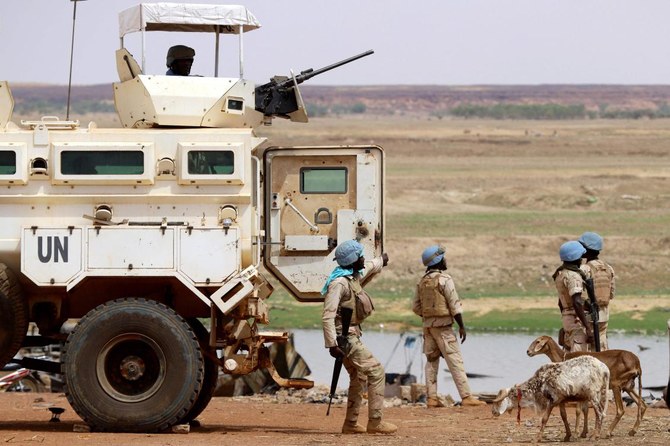
DAKAR: Three UN peacekeepers were killed on Tuesday when their convoy struck a roadside bomb in militant-torn central Mali, the mission said, in a fresh blow to the long-running operation.
“A MINUSMA Force convoy hit an Improvised Explosive Device #IED today,” it said in a tweet that gave a preliminary toll of three dead and five seriously injured.
The mission gave no immediate word about the casualties’ nationalities.
An impoverished state lying in the heart of West Africa’s Sahel, Mali is struggling with an 11-year-old militant insurgency that has claimed thousands of lives and forced hundreds of thousands from their homes
MINUSMA — the UN Multidimensional Integrated Stabilization Mission in Mali — was created in 2013.
With more than 13,500 military personnel and police, it is one of the biggest but also dangerous UN peacekeeping missions, suffering a high toll especially to IEDs.
In January, UN chief Antonio Guterres said in a report that 165 peacekeepers had died and 687 were wounded in hostile acts since July 2013.
The force recorded 548 IED attacks up to the date of the report, claiming 103 lives and 638 wounded among MINUSMA personnel.
Anger within the Malian military at the government’s failure to roll back the insurgency led to a coup against the elected president, Ibrahim Boubacar Keita, in August 2020.
The junta wove closer ties with the Kremlin, bringing in Russian paramilitaries and equipment, as relations with France, the country’s traditional ally, spiralled downwards.
France in 2022 withdrew its last troops from Mali deployed under its long-running Barkhane anti-militant force in the Sahel.
The junta in Bamako routinely claims that it is gaining the upper hand against the militants since it has pivoted to Russia.
On Monday, it protested after the head of the European Council, Charles Michel, last week said that the Malian state was “collapsing” and that the militants were gaining ground.
The militants insurgency began alongside a revolt by ethnic Tuaregs demanding self-rule in the north of the country in 2012.
France sent in troops to beat back the rebellion, but the militants regrouped and expanded into the center of the country in 2015.
From there, they carried out bloody incursions into neighboring Niger and Burkina Faso.
Meanwhile, armed groups who in 2015 signed a peace deal with the government said Tuesday they were mustering a major force to tackle insecurity — and were doing so without the junta.
“Forces are converging on Anefis and there is another group in Ber,” said Mohamed Elmaouloud Ramadane, spokesman for a coalition of former rebels called the Coordination of Azawad Movements (CMA).
Anefis is located in the Kidal region and Ber in the Timbuktu region.
Both regions have been battered by a months-long offensive by militants linked to the Daesh group.
The operation will entail hundreds of men and a large number of vehicles, and will chiefly comprise patrols to boost security for local people, the CMA said.
Asked whether the state would also take part in the operation, the spokesman said, “Not at all. We are intervening in the zones that we control.”
The CMA joined the government and pro-government forces in signing the Algerian-mediated peace deal in 2015.
The accord offered more local autonomy and the chance for former rebels to integrate their fighters into a state-run “reconstituted” army that would operate throughout the north and maintain security in Kidal.
It has often been touted as a potential blueprint for overcoming Mali’s chronic problems.
But it has come under mounting strain.
Virtually all of the armed groups who signed it have suspended participation in the agreement, accusing the junta of failing to uphold its side of the deal.


![]()

Three UN peacekeepers killed in Mali blast
Short Url
https://arab.news/69aju
Three UN peacekeepers killed in Mali blast
- The mission gave no immediate word about the casualties' nationalities
- The force recorded 548 IED attacks up to the date of the report, claiming 103 lives and 638 wounded among MINUSMA personnel


Latest updates



© 2026 SAUDI RESEARCH & PUBLISHING COMPANY, All Rights Reserved And subject to Terms of Use Agreement.