
ISLAMABAD: An anti-terrorism court (ATC) in Lahore on Thursday accepted a request by the military to hand over 16 suspects to be tried under the Pakistan Army Act in a case relating to attacks by political protesters on the house of a top military commander earlier this month.
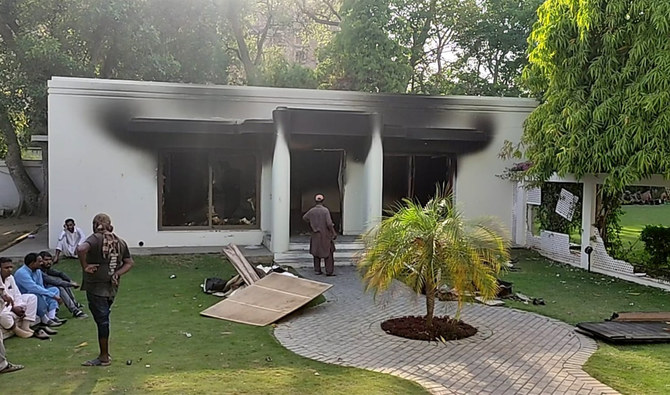
Authorities began a crackdown on close associates and supporters of former Prime Minister Imran Khan after his followers attacked security forces and torched government and military properties, including the home of the Corps Commander in Lahore, following the popular opposition politician’s arrest on corruption charges on May 9.
Troops were deployed to contain the violence, which subsided only after Khan was released on bail on May 12. Thousands of supporters of the popular opposition politician have since been arrested, including the most senior leaders of Khan’s Pakistan Tehreek-e-Insaf (PTI) party. Many top aides have also since announced leaving the party.
“In view of request made by Irfan Athar, commanding officer/military officer, duly forwarded by prosecution as the case of the above mentioned is exclusively triable by [the] military court, therefore, while accepting the request of the commanding officer […] superintendent Camp Jail is directed to hand over custody of the [16 accused] for further proceedings in accordance with the law,” the court said.
Pakistani media widely reported that the commanding officer told the court the suspects had been found guilty under sections 9, 3, 7 and 9 of the Official Secrets Act, which relate to incitement to violence, spying and interfering with the work of police or army officers respectively. The suspects would now be tried under the Army Act 1952.
“The prosecution did not object to the commander’s request, the court ruled,” local media outlet Samaa said.
The Pakistan Army Act of 1952 established military courts primarily to try members of the military or enemies of the state. Civilians accused of offenses such as waging war against the armed forces or law enforcement agencies, or attacking military installations or inciting mutiny, can be tried by military courts under a federal government order.
Military courts operate under a separate system from the civilian legal system and are run by military officers. The judges are also military personnel and cases are tried at military installations. Trials are closed to outsiders, and no media presence is allowed.
The courts have faced widespread criticism from within Pakistan and rights organizations globally because of their secretive nature and their existence alongside a functioning civilian legal system.
“It is alarming to note that the Pakistani Army has stated its intention to try civilians under military laws, possibly in military courts. Trying civilians in military courts is contrary to international law,” Dinushika Dissanayake, Deputy Regional Director for South Asia at Amnesty International, said this month.
“This is purely an intimidation tactic, designed to crack down on dissent by exercising fear of an institution that has never been held to account for its overreach.”
The army has said in the past trials held at military courts are fair and guarantee human and legal rights.
Khan’s PTI this week filed a petition before the country’s top court, calling on it to intervene against the use of military laws to try suspects accused of attacking army installations during the recent protests.
“On the pretext of arson on 9th may (condemned by the entire PTI leadership) the state is trying to dismantle the party ... and trying PTI members in military courts.” Khan wrote on Twitter on Thursday afternoon.
“This is not dismantling PTI but our democracy i.e. our freedom.”