Guam weathered its most powerful storm in years without major damage on Thursday after Super Typhoon Mawar unleashed winds of up to 150 mph (240 kph) and torrential rain on the Western Pacific Island.
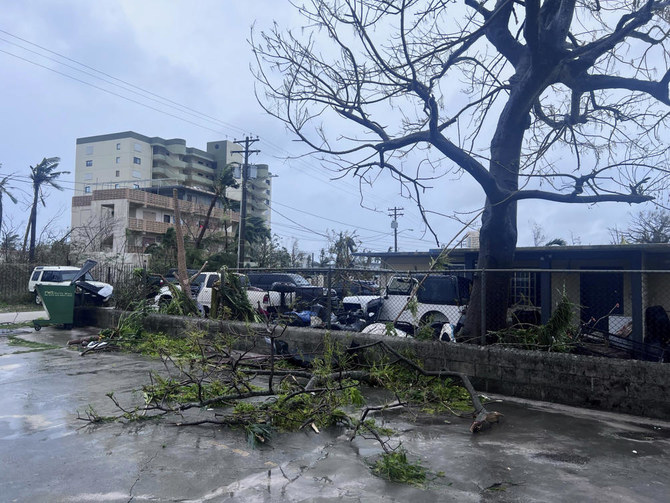
All but 1,000 of the island’s 52,000 homes and businesses lost power, according to the Guam Power Authority, but government officials reported nothing unusual in hospital emergency rooms, and only moderate damage such as flooding, fallen debris and downed power lines.
“I am so glad we are safe. We have weathered this storm. The worst has gone by,” Governor Lou Leon Guerrero said in a video message.
Still, she warned people to stay home for their own safety until the government declared it was safe.
“It seems that roads are passable, but you should not be on the road,” Guerrero said after touring the island, a US territory that is home to about 170,000 people, including about 10,000 US military personnel.
Before landfall, she had compared the storm to 1962’s Typhoon Karen, which flattened much of the island.
The eye of Super Typhoon Mawar tracked just north of Guam early Thursday, moving northwest at a sluggish 8 mph, delivering rainfall of up to 2 inches (5 cm) per hour overnight, the US National Weather Service (NWS) said.
Images posted on social media showed ominous clouds drifting over beaches, rains lashing buildings and winds bending palm trees.
Wind speeds placed the storm in Category 4, the second-strongest designation on the Saffir-Simpson Hurricane Wind scale, and just short of Category 5.
People in Guam take typhoons seriously and typically hunker down in reinforced concrete structures, said Landon Aydlett, the warning coordination meteorologist for the National Weather Service in Guam.
After the storm passed, Guam’s Office of Civil Defense issued a bulletin warning people that the highest stage of alert remained in effect.
“In addition to the tropical storm force winds, hazardous surf and seas remain. Remain out of the water due to life-threatening conditions,” the bulletin said.


![]()

Guam weathers Category 4 super typhoon without major damage
Short Url
https://arab.news/4ucra
Guam weathers Category 4 super typhoon without major damage
- All but 1,000 of the island’s 52,000 homes and businesses lost power
- The eye of Super Typhoon Mawar tracked just north of Guam early Thursday


Latest updates


© 2026 SAUDI RESEARCH & PUBLISHING COMPANY, All Rights Reserved And subject to Terms of Use Agreement.